
Why Atsuko Okatsuka’s Comedy Connects Across Cultures
Special | 30mVideo has Closed Captions
Comedian Atsuko Okatsuka returns to the show to talk about her creative process.
Comedian Atsuko Okatsuka joins us to talk about how she bridges cultures with her work, crafting jokes that land wherever she performs. Atsuko cites Lucille Ball as a major influence when she was a kid growing up in Japan, inspired by the universality of her physical comedy. Whether it’s here in the United States or abroad, Atsuko is always finding new ways to tell her story.
Problems playing video? | Closed Captioning Feedback
Problems playing video? | Closed Captioning Feedback
Support for American Masters is provided by AARP, The Rosalind P. Walter Foundation, Thea Petschek Iervolino Foundation, Burton P. and Judith B. Resnick Foundation, The Philip and Janice Levin Foundation,...
Support provided by:

Why Atsuko Okatsuka’s Comedy Connects Across Cultures
Special | 30mVideo has Closed Captions
Comedian Atsuko Okatsuka joins us to talk about how she bridges cultures with her work, crafting jokes that land wherever she performs. Atsuko cites Lucille Ball as a major influence when she was a kid growing up in Japan, inspired by the universality of her physical comedy. Whether it’s here in the United States or abroad, Atsuko is always finding new ways to tell her story.
Problems playing video? | Closed Captioning Feedback
Where to Watch American Masters
American Masters is available to stream on pbs.org and the PBS app.
Buy Now
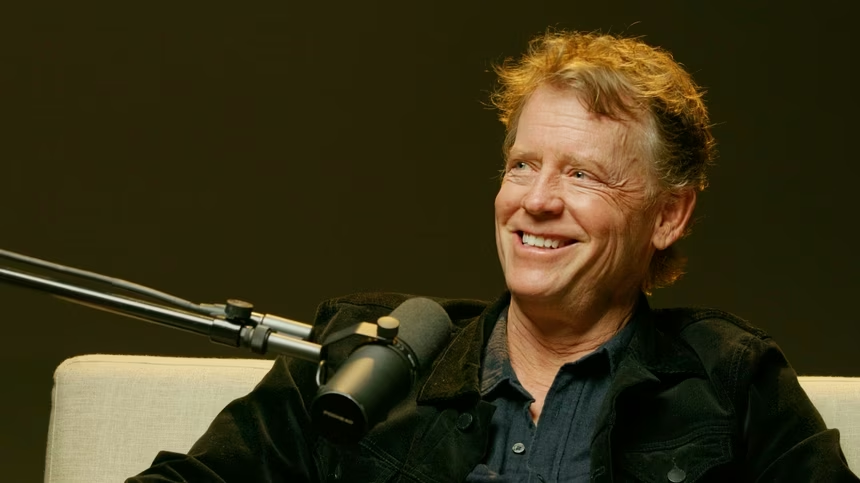
A front row seat to the creative process
How do today’s masters create their art? Each episode an artist reveals how they brought their creative work to life. Hear from artists across disciplines, like comedian Chris Fleming, actor Greg Kinnear, sports journalist Taylor Rooks, and more on our video podcast "American Masters: Creative Spark."Providing Support for PBS.org
Learn Moreabout PBS online sponsorshipMore from This Collection
How do today’s masters create their art? "Creative Spark" presents narrative interviews that go in-depth with an iconic artist about the creation of a single work. Each episode offers a unique window into the world of art and the creative process of artists and cultural icons across a wide range of disciplines, from music and comedy to poetry and film.
Mike Faist Embraces the Unknown
Video has Closed Captions
Actor Mike Faist explores the creative process behind his work on East of Eden. (44m)

The Many Passions of Matteo Lane
Video has Closed Captions
Comedian Matteo Lane on stand-up, painting, singing, performing on Broadway and much more. (55m 8s)
Michael Sarnoski: What Robin Hood and Folklore Tell Us About Ourselves Today
Video has Closed Captions
Filmmaker Michael Sarnoski breaks down his revisionist version of the Robin Hood story. (28m 4s)
Tyler James Williams on 30 Years of Acting and Protecting the Next Generation
Video has Closed Captions
Actor Tyler James Williams talks about his acting process and what drives his work. (35m 23s)
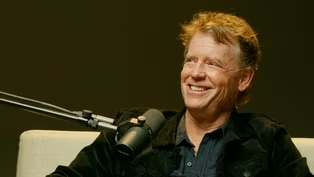
Greg Kinnear on Acting, AI, and Why Movies Still Matter
Video has Closed Captions
Oscar-nominated actor Greg Kinnear shares some "big thoughts." (27m 33s)
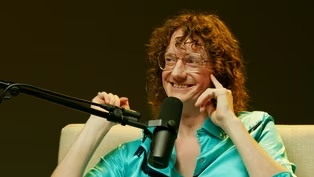
Chris Fleming Embraces the Chaos
Video has Closed Captions
Comedian Chris Fleming talks about the process behind his iconic manic stage persona. (39m 17s)
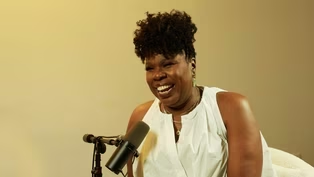
How Leslie Jones Became a Comedian
Video has Closed Captions
Comedian and actress Leslie Jones does a deep dive on her creative process. (31m)
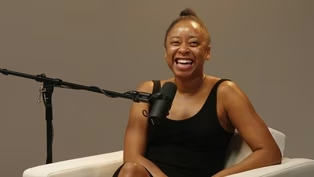
Phoebe Robinson Shows Her Work
Video has Closed Captions
Comedian Phoebe Robinson takes on hustle-culture in biting comedy special. (31m 45s)
Sarah McLachlan: Making Music to Connect and Heal
Video has Closed Captions
Singer-songwriter Sarah McLachlan opens up in a candid interview about making music. (37m 19s)
How Natasha Rothwell’s Life Brought Her to “The White Lotus”
Video has Closed Captions
Actress Natasha Rothwell on her creative process in "The White Lotus." (33m 40s)
Daniel Dae Kim Leads Spy Drama and Fights for Industry Change
Video has Closed Captions
Actor Daniel Dae Kim on his groundbreaking career and new project, "Butterfly." (21m 48s)
Phil Rosenthal’s Secret Recipe: Good Food and a Laugh
Video has Closed Captions
TV writer and host Phil Rosenthal talks about finding our shared humanity in food and comedy. (22m 53s)
Providing Support for PBS.org
Learn Moreabout PBS online sponsorship- You say in the special that America is like an escape room.
- I can understand people being stoked about escape rooms, being like, "Ooh.
Like, I'm gonna get thrown off."
(Atsuko chuckling) And I paid for it.
- Usually the fun thing about escape rooms is that it's kind of a construction, right?
But then America- - Yes.
Yeah.
- Can't escape the health insurance industry.
- For sure, but sometimes you'll get close, right, to solving the game.
And then, you win enough and you go, "Okay, I'll stay a little longer.
I'll do it again."
Yeah, and I think that's the resilience of human beings, though.
We get a little taste of, like, the dream or what you came for could be.
And then, boom, sweetie, you're stuck in the... You just bought another season of the escape room pass or whatever.
Yeah.
(upbeat music) - This is "American Masters: Creative Spark," and I'm your host, Joe Skinner.
Our guest today is comedian Atsuko Okatsuka.
She was last on the show five years ago during the peak of a global pandemic.
And since then, her career has skyrocketed, defined by jokes about her immigrant experience told in her own autobiographical style.
In her most recent special called "Father," Atsuko reflects on reconnecting with her dad through trips to Japan.
We love Atsuko's Fearless embrace of her own weirdness, and we're thrilled to have her back; this time, in person.
(pensive music) A lot has changed since we last spoke.
2021 was kind of a big time for you with TikTok in particular.
- Yeah, I guess so, yeah.
It was a big moment for TikTok, too.
(Atsuko chuckling) Not because of me necessarily, but because everyone was on there because we were all locked down and the pandemic had us all inside.
And so, the way to stay connected was social media.
But I did learn a lot of things about myself as a performer, doing comedy shows on Zoom, for example, or turning to my phone more, and talking directly to people on TikTok or Instagram, doing dance videos, trying to make people feel better from home with my grandma, and then posting it online, and suddenly growing an audience online that was bigger than before, going, quote, unquote, "Viral," by accident.
So, when standup comedy was like allowed back live, I had already grown as a performer and in a way where I was more vulnerable.
And also, there was no... I didn't want to take anything for granted anymore, too.
Right, so I started talking about things even in standup that I never did before.
I'd been doing standup where I started like 16 years ago, but suddenly I was now talking about my mom who has schizophrenia and also gets seizures a couple times a week.
And so, things that were difficult to talk about, I finally was able to.
- Was it something about being kind of stuck at home in that virtual world that kind of you think helped you get better at talking about those things?
- Yeah, it was like... There's no more BS, there's no more time to waste.
I was with my mom a lot, and I knew other people who were suffering, so I was like, "Let's talk about the difficult things, but make it funny, that's my job."
And I think, and I was seeing more and more people as I became more... Not just vulnerable, but real and an open book.
They also were that back to me, too.
That's when they felt seen, finally.
And in turn, I felt seen, too.
And that's what a, quote, unquote, audience is, is fellow weirdos who go, "Oh, yeah, you've built a community of us.
We wanna come see you live.
we connect with your standup and your thoughts.
Thanks for making schizophrenia funny."
"My mom has it too," or, "My brother had it," or, "I have it," people started opening up.
- I mean, it sounds to me like you're describing the process of becoming yourself.
- Right, which is so hard to, I think, find.
- [Joe] Yeah, I can imagine.
- Yeah.
- So, why do you think our culture values that so much right now for artists is the idea of being yourself?
- I mean, maybe because of like... Again, like the life is short, it's fleeting, maybe.
Internationally, we all went through something together that, for once, you knew what someone else in like Iceland was feeling, or maybe it was Iceland lockdown, maybe not, but for the most part, right, we all were connected and for once in a long time.
And I think that that helped with not wanting BS.
But then with every, like, thing that happens, there's like a counterculture that happens right after, right?
And so, it's funny you said like, "People value, like, being yourself," and then immediately after that it was like suddenly, like AI got really strong and AI videos or something.
And so, we're craving reality still, like this video of like a person reuniting with their dog they haven't seen in 20 years is so sweet, and then you find out it's AI and you're like, "Oh, I was craving that real moment."
- [Joe] Right.
- Right?
I think so more than ever, too, it's back.
Like, we want authenticity.
Real people, real feelings.
Yeah.
- And so are you thinking about that when you're developing something like "Father"?
- Yeah, I think so.
Yeah, for sure.
I'm thinking a lot about, "Okay, I want it to be entertaining and funny."
So, I struggle because it's like, "Well, I wanna talk about how I reconnected with my dad this time around.
And I want to talk about how I was undocumented a little bit more than I did in the first special, but how to make that funny."
So, it's a struggle.
Like, "Okay, well, I don't wanna stay in darkness too long."
Reconnecting with a whole father, that's a drama, right?
- [Joe] Right, yeah.
- But how to make that funny.
(audience laughing) I was raised by two women, my mom and grandma.
Yes.
(audience cheering and applauding) We were a girl gang, except one of us was extremely old; (audience laughing) one of us had schizophrenia, my mom; and I was a child.
(audience laughing) So, we were more like a social worker's worst nightmare.
(audience laughing) - When you're sort of putting that together, are you balancing out like, "Oh, this is veering into too dramatic right now," and are you kind of like putting your hand on the scales to try to balance that out as you're going, or it's more intuitive than that?
- So I tape every show, and then I'll watch the performance, and I'll really like try to put myself in the shoes of someone watching it or hearing it for the first time.
And I'll go, "Okay, okay, this part is way too dragged out.
This is now just storytelling time."
Or, "Now, this is a TED Talk, it's more of a speech.
Let's entertain again."
Or 'cause storytelling is entertaining, too, but I just have to remember, "Okay, wait, let's..." I think sometimes, it's hard because sometimes the standup comedy person in me could be the person like attacking my genuine self a little bit.
- [Joe] Hmm.
- Judging it.
"Hey, where's the funny jokes per minute?"
Like, it's like the traditional old-school standups of, like, New York or something, what they would say.
These terms that club comics throw around, right?
Jokes per minute.
(Atsuko chuckling) - But also, like, clearly your special is pushing back against a lot of those conventions and rules, right?
And that seems to create like a tension.
- That's true.
Yeah.
I think I have to remember that that's also me, like not speaking English properly or not even using the right words.
Sometimes, I make up words.
Sometimes, it's just a sound that comes out of my mouth.
(Atsuko grunting) And then, you know what I mean?
It's in my eyes, sometimes, that what I just told you is like... It was frightening to me or whatever.
I'm very emotive because English wasn't always a language I spoke.
It's not my first language, it's my third.
And so, I think that... Yeah, I have to remember, I'm not the... I'm not traditional, I'm unconventional.
But, traditional rules work, too, for a reason.
So, yeah.
- Hmm.
How do you think about comedy as a way to bridge culture?
- Comedy, what is it, bridged me with the rest of the world, so I should be able to do the same.
Meaning when I was little kid living in Japan, I was watching Lucille Ball and I didn't know what she was saying, but I could, from her physicality, and the set pieces, and her facial expressions, what was happening, the gist of it, I got.
So, I think that's why I'm also very physical, and I gesture a lot, or emote a lot with my face because that's universal, right?
And I don't use super difficult English words.
Like, I'm not very cerebral.
I'm not using references that are very local.
It's important to me that I reach as many people as possible.
The point for me with art is I always wanted to be understood, so why would I make myself even hard to understand?
That's good if you want... Trust me, I went to art school.
Like, I know trying to have a small audience, okay?
Or not trying to, but living in that space, right?
It's like, "This is for the art, this is for my integrity."
And that's cool.
But I want to talk to more than 15 people.
I'm an only child, I have half siblings that I'm just meeting for the first time.
And I was separated from my dad as a kid without me wanting that.
Moved to the US without me wanting that.
Became undocumented, live in a garage.
My first friends were the pigeons.
Of course I want to be understood internationally with as many people as possible.
And so, yeah, like I'll make sure my references, if like the punchline, while I was working on it, is like something like Trader Joe's, I'll make sure to change it to something that internationally people will know as much as possible.
I've even started workshopping jokes in Japan to start before I tour now.
- Oh, wow.
- So, during the holidays, I spend time in Japan now.
I've been doing this like for two years, where I'll be near my dad and some of my relatives in Japan.
And then, at the Tokyo Comedy Bar there, I will start writing new jokes for my new tour.
- Do international audiences receive your comedy differently?
- They all get it.
Everyone's started to, because of online, because of Instagram, TikTok, people mostly see standup there, honestly.
They understand the cadence and they understand American standup comedy, and watching it in English, and what a set up punchline looks like, too.
Yeah, they've even started learning English more.
Sometimes, through... A lot of, like, Japanese people, Japanese locals who are shy about their English have even told me they learn English through watching my standup, too.
- [Joe] Oh, wow.
- The places that get laughs in the US, or Canada, or London, or something get laughs in Indonesia, Malaysia, Philippines, Norway.
Yeah,.
it's been really cool to see.
Some things, some references I'll change.
Like, in "Father," I talk about cheerleading, and so I would just set it up a little differently because cheerleaders don't exist outside of the US.
So, but they've... Internationally, people have seen "Bring It On" or they know what it is because America number one, (Atsuko and Joe laughing) Or which is such a... It's a wild thing to be constantly reminded of, actually- - [Joe] Right.
- Is that God, we are the center of the world.
- [Joe] Right.
- Culture-wise, everyone watches our stuff- - [Joe] For now.
- And those are politics.
- [Joe] For now.
- For now, for now.
But it's like, "We took it for granted.
What spoiled brats we are."
That, like, "Dude, we could travel and not have learned another language."
Americans, like English speakers, we're so lucky.
Truly, other people bend over backwards trying to understand.
They know what we're going through, they know our economics.
We go to a place, we have no idea.
Wait, you have a president?
You have elections?
I didn't know, I didn't know that.
'Cause we didn't have to learn about other places, and we don't... Anyway.
- It's pretty cocky.
- It's pretty cocky, yeah.
- You say in the special that America is like an escape room.
- Right, yeah.
- What keeps you in America?
Why not just- - What keeps people going back to escape rooms?
- Yeah, what keeps people going back to escape rooms?
I've never been to one.
- People love escape... Oh, I've never been to an escape room, too, but, oh, I have so many friends who love it.
Love.
Oh, my goodness.
They love the mystique, the mystery.
They love like, "Oh, we have 10 seconds to figure this out."
The anxiety, I think.
Built in anxiety.
I like thrills, so I love like an amusement park, so I kind of get that mindset.
I love, like, Disneyland.
I'm kind of a... Not quite a Disney adult in that, like, remember when during the pandemic, when like people were like protesting outside Disneyland for like being shut down, with signs that say like, "Bring back the happiness, bring back the joy."
Remember?
- [Joe] Mm-hmm.
- I'm not like that.
I was like, "Okay."
- One rung below that level of Disney adult.
- Yeah, like, I get excited, I get really stoked and, like, I get super organized suddenly.
My husband calls it my Disneyland brain where I'm not organized typically.
Like, I was late today coming here.
I have a hard time finding my keys, but once you drop me off at Disneyland, I'm suddenly the leader.
I'm like, "Okay, guys, I have the app here.
I've planned out the whole day.
We're going on this ride first, and then we're gonna hit this food cart, okay?"
Because usually, there's not a line around 10:30 in the morning.
I'm like that with Disneyland.
And so, I can understand people being stoked about escape rooms, being like, "Ooh, like... I'm gonna get thrown off, and I paid for it."
And there's set pieces, and maybe there's a storyline, I'll be entertained at the same time, I can show off my skills.
Different people's personalities come out.
I think people... That's why people liked watching "Squid Game," too, right?
That was a big like, quote, unquote, kind of escape room.
- [Joe] Right, yeah.
- Right.
- Usually, the fun thing about escape rooms is that it's kind of a construction, right?
But then America- - Yes.
Yeah.
- Can't escape the health insurance industry here, right?
- For sure, but sometimes you'll get close, right, to solving the game.
And then you win enough and you go, "Okay, I'll stay a little longer, I'll do it again."
And then, it's good at that.
It's like you go... Yeah, and I think that's the resilience of human beings, though, too, is we get a little taste of like what the dream or what you came for could be.
And you go, "Whoa."
Oh, God, sorry.
I got so sad thinking about that.
But it's really cool of human beings to be able to do that.
Like, I will keep going, then, because... Yeah, I do have a kid or like... I'm child free, but I can imagine you see your kid playing with another kid or something, getting along with them, and you go, "Oh, well, they made a friend, so yeah, this... Yeah, right, this is for them.
So, yeah, I'll stay longer."
I can see that happening, for sure.
And then, boom, sweetie, you're stuck in the... You just bought another season of the escape room pass or whatever.
Yeah.
(pensive music) - So, when did you start going back to Japan more frequently?
It sounds like that's something that's kind of been a new thing for you.
- Yeah, so because of standup comedy, I was able to go back to Japan more.
It's so wild.
(Atsuko chuckling) I had to go away from Japan, be away for so many years, and then get good at this craft in a language that's not my first, my native tongue.
And then, they're like, "Come back, come back.
Come.
We love you."
And yeah, so that's something I think about and trip about all the time where I'm like, "That's so wild.
Like, I never wanted to leave you guys."
But now, like strangers there know my name.
Not just that, they're proud of me.
Not just proud of me, but, like, stoked.
They're like, "You represent us."
It's like, "Oh, God, I feel like a Olympian athlete or something."
And I was getting to perform in front of my dad, too.
He had missed out on so much of my life.
And so that's something I always feel a little sad about, and I think he feels sad about, too, because neither of us kind of had a say in that when my grandma just took me from him to come to the US for the two-month vacation that turned into forever, right?
So, he got to come see my shows.
He was at both that I did initially.
I did four shows in Tokyo total for like 4,000 people.
And in Japan, right, like when you come home from work or school, you go, "(Atsuko speaking in Japanese), I'm home."
And everyone in your family goes, "(Atsuko speaking in Japanese), welcome home."
Right, so I got on stage.
The first show in Tokyo got... And I hadn't been back in a long time, never performed there.
I tried singing.
I said, "(Atsuko speaking in Japanese)," I said, "I'm home."
And thousands of people said, back to me, "Welcome home."
And I was like, "Oh, my God.
What was that?
That wasn't practiced."
I got so emotional.
Yeah, it was a really cool moment, where it was like, "God, like..." I felt like we all went through it together.
Yeah.
- I love that.
- Yeah, it was really cool.
But there's still like a layer of me that's sad about, like, my dad didn't know what I was saying 'cause I'm doing standup in English.
So, some things were won, but at many costs, right, like a lot of things.
I was undocumented, and lost a lot of Japanese language, and I can't even communicate with my dad, really, without a translator.
So, it's like a... Yeah, that's a lot of immigrant stories, though.
- Wow, that's such a sweet story about (Joe speaking in Japanese).
I love that.
- Yeah.
I didn't know.
I didn't know you could do it on stage.
I don't know the rules- - Right.
- But again, break the rules, try it out.
- It also reminds me of the cheerleading bit from "Father" too.
I guess that's the American version of (Joe speaking in Japanese).
- Right, yeah.
Ready?
Okay.
Yeah, exactly.
Yeah.
I love a call and response.
The cheerleader in me is always trying to get a group of people to do something at the same time.
Dance moves say the same thing.
I'd be a great dictator.
(Atsuko laughing) Everyone, at the same time.
(Atsuko speaking in Japanese) - I like to think you're building community.
(Atsuko laughing) - Yeah.
It's a fine line, honestly, because people have started to show up to my shows wearing wigs of my bowl cut, and I bring them onto stage and I'm just looking out at the sea of people.
And then the people on stage wearing wigs of my bowl cut.
I go, "God, this is just one way to start a cult."
- One way to build community, Atsuko.
- Thank you.
Yeah, yeah.
That's what Jonestown was, was a community, too.
(Joe laughing) Exactly.
That's right, yeah.
- That's what we're all doing here is we're building communities.
- I think Charles Manson famously said that, too, many times, "Hey, guys."
- [Joe] Southern California's good for that, I guess.
(Atsuko laughing) - When people are like, "Hey, this feels kind of..." Sweetie, this is for the community, yeah.
I think famous, famous, famous Manson words.
"Sweetie, this is for the community."
(Joe laughing) Or maybe it's a drag race I'm quoting.
- Six of one, half dozen of another.
- Another saying I don't know.
(Joe chuckling) - Well, a lot of your comedy does mind the autobiographical, as we've been talking about, and so I'm just curious: Do you ever worry about running out of things to say about yourself?
- I've had that fear, and like very recently too, as I'm touring my latest hour, and writing and rewriting, throwing away jokes.
But I think I'm always reminded, there's always so much more to talk about as... Because you are a constant moving thing, just like the world is.
And so, as long as you go with the world, there's always so much to talk about.
A perspective like America's the escape room of countries, that comes from my POV and what I've gone through, but also it's because I'm moving with the world.
And so, other people have also felt that way.
They're like, "I also live in America and I also feel that same way."
Or people who don't even live in America can see that that's true, right, just from the news, or having family in the US, or friends.
And so, I think as long as you're staying in conversation of the times, with the times, there's always so much to talk about from your perspective, from what you're going through.
So, yeah, I'm... And then, like, I'm always trying to look for the absurd as a way of surviving and as a way of... (Atsuko laughing) It's a necessity for me to laugh about things.
So, the jokes will always come.
I've had to remind myself of that, yeah.
- Yeah, I think in the special, you kind of nod at this idea, though, 'cause you talk about, "I want to cut my hair, I want to try this hair."
- Right, right.
But I can't because this is my brand.
(Joe and Atsuko laughing) Yeah, and that's another thing.
Like, it's a observation.
It's a silly one.
It's also true.
(Atsuko chuckling) This haircut is on merch, it's on so many shirts.
(Joe laughing) - It's on a salad bowl.
- Hundreds of shirts, yeah, exactly.
Yeah, and not just bowl, but it's because it's a pun, right?
It's a play on the fact that I have a bowl cut, that's why there's two restaurants doing bowls.
- And "The Big Bowl Tour," right?
- And "The Big Bowl Tour," which is my tour that I'm on right now to... Yeah, so... (Atsuko laughing) There was even like a giveaway we did through a whiskey company, where it was like a bowl that had my hair cut on it, so people could, like, eat out of it.
Anyway, so there's been a lot of puns, a lot of merch made, and people show up to my shows wearing wigs of it.
And it represents to me, like, embracing the things that made me feel like a freak in the past, like a weirdo.
A lot of children have this haircut that were forced on.
It was forced on them by their parents, and they hated it.
They're like, "It was ugly.
I just want long, beautiful hair."
And it's just me being, like, "I embrace my weirdo self.
I embrace the things that made me feel embarrassed in the past."
Also, I like to play with like gender norms a lot when I do get... When I have gotten hateful comments about my looks, it's been from guys who hate short hair on a girl.
They're like, "Is this a girl or a boy?"
They get weirdly, like, transphobic about it, and they're like, "'Cause girls have, like, long hair.
I'm not attracted to this."
And so, it's like a... Not an act of defiance, but it means a lot, this haircut.
And it's also a nod to my culture and where I'm from, in Asia.
In Asia, when I say, "Every child had this haircut," every child had this haircut.
And like when I'm in Asia, it's like me and babies we're staring at each other.
They look at me like, "Are you our leader?"
You know what I mean?
Because we go, "Yeah."
It's like the "Spider-Man" thing, but they're like, "This is an elongated version of us.
(Joe laughing) Why does she get her own seat on an airplane?
Why does she get to walk around without her parents?"
They all look at me like that.
And... So, it would be, I think, like another phase in my life.
Maybe something big has to happen for me to change the hair, but I do want to.
Like, musicians get to do that too.
- [Joe] Right.
- Yeah.
- For my last question, what do you hope people get out of the special?
- I think, like, my main message always is being an adult is hard, right?
I talk about making friends as an adult.
How do you do it?
Gosh, it's, like, you even have to have different groups of friends.
You have to separate your daytime friends from your nighttime friends.
If they meet, they'll know you're a liar (Atsuko chuckling) because you act different when you're at night.
And it's like, "Oh, you drink?"
And your daytime friends are like, "Oh, okay.
You party this hard?"
(Atsuko chuckling) It's like, "Oh, sorry, I was trying to keep that away from you."
And to realizing me and my husband were never married because paperwork is hard.
But what does that mean?
Who made the rules on that?
I was undocumented.
I didn't want that as a kid to... My dad wanted me to have kids, and I'm like, "Dad, I think our family should stop."
And to my husband, getting a vasectomy is what we decided.
And he has gotten one since.
But we even did that wrong.
Like, we... Oh, we somehow forgot that there were two procedures being done, a vasectomy and this other, like, one for an injury that he had in the past.
So, anyway, he couldn't walk for like three weeks.
And I'm like, "Oh, God," I'm like cooking.
I just learned how to do the laundry.
I talk about that, how I didn't know.
I hadn't been doing the laundry for the past seven years.
It's been my husband this whole time.
So, the point is like none of us were really taught exactly how to be adults.
We weren't really ready for it.
So, we might as well, like, have fun while we're doing it and laugh about it.
Don't be hard on yourself because it truly is like all an experiment, you know?
We're all truly just improvising and trying our best.
Yeah.
(pensive music) - [Joe] That's our show.
A big thank you to Atsuko Okatsuka for taking the time to talk.
"American Masters: Creative Spark" is a production of the WNET Group, media made possible by all of you.
This episode was produced by me, Joe Skinner.
Our executive producer is Michael Kantor.
Original music is composed by Hannis Brown.
This episode was mixed and mastered by Josh Broome.
Funding for "American Masters: Creative Spark" is provided by the Rosalind P. Walter Foundation, the Anderson Family Charitable Fund, the Mark Haas Foundation, Sue and Edgar Wachenheim III, the Charina Endowment Fund, the Ambrose Monell Foundation, the Kate W. Cassidy Foundation, the Philip and Janice Levin Foundation, and by PBS viewers like you.
Thanks.
See you soon.













Support for PBS provided by:
Support for American Masters is provided by AARP, The Rosalind P. Walter Foundation, Thea Petschek Iervolino Foundation, Burton P. and Judith B. Resnick Foundation, The Philip and Janice Levin Foundation,...