
The Future of AI: Boom or Bust?
Season 9 Episode 6 | 26m 46sVideo has Closed Captions
What could AI mean for the job market and the economy?
Is Artificial intelligence going to cause massive job losses or spur a revolution in work rivaling the Industrial Revolution? Even the experts on AI are in a debate on what the future of the technology looks like. The top experts came to Las Vegas to discuss the future of AI boom.
Problems playing video? | Closed Captioning Feedback
Problems playing video? | Closed Captioning Feedback
Nevada Week is a local public television program presented by Vegas PBS
The Future of AI: Boom or Bust?
Season 9 Episode 6 | 26m 46sVideo has Closed Captions
Is Artificial intelligence going to cause massive job losses or spur a revolution in work rivaling the Industrial Revolution? Even the experts on AI are in a debate on what the future of the technology looks like. The top experts came to Las Vegas to discuss the future of AI boom.
Problems playing video? | Closed Captioning Feedback
Where to Watch Nevada Week
Nevada Week is available to stream on pbs.org and the PBS app.
Providing Support for PBS.org
Learn Moreabout PBS online sponsorship-How vulnerable are U.S.
elections to cyber attacks?
Hackers from around the world convene in Las Vegas to try and find out.
Plus, as artificial intelligence systems grow smarter, might they escape control?
(Geoff Hinton) They're going to be able to outthink us, and so my belief is we have to figure out how to make them benevolent.
-A warning from the so-called Godfather of AI, who debated the technology's promise and risks at the Ai4 conference, that's this week on Nevada Week.
♪♪ -Support for Nevada Week is provided by Senator William H. Hearnstadt and other supporters.
-Welcome to Nevada Week.
I'm Amber Renee Dixon.
Las Vegas recently hosted the Ai4 conference at the Venetian, and three trailblazers in artificial intelligence took part in the keynote speech.
Among them was Geoffrey Hinton, who's widely regarded as the Godfather of AI.
In the 1980s, inspired by the structure of the brain, he created an early computer model that helped lay the foundation for modern AI.
And in 2024 he even won a share of the Nobel Prize in Physics for his work but now considers AI a potential threat to society.
At the conference, he said this about AI agents, which are systems that can take a goal, make a plan to accomplish it, and then take action and readjust in order to achieve it.
-What's happening is these things are getting smarter.
And once you have AI agents, you give them goals.
And to achieve goals, they have to create subgoals.
Like if you want to get to Europe, you have to get to an airport.
Now, one subgoal that we've seen them generate is self-preservation.
So obviously, if an AI agent has some things it's trying to achieve and it's smart, it realizes that if it ceases to exist, it won't achieve those things.
So I think as they get smarter, we're going to see more and more complex intentions they have and more and more ability to escape control.
And so I don't believe we're going to be able to keep control of them in the simple way of just we outthink them so they can't escape.
They're going to be able to outthink us, and so my belief is we have to figure out how to make them benevolent.
We have to figure out how to make them care about us more than they care about themselves.
-Hinton's argument raises questions about who should regulate AI and to what extent.
But complicating that conversation is that some AI experts disagree about how serious and immediate the risks are.
Joining Hinton for the conference keynote were Andrew Ng, a pioneer in AI and online education; and Fei-Fei Li, a pioneer in AI research, who's widely recognized as the Godmother of AI.
Each offered different views on the fear surrounding the technology and what it could mean for jobs.
(Fei-Fei Li) On one side, the extreme rhetoric is the doomerism and really the fear mongering rhetoric.
On the other hand, I also think that the total utopian talk is not helpful either, because every tool is a double-edged sword.
AI is such a powerful tool.
It will, if not wielded in the right way, bring harms.
-Someone who works in a call center, that's a job that's not safe.
AI can do a better job; maybe not today, but very soon AI will be able to do a better job than the people who work in call centers.
It will actually know the answer to your question.
Now ask, what are those people going to do?
They typically don't have a high level of education.
Any job you could retrain them for, AI will be able to do.
(Andrew Ng) One of the things I worry about is the recent AI "job apocalypse" scenario, which paints a picture that AI is so powerful it will wipe out 50% of all jobs and maybe they're rewriting industries and so on.
The reality I see on the ground is, of all the disciplines that AI is entering is affecting software engineering the most because AI is amazing at writing code.
And it turns out that software engineering job postings are up, and we can't find enough skilled software engineers.
Yes, there is a lot of hype in the media about AI layoffs where businesses are saying, Because of AI, I'm laying off a lot of people.
But the reality is, speaking with a CEO of a large workforce complete recently, they said that he ran a survey of people that were actually recently laid off.
And what percentage do you think actually were replaced by AI?
Not 50%, not 20%, not 10%, but 1.4%.
-Ng's assessment of job displacement differs sharply from Hinton's.
Hinton met with the media after that panel discussion, and I got to ask him what he thinks about how AI might impact Nevada's hospitality workforce.
-I think that'll survive longer than routine office work--so call center jobs, for example--because it involves physical things.
And robotics currently lags behind the rest of AI.
But I think robotics will catch up.
So I think, for example, jobs cleaning hotel rooms, I can't give you a timescale.
Robotics is always slower than you think, so maybe it'll be 10 years before you have robots from Musk or from China cleaning hotel rooms.
I think people like interacting with people still, so I think sort of front desk jobs, particularly in luxury hotels like the Four Seasons, I think people will pay a premium for having people to interact with rather than AI.
-Despite his concerns, Hinton says he believes AI can greatly improve several fields, including healthcare.
The American Medical Association also sees that potential but says the guardrails needed to protect patients are not keeping pace with the technology.
At Ai4, I sat down with the AMA's CEO, Dr.
John Whyte.
I began by asking him how AI could help address healthcare workforce shortages.
(Dr.
John Whyte) I want to start off by saying AI is not going to replace doctors or nurses or pharmacists.
What I think they can do is actually help reduce that administrative burden, the amount of charting that nurses need to do, the amount of forms that I need to fill out as a doctor.
That frees up more time for health professionals to see patients, because we're not going to be able to churn out more doctors, nurses, and pharmacists in any short period of time, just given the amount of training.
That's where I think they're going to help in these workforce shortages.
-When you think about how AI is being used in healthcare, can you give our viewers some examples that may surprise them of how it's being used?
-Some exciting ways that AI is being used, it's really assisting doctors make decisions; so, in terms of checking for polyps or checking for tumors and mammograms, an AI tool that helps the radiologist or the GI doctor find more tumors.
That's what I think is really exciting.
-What keeps you up at night when you think about AI in healthcare and regulations that do not yet exist?
-Well, I don't get caught up, you know, losing sleep over that there's going to be robots taking over the healthcare system.
What I get frustrated by is the lack of trust in the healthcare system, the lack of trust in these institutions that we've had, the FDA, the CDC.
So where do patients go to get information?
We have to acknowledge that patients are using generative tools.
Before they used to use WebMD and Google.
Now they're putting into a chatbot, Hey, like, what condition do I have?
What do we know about the fidelity of that information?
How do I know it's credible?
That's what keeps me up at night, because I think there's potential harm there, too, as well as benefit.
-And there are documented examples of the harm that chatbots have caused when people are seeking medical treatment or mental health treatment.
Where do you start with regulating that?
-And the AMA has been very involved, particularly in mental health chatbots.
So let's be honest.
This is to the point, there's a shortage of mental health professionals.
So let's not think that patients aren't utilizing these tools.
They are.
But what's the guardrails?
What's the framework?
So if someone's talking about something that might give the idea that there's something called suicidal ideation, that I might harm myself, you got to escalate that up to a real health professional.
You need to make sure that it doesn't give them information as to how to harm themselves.
And there's been data and instances where that's been shown.
We need the industry, first of all, to step up and say, These are the guardrails.
We don't start with regulation.
We want industry to be good partners to actually help people get better care.
Maybe we start with anxiety.
Maybe there's other issues that we can think about, and let's evaluate them.
I do think there's a role for these tools, but we have to have the right framework.
And it's not there yet, Amber.
-Who are you talking to in the industry?
Who's doing it well, in your opinion?
-I'm going to be honest.
Right now, I think the tech industry is the tail wagging their dog.
And they're kind of saying where innovation is, and I'm saying, okay, as doctors, let's talk about what problems we're trying to solve and then let's utilize tech to help solve those problems.
That's not how it's being done.
What we need to do is to have physicians, have the medical community, and have patients working with tech from the beginning.
We want to protect patients.
This is about outcomes and patient safety as we're talking about health.
It's our most important commodity.
And what I often say to patients is, would you upload all your financial advice into some generative tool?
But patients upload their labs, their medical records.
They don't even take their name off of things.
You wouldn't do it with your financial information.
Your health is even more private.
There's no expectation of privacy on many of these tools.
How do I know they're not going to sell that information, market me products from that?
So we need some guardrails there as well.
-The AMA represents physicians across the country.
Does that mean that the AMA also supports a federal framework to regulate AI?
-What's a little tricky, Amber, is there's the practice of medicine, the practice of nursing pharmacy, which are regulated by states, and some of these tools are getting dangerously close to practicing medicine.
And AI should be augmented intelligence, helping support the doctor, not functioning autonomously, just making decisions.
States play a role there because it's the practice of medicine.
But the federal regulation also plays a role because most of these are tools or devices.
And if we have a new framework about these devices, the FDA could preempt them from being utilized if they don't meet certain evidentiary standards.
There is a company that has a pilot program in Utah where patients, if they participate in it, can ultimately have this tool that will renew prescriptions.
Right now, it's in a pilot.
But ultimately, without a physician ever looking at it, will just decide that whether or not you still need this statin or you need this antidepressant.
We don't support that at the AMA.
There's a lot of factors that go into renewing medications.
But here's also the challenge, Amber: What's the problem they're trying to solve?
Do patients not get their prescriptions renewed in a quick period of time?
They do.
Most data shows within two days.
Is it reducing cost or improving access?
That's not what this is doing.
So here's an interesting technology, but what's the problem that we're trying to solve?
Where's the physician in this?
-Dr.
Whyte did praise a Nevada law that took effect last year.
Assembly Bill 406 says counselors, psychologists, and social workers in Nevada's public schools can only use AI for administrative tasks like scheduling and managing records.
Meanwhile, the need for safeguards extends beyond AI.
Last year, a cyber attack crippled several state government systems.
Nevada's response to it is just one topic I recently asked cybersecurity expert Jake Braun about.
Braun leads the University of Chicago Cyber Policy Initiative.
And at this year's DEFCON conference in Las Vegas, he unveiled a new program to help small water utilities defend themselves from cyber attacks.
DEFCON is a long-running convention for hackers; and it's also where, in 2017, Braun helped launch the Voting Village, where hackers and researchers test election systems for weaknesses.
(Jake Braun) It was launched in 2017 on the heels of the 2016 election interference from the Russians, where they hacked into election systems around the country and were able to exfiltrate data from voter registration databases and things like that.
There's no evidence any votes were changed or deleted or otherwise manipulated, but we do know that these Russian hackers were able to get into voting systems and, at the very least, exfiltrate data.
And so at the time, there was a lot of folks in the election industry who were saying that elections were secure and nothing could be hacked and everything was, you know, puppy dogs and roses.
And the the hackers know that that's not the case.
And so we decided that we couldn't just say that; we had to show people.
And so we went and bought a bunch of voting machines.
And to this day, the Voting Village has never encountered a voting machine that it could not hack successfully, so there are still very real vulnerabilities in our election infrastructure that need to be addressed.
And a lot of that requires federal funding to help improve security features of voting machines, network security of the election offices, and so on and so forth.
-So according to the DEFCON website, the Voting Village has been invited to testify to Congress about how to strengthen election infrastructure.
What has actually changed as a result of the Voting Village?
-Number one, people became aware of the insecurity of the voting system; but, two, it helped dislodge about a half a billion dollars in funding for voting equipment around the country back in 2018.
And so DEFCON wasn't the only group that helped ensure that money got delivered to election offices, but they played a big role in highlighting the need.
-And so, where has that money gone to improve what kind of infrastructure, in particular?
-I think that election offices have done a lot in terms of putting security on their network to stop the bad guys from getting in to begin with.
There's also a lot more information sharing now about threats, from the federal government to election offices, that didn't exist before.
And the infrastructure to share that information wasn't there before.
Probably the most important thing, and this may be weird hearing from a cyber guy, was there's been a massive shift to paper ballots.
And that analog solution is your best cybersecurity.
-The 2020 election, which President Donald Trump claims was stolen, where do you stand on that?
Where were you at that time in your career?
-So I think that it's an incredibly complicated issue, of course, because there are real flaws in our election systems.
There is real insecurities, and there are foreign entities, like the Russians in 2016, who have exploited those entities.
That being said, there's no evidence that the 2020 election was stolen or that votes were manipulated.
And in my career, I was working for the Biden campaign at the time.
-You worked under two Democratic Presidents, Biden and Obama, in cybersecurity.
And so we may have viewers who think, well, of course he's going to say that there's no evidence that the 2020 election was stolen, because he worked under Democratic Presidents.
What would you say to that?
-Go back and look at the evidence.
-Okay.
Let's talk about the threats that do exist.
And maybe we should first clarify the difference between manipulating votes and election interference.
There's a difference there, and I'm not sure that's easily understood.
What is it?
-So election interference could take any form.
So, for example, actually in '20, the Iranians did do a whole host of mis- and disinformation around the election, but they didn't actually hack any voting infrastructure; whereas, the Russians in 2016 actually hacked voting infrastructure.
And so that's kind of the difference.
Any type of way you can make voters maybe not know what their polling place is or think the time to go vote is wrong or have bad information about a candidate that's untrue or something, that could be election interference.
But the actual hacking of an election is when the computer equipment that underpins the election is altered or otherwise broken.
-The misinformation, though, what does that look like?
I think I heard you on a podcast in 2024 talking about if there are long lines at a voting center or there's something that malfunctioned--a piece of equipment that malfunctioned--and someone tweets out a picture of the long lines and says something to the effect that, Oh, gosh.
Who knows what's going on?
We're hearing equipment may not be working.
Then what happens after that?
-Well, the concern, of course, is that conspiracy theories will get spun up about what's happened.
And a lot of times-- This voting equipment wasn't made like an F-16 plane or something like that with all these security features.
It was made to be cheap and count votes.
And so a lot of these machines just kind of break.
And so I think the example you're talking about was in 2018 in Texas.
One of the machines had kind of a glitch where the screen would kind of shake or look like it would shake, and so people thought it was hacked.
But really, it was just kind of a bad machine that just wasn't working well.
And so what happens is then people will say, Oh, well, no, the election's hacked.
And then all of a sudden the conspiracy theories start, and then you get foreign actors who come in and take those conspiracy theories online and spin them up to seem like they're, you know, mainstream validated claims when, in fact, it's just conspiracy theories that were started by somebody who was waiting in line too long and saw a machine behave in a way they didn't think was appropriate.
-That can have a tremendous impact, right?
-It's had a tremendous impact on our country.
I think that we're in a situation where a lot of people don't trust the outcomes of elections now.
And, really, there's no reason to not trust the outcomes of elections at this point.
We are very good at counting votes.
We've been doing it in this country for 250 years.
And particularly with the massive move to hand-marked paper ballots, as we've seen all across the country, if there's ever a question, you can just go back and have humans count the ballots.
-Those paper ballots, though, can take longer to count.
Am I right?
And then that leads some people to thinking, Oh, this is taking way too long to get the results.
There must be something funny at play.
-Yes, of course.
You know, in this country, we're very good at both sides of the aisle spinning up conspiracy theories that service whatever they, you know, whatever claims they want to make.
But really, at the end of the day, while it may take longer and it may cause a lot of consternation, knowing that a bunch of humans can sit there and hand count every ballot and other people can watch and validate that that was done correctly is how we get to the right result.
-Okay.
The State of Nevada had its own cyber attack last year; and several months later, the Governor's office came out with a report about how it confronted it, saying that they achieved full recovery within one month.
No ransom was paid.
No evidence of successful extraction of the data or publication on a leak site.
And in total, $1.5 million was spent on recovery efforts.
Taking that all into account, what do you think about the state's response?
-Well, first and foremost, I want to applaud the Governor and his team for not paying the ransom.
We need more people to have the courage to stand up and do that and do the really hard work that the Governor and his team had to do to back up all their systems and kick out the bad guys out of the network and all that type of stuff.
It would be a lot easier to pay the ransom, and it's really laudatory that the Governor and his team did not pay the ransom and did the hard work to clean up the system and kick out the bad guys.
-As a result, will the elections be more secure in Nevada this year?
-Oh, absolutely.
I mean, elections are more secure now than they have been in modern history, and that's true in Nevada for sure.
-Okay.
And you have also used this week for DEFCON to announce a really neat initiative project, and this is related to the cyber attacks that we are seeing on water utilities across the country.
What do we know about what's happened, and what are you now doing?
-Most recently, there's attacks that presumably are from Iran.
I don't think the actual attribution has been definitively made yet, but presumably they're from Iran.
Those attacks, I think, should be viewed as a shot across the bow from the Iranians, telling the American people and the administration that they can do really three things: They can shut off the water to our military assets, which are almost all supported by civilian water utilities; they can shut off the water to our key economic driver in this country, which is our AI prowess and the data centers that power AI which are also all supported by civilian water utilities; and then in a time when the country is deeply divided over the Iran war, undermining trust in the government to be able to deliver basic services.
And so I think that's what we're seeing here.
This wasn't an attack that had anything to do with a particular water utility.
It was about sending a message.
-And so you have come up with a way to fight this.
I think its focus, though, is on small communities who are being hacked, their utilities are being hacked.
Why and how does this project work?
-Sure.
So there's about 150,000 water utilities in the country, so nearly all of them are small.
There's a handful that are large, but almost all of them are small.
And to secure those utilities, we spent two years with our DEFCON researchers working arm in arm in the trenches with water utility folks to figure out what would work.
And what we found is that you really need to take the approach that you would to secure a small business--because that's really what most of these water utilities are, small businesses.
And so we've set up a program called the Water Watch Center, where it's a nationally scalable program where we have these small cybersecurity providers that support small businesses today and also support water utilities today, who now are able to provide cybersecurity for free for small utilities around the country.
-Who's funding that?
-Several philanthropic funders are behind this.
Craig Newmark, Craig from Craigslist, is one of the biggest funders of it.
There's a few other philanthropies.
And one of our funders is also DARPA, which is the research agency for the U.S.
military.
And they're funding us to do research on how we could potentially use AI to better secure these systems in a scalable way, because getting to 150,000 water utilities is no small feat.
-I think for people watching at home, this can all be very scary.
And they may think there's nothing they can really do to help with this.
Is there anything they can do?
-There absolutely is.
Nowadays, cyber attacks aren't done on their own or in a vacuum.
Cyber attacks are nearly always coupled with mis- and disinformation from foreign actors.
In this case, likely Iran.
And so as your viewers are seeing a social media post that was sent to them by their cousin or something, checking that information before they forward it on to everybody with reputable news organizations like yourself and others to make sure that information is accurate so that they don't inadvertently become an agent of the Iranian military is really important.
So checking your information to not spread mis- and disinformation for the Iranians is something that every person in Nevada can do themselves.
-To learn more about the Voting Village, visit vegaspbs.org.
There you will also find the American Medical Association's newest policies on AI.
For now, I'm Amber Renee Dixon.
We want to thank you for watching, and we hope to see you next week on Nevada Week.
♪♪♪
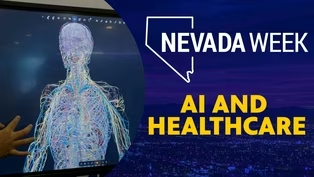
Video has Closed Captions
Clip: S9 Ep6 | 7m 5s | Can AI chatbots help healthcare, or do they risk doctors losing touch? The AMA CEO weighs in. (7m 5s)
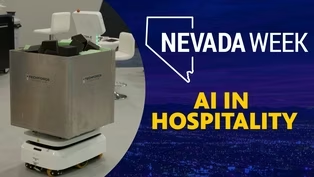
Video has Closed Captions
Clip: S9 Ep6 | 1m 8s | AI handles research and data, but how will it impact human-centered hospitality jobs? (1m 8s)
Video has Closed Captions
Clip: S9 Ep6 | 12m 32s | As hackers evolve, a cybersecurity expert details the threats to elections and infrastructure. (12m 32s)
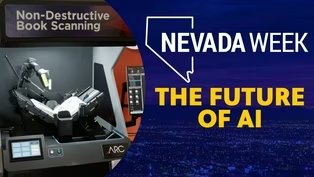
Video has Closed Captions
Clip: S9 Ep6 | 4m 12s | AI pioneers gather in Las Vegas for Ai4 to debate what the future of technology will look like. (4m 12s)
Providing Support for PBS.org
Learn Moreabout PBS online sponsorship New Episode
- News and Public Affairs

Top journalists deliver compelling original analysis of the hour's headlines.

- News and Public Affairs

Today's top journalists discuss Washington's current political events and public affairs.
 New Episode

 New Episode


 New Episode


Support for PBS provided by:
Nevada Week is a local public television program presented by Vegas PBS