
Improving School Traffic Safety
Season 9 Episode 12 | 26m 46sVideo has Closed Captions
Improving traffic safety around schools and native students get help with college costs
After several hundred students were hit by cars last school year, Clark County, the Clark County School District and Southern Nevada cities stepped up to improve safety. How are those efforts going? Plus, native students in Nevada get help with college from a law that waives certain fees
Problems playing video? | Closed Captioning Feedback
Problems playing video? | Closed Captioning Feedback
Nevada Week is a local public television program presented by Vegas PBS
Improving School Traffic Safety
Season 9 Episode 12 | 26m 46sVideo has Closed Captions
After several hundred students were hit by cars last school year, Clark County, the Clark County School District and Southern Nevada cities stepped up to improve safety. How are those efforts going? Plus, native students in Nevada get help with college from a law that waives certain fees
Problems playing video? | Closed Captioning Feedback
Where to Watch Nevada Week
Nevada Week is available to stream on pbs.org and the PBS app.
Providing Support for PBS.org
Learn Moreabout PBS online sponsorship-Getting to and from school can be scary in Clark County.
How the community is coming together to reduce the number of traffic accidents in school zones, plus... -I knew college was expensive, but seeing, like, my amount due, I didn't realize how expensive it would be, like seeing it firsthand.
So definitely the fee waiver, huge relief.
(Amber Renee Dixon) Despite its reported success, the future of Nevada's Native American fee waiver is uncertain.
Find out why this week on Nevada Week.
♪♪ -Support for Nevada Week is provided by Senator William H. Hernstadt and other supporters.
-Welcome to Nevada Week.
I'm Amber Renee Dixon.
Last school year was a harrowing time for children in school zones.
During the 2025-2026 school year, law enforcement across Clark County recorded more than 400 collisions involving students.
The latest data shows there have been 64 crashes so far this school year.
That's three more than at the same time last year.
Right now, local leaders are implementing a plan to try and address the problem.
Clark County's Office of Traffic Safety created the School Traffic Safety Working Group, which recently provided Clark County Commissioners with a progress report following the first 30 days of school.
Joining us to talk about those efforts are Commissioner Michael Naft, Chair of the Clark County Board of Commissioners; Andrew Bennett, Director of the Office of Traffic Safety in Clark County; and Chief Jeff Clark, the new Chief of Police for the Clark County School District.
Thank you all for joining Nevada Week.
-Thank you.
-Andrew, I will start with you.
As the leader of this working group, what do you make of those numbers we just talked about?
(Andrew Bennett) I think at the end of the day, we know about these numbers because of the work that has been done in this working group.
You know, working with school district police over the last three years, it was important for us to understand the problem that we're facing.
Five years ago, we were asked about, from a reporter, how many kids were hit on the way to or from school.
We started by collecting that data by hand.
It's now automated.
We have a clear understanding of the problem, and that's why we put together this plan.
At the end of the day, we're about 45 days into a five-year plan, so there's plenty of room for us to continue to improve and make these recommendations into actions.
-Chief Clark, what have you recorded as far as data related to enforcement this school year?
(Jeff Clark) You know, I'm happy to say in the first three weeks of this school year, as compared to the first three weeks of last year, we were up over 40% in traffic enforcement.
And that was citations, car stops.
And then our overall collisions are down.
Now, obviously, we're talking here about student safety, but the overall collisions are down.
And so my officers are working hand in hand with Metro, Henderson, North Las Vegas, Nevada State Police to increase the enforcement in and around schools.
And it's important to note with the doubling of fines for any infractions that happen on the school zones, if that doesn't keep you, you know, driving a little slower and a little bit more cautious in a school zone, I will tell you what will.
I've instructed my officers--if we have the lawful and legal ability to tow a car--if you're driving reckless through a school zone, we're going to tow your car because we need to take that really deadly weapon out of the hands of someone that probably shouldn't be driving it.
-You're going to tow that car?
-If we can legally do so per the law.
-You're going to pull them over-- -Yeah.
- --and then call a tow truck?
-We give them a ticket, and then we will tow the vehicle, yes.
-Why would you not legally be able to do that?
-There are certain things we can't.
If someone doesn't use their turn signal or they are, you know, they're going 5 over in a school zone.
But if someone's reckless, they have a revoked driver's license, they don't have car vehicle insurance, then we can.
So those are the kind of things if we come across, then we will.
-The increased penalties that he's talking about, what is your level of concern that once they get to a judge they will be punished as the law states?
-Enforcement starts with legislation and ends with adjudication, and the officers are in the middle writing those tickets.
We were successful, incredibly successful, passing AB6 unanimously with the support of both Houses and the Governor.
Now that we have citations rolling in, we had a conversation just last night with the court system, ensuring that we have a continued ability to look at that data, ensure that civil citations have a higher percentage of going through as the citation that was written than criminal citations.
About 98% of civil citations go through as written.
In civil citations, you're either found guilty or not guilty.
There's not much pleading those citations down.
And so we believe that we have seen those double penalties go through today.
You know, tickets, you know, are pretty much starting at $415 and going up from there.
And so we believe having those continued conversations, which is called out in the report, of ensuring that from legislature to adjudication and prosecution, everybody's aligned in that goal.
-Commissioner Naft, what are some of the tangible successes so far?
(Michael Naft) Look, first of all, a tangible success to me starts with getting the right people in the room around the table and actually making decisions that we can execute on.
That was the first step.
That's not insignificant.
Having, you know, like we did this year for the first time ever, every region of this valley in Southern Nevada, every city, the county was providing the same resources to their students, to their parents and families, in educating them about the rules of the road.
These are things you can't take for granted, but it's also the little things, right?
It matters when crosswalks are not painted properly.
When we have all summer long to paint the crosswalks and you go back to school and they're not painted properly, that's a failure on the municipality's part.
It's something we have hammered away at the county, and our sister jurisdictions have done the same.
That's why you've seen a significant increase in the number of crosswalks that have been painted, repaired, replaced.
These things matter.
If you can't get the basic fundamentals right, it's hard to move on to Phase 2 of these recommendations.
So, you know, looking at 14 of the 19 immediate actions being taken in advance of the school year, that's success.
We've got a lot more work to do, but it starts with those basics.
-What about the budget?
CCSD has to reduce its budget by $51 million, and there is a proposed 2.5% cut across the board in the central office, which is where I believe CCSD Police would fall under.
Is this going to impact your ability to be in those school zones and traffic enforcement?
-You know, we're still in the process of going through those reductions and what those will look like.
But, no, I will make sure that our student safety is priority.
It's paramount to this.
When you look at the strategic plan of the District, we're all about Pillar 3: safe and supportive schools.
And Superintendent Ebert is fully behind that.
So we will ensure that the patrols and the officers that are available for these kind of issues are there.
And again, mentioned earlier, though, I have great relationships with the heads of agency for all the municipalities and different police departments here.
It's always a phone call: Hey, help me out in this area.
And they always are willing to help, just like we're willing to help them.
What a lot with Andrew and Commissioner Bennett-- or Commissioner Naft already have spoken about is the engineering piece.
And part of that, my officers are in all these schools day after day.
So I've already challenged them to find those engineering problems like the crosswalks that need painted, sidewalks, you know, bushes that need cut back, because they are their daily eyes and ears, right?
And so I've directed them to let me know so I can let my friends in government know what needs to be addressed.
And the other E that we haven't really touched on a whole lot is the education.
-Oh, I thought you were going to say e-devices.
-No.
We've talked about engineering, we talked about enforcement, but when it comes to the education piece, what I tend to notice is people, they only seem to care when their kids are in the car.
They'll drop them off, and that's when you see them speeding out of the school zone.
They need to understand that their actions can affect somebody else just like if someone else drops their kid off and takes off.
We also need to make sure that these kids have their heads out of their devices, maybe pull their AirPods out while they're walking to and from, because there is-- the onus is also on kids when they're crossing the street.
Do it safely.
Use your crosswalks.
Go to the crossing guards.
Take just a quick minute to protect yourself as well.
-Okay.
So you mentioned education as one of the key components to improving school traffic safety, and so Vegas PBS caught up with Safe Routes to School to see what they were doing out at Liberty High School.
(Jennifer Grube) I'm with the District.
We're just educating drivers today on active school zone laws.
With a positive presence, our main goal is that of education, making sure that our drivers are aware of active school zone laws.
Depending on where we're at, they may or may not know.
The big one here, because it's such a big street, is the U-turns.
So if you have any questions at all about active school zone laws, let us know.
Our main message for parents would be that, you know, arrival and dismissal is chaotic, but it is just a short 20 minutes, if that, in time.
So just to calm down, just to obey by the rules of the road.
Just like we ask our students to do, we expect our parents to do the same thing.
(a parent) I have to get here 40 minutes early to park on this side because I don't even trust a 15-year-old walking in the crosswalk.
-Well, this is-- this is a perfect place to do it is on curbside, so we would just recommend that, in general.
-Absolutely.
-Okay.
Thank you.
-Thank you.
-I see we're utilizing some cones.
Great.
Yeah, it's working, huh?
Okay.
I'm gonna go check out the crosswalk area.
I'm doing a follow-up on how many students are crossing and if they are utilizing the crosswalk appropriately and the behaviors of traffic and how they are acting in and around when it's an active school zone.
We are initiating what we call a Safe Travels program with our high school students.
We've invited high schools all around the district to participate in this initiative, where we give safety and put it in the hands of our students for them to produce safety messages for each other.
And we're really hoping to see some great things out of that.
Because this crosswalk is in a school zone, traffic should wait until all pedestrians cross the crosswalk.
These kids are being great today.
Love it.
-A bunch of smiles on all your faces as we watched that.
It's pretty neat.
But Andrew Bennett, as you noted to the Clark County Commission, there's a gap with charter schools and their access to this specific program.
How can you increase their presence?
Is that money again?
-No.
So I think when you look at how Safe Routes is funded, CCSD doesn't fund Safe Routes.
Safe Routes is funded by the Southern Nevada Health District, RTC, and NDOT.
And so I think there's a conversation to ensure that we need to understand that the charter schools are the second largest school district in the nation--or, sorry, in the state--and we need to make sure that those resources are available to them.
I know that the Charter School Authority has put into their budget for this legislative cycle as well to ensure they have a Safe Routes to School coordinator, which was a recommendation in the report as well.
So again, ensuring that there's a central resource has been a key component of this, whether it's education and support.
And so we need to make sure that it does reach the charter schools and the private schools as well.
-I talked about e-devices, which means e-bikes and then other-- what else are there besides e-bikes?
E-scooters.
Okay.
What kind of legislation is being proposed?
I imagine that you were consulted on how to reduce the large amount of collisions involving these e-devices.
-Well, I'm law enforcement, so I would have to defer to Commissioner Naft, some of my folks here in the legislature.
-Yeah.
I think, you know, first of all, to take a step back before the legislature, Clark County actually took some action on this that was within our authority now nearly two years ago, a little over a year ago, where we passed our ordinance related to e-devices.
We broke them down into classification.
We required helmets at the county level.
That's something that I personally would look to our friends in the legislature to require.
We know that they save lives and are a critical tool when it comes to safety.
But we took that first, that first crack.
I think there's still lots of room, lots of room for the legislature to continue to enhance what we've done and work on some policies, like I said, that really aren't dependent on what side of the road you're on.
This is a-- you know, I won't speak for my colleague in law enforcement, but as the chief knows, this is a very difficult issue to police, to enforce.
When you have kids on mopeds that are going fast, it's difficult for even the most well-intentioned driver to look out for individuals who are shorter than their vehicle that can't be seen, that are unfamiliar with the rules of the road that are given these devices without any education, at least not formally, and so this is a significant problem.
And the data clearly backs that up.
So, you know, we ought to find policies not just at the municipal level, but up and down the state that could be applied here.
-Andrew, what will be in this legislation that's being proposed at the state level?
-Absolutely.
So the plan clearly laid out a path forward.
And so minimum age for some of these devices, I think, is a crucial part.
Some of these devices get towards the category of vehicle, and we have elementary school kids riding an e-motorcycle to school, which is wholly unacceptable.
Utah passed a similar law last year that essentially mandated that you have to demonstrate the rules of the road.
And when we look at the cause of these crashes, the majority of the time when it is the student's fault, it is a lack of understanding of the rules of the road.
And so mandating some type of, you know, permit lite that, you know, you have to demonstrate the rules of the road, which has been successfully implemented in Utah, and then expanding some of the non-tampering provisions.
We have a lot of kids that are getting a legal e-bike and turning it into an illegal motorcycle.
Ensuring that there's anti-tampering laws and then a universal helmet law for any e-devices.
And so we believe that BDR 482 is going to be the path forward.
They took the majority of the recommendations that's in the report, and we look forward to them taking action this legislative session.
-And the minimum age you're considering?
-You know, so it's scaled between speed and power of the device.
And so essentially the minimum age would be 11, as recommended in the report.
That's a starting point; we don't believe that's where we'll end up.
But you know, anybody under 11 should be on a push scooter or traditional bike.
And then we would scale up from there.
-All right.
Thank you so much for joining Nevada Week.
-Thank you.
-We move now to higher education and the funding available for Nevada's Native American students.
A recent report from Guinn Center, a nonpartisan policy think tank, finds financial sustainability is a key concern for the future of the Native American fee waiver.
Established in 2021 and expanded in 2023, participation in the program has surged, leaving institutions in Nevada's System of Higher Education, also known as NSHE, to absorb millions of dollars in foregone revenue.
The Guinn Center report recommends stable, dedicated state funding to support the program.
And to learn more about its impact, we sat down with Tammi Tiger, Founding Director of Tribal Education at UNLV's College of Hospitality and a member of the report's steering committee; along with UNLV student Maya Nutumya.
-I want to start with you, Maya.
You are in your third year at UNLV.
What has your experience with the Native American fee waiver been like?
(Maya Nutumya) Honestly, it was a little bit of a struggle at first.
But since this is my third year, it hasn't been really much of a worry.
It's been a huge financial relief, and I plan on using it for many years to come.
-What would life have been like for you had you not had access to that waiver?
-Honestly, I don't think I would be at UNLV if it wasn't for the fee waiver.
I would have probably planned to go to community college and just probably stop there.
I wouldn't be able to have made these connections, honestly, without it.
So, yeah.
-Tammi, how does Maya's experience compare with what was presented in the Guinn Center report on this fee?
(Tammi Tiger) Maya's experience is really a success story.
I think what we wanted the report to show is the qualitative perspectives of all the students that are benefiting from the fee waiver.
And since it, since the fee waiver came about in 2021, of course it took some time for the institutions to adapt and be ready and develop systems to support the students.
But we really relied on the anti-network, like Maya's describing, to make sure that our students were aware and help them navigate the system.
But she definitely, having, being able to recruit up to Northern Nevada from UNLV is always challenging.
And so I happened to be at a summer camp up north recruiting with the Tribal Education Initiative, and that's how it began.
-And were you recruiting on behalf of UNLV?
-Yes.
-Okay.
What systems does UNLV have in place that support this waiver?
What do you think UNLV is doing well?
-UNLV has put the fee waiver on the web page under financial aid.
When you start your application process, you can drop down and select your tribe, which is supposed to automatically trigger the next step to upload your NSHE fee waiver form to be reviewed and see that you're eligible for the fee waiver.
-Okay.
-So they've embedded it into the application system.
-And that is not the case across the board, because this is being utilized at UNR, some of the community colleges as well?
What's going on at other places?
-From what I understand, it's very inconsistent all across the NSHE system.
And that's been part of the challenges that our students are facing.
Like Maya said, some of them will start at maybe Great Basin or Community College, CSN, and then transfer in, or sometimes they don't even know about it, for one, until someone tells them who may not be part of the institution.
And then it's just like, who's the right person to talk to?
Are the people on the institution side talking to each other?
Do they have the basic knowledge of, you know, what determines a tribal citizen or descendant has even been a huge factor in helping our students to navigate the system.
-From the report, several students were interviewed.
And the feedback included how this waiver changed their lives, their families' trajectory, and truly gave them hope for a future they did not previously have.
Do you relate to that?
And if so, how?
-Oh, yes, 100%.
I didn't realize how-- Like, I knew college was expensive, but seeing my amount due, I didn't realize how expensive it would be, like seeing it firsthand.
So definitely the fee waiver, huge relief.
Like, I plan on taking summer classes, too, but I heard summer classes were more expensive, more costly.
And luckily the fee waiver covers those as well.
And I also, if I ever go for my master's, I'm definitely going to keep using it.
So it's I don't have to worry about paying any, like, the expensive fees.
Like going to the gym, I go.
And then if I needed to see like a dentist, that's covered too.
So it's definitely helped me health-wise, financial-wise, and also mentally too.
-Does the fee waiver include housing?
-Unfortunately, it does not.
I have to get more, like, more scholarships for those.
But it would be nice if it could cover housing.
-Well, I imagine that's a big impediment.
-Mm-hmm.
-We've had students from the first year that it came into play that had to go back home because, like Maya mentioned, there are so many other costs associated with going to college, especially if you're going away from college, away from home.
Not a lot of tribal citizens live close enough to be, you know, commuter students like we have here in Las Vegas.
There are tribes all the way at the borders of all across the state, and so they have to move onto campus.
I mean, even here in Moapa, that's an hour drive, right?
-Right.
-So there's really probably, except for just a handful of tribes that are close enough to commute back and forth, so having that additional need of housing expenses, meals, everything that comes with going away to college and living on your own is another financial burden on the family.
-Speaking of costs, this is costly for the state and for the institutions that are involved.
It has developed over the years.
It started in 2021-2022.
And NSHE gets a certain amount of money from the state each year, about $450,000.
When there were ARPA funds, NSHE got a lot more.
But in its current form, the universities and community colleges that are taking part in this are operating at a loss.
They are paying for this waiver themselves.
2025-2026 school year, foregone revenue by the institutions involve over $4 million.
How does this continue, Tammi?
How can this be sustained?
-Well, there definitely-- That definitely needs to be a conversation between NSHE and the tribes and the State and the community and how we fund and what are the priorities for education, considering that that $4 million represents nearly 1,000 students and over a 500% increase since it was enacted.
And so you're uplifting not only that student, their family, the entire tribal community.
And the fact of the matter is that the system of education that we, that we have was based on land grant.
It was based on unceded lands.
There are no treaties giving up land for the institutions that they were built.
The Morrill Act was passed in the 1800s, and again-- in the late 1800s to take land from the tribes that were living here and create this higher education system that is all across the country.
And so when you look at tribes like mine that treatied for the lands to move--and there were different promises made with that--here in Nevada, there were no treaties to give up their lands; their lands were unceded.
And so the tribes essentially lost the lands that these institutions are built on.
And what is the valuation of that land today?
How has the state benefited from that land today if we think about numbers?
Those tribes were removed, displaced, put in rural areas where they really had almost no access to education or jobs, and so this comes as a matter of maybe more reparations or what's owed, what's owed to the tribal people of these lands?
-There's an excerpt from that Guinn Center report that said some students reflected on misconceptions about the waiver itself, such as outsiders framing it as a free handout.
One participant stressed it would be nice if people understood more of the history of why Native people would be getting this.
There's a whole history of why this is even on the table.
Tammi, you just did a wonderful job explaining that.
Is there anything that you want to add, Maya?
-Some reservations I've seen, they're just in the middle of nowhere, so that increases like the poverty rates, especially in like rural areas in Nevada.
So some kids just really can't afford to go to college.
And with this fee waiver, it's like a huge help to them.
It like gives them a chance to like get educated, get a career, and start a life.
-There were efforts last legislative session to limit who could qualify for this, and that could have included you, Tammi.
You are also utilizing this fee waiver for your PhD.
-Yes.
-What are you doing?
What are you pursuing?
And why is that so significant in terms of representation?
-Well, I am studying.
I am one of the first Native students in the College of Hospitality, studying Tribal Economic Development and Gaming and Hospitality and Tourism Industry.
Ashley Hemmers with Fort Mojave Tribe, we both decided to join in and do this together.
So that means we're leading research in an area that has almost no Native-authored research from our perspectives.
And that's what we're seeing in a lot of the locals who are using the fee waivers; they're going back not only to finish their undergraduate degree, but to get a master's degree to be able to advance their careers, to be able to contribute back to this community that I've lived in for 40 years now.
You know, I'm a product of displacement and relocation, where I don't have access to the services that my tribe would normally offer someone that lived there because our families were relocated to urban areas.
And so-- And we're often the least represented.
So I think it's such a monumental impact for not only me, but my family, my tribe, and what I can give back to the tribal gaming industry.
I think of-- we think of things in that perspective.
We think of like very holistically of how education is something that was promised to our people.
Education is something that you can't take away from us once we have it.
We represent entire communities.
-Tammi Tiger and Maya Nutumya, thank you so much for joining Nevada Week.
-Thank you.
-The Guinn Center says a grant from the Yuhaaviatam of San Manuel Nation made their policy report possible.
The Yuhaaviatam of San Manuel Nation is also a supporter of Nevada Week.
To read the Guinn Center report on Nevada's Native American fee waiver or to find any of the other resources discussed in this show, including the final report from the Traffic Safety Working Group, go to vegaspbs.org, and we'll see you next week on Nevada Week.
♪♪♪
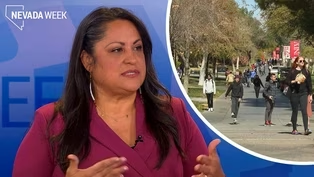
Native American Student Fee Waiver
Video has Closed Captions
Clip: S9 Ep12 | 11m 21s | Nevada offers college fee waivers for Native American students to make higher education affordable. (11m 21s)
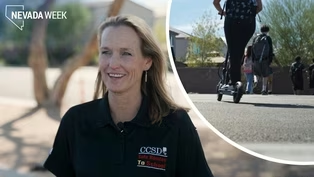
Safe Routes to School Education
Video has Closed Captions
Clip: S9 Ep12 | 1m 56s | Safe Routes to School reminds Southern Nevada drivers and students of active school zone rules. (1m 56s)
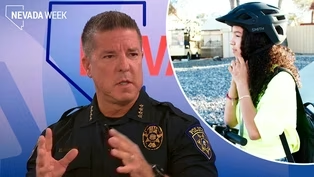
Video has Closed Captions
Clip: S9 Ep12 | 11m 57s | What changes have been made to improve safety around Southern Nevada’s schools? (11m 57s)
Providing Support for PBS.org
Learn Moreabout PBS online sponsorship New Episode
- News and Public Affairs

Top journalists deliver compelling original analysis of the hour's headlines.

- News and Public Affairs

Today's top journalists discuss Washington's current political events and public affairs.
 New Episode

 New Episode


 New Episode


Support for PBS provided by:
Nevada Week is a local public television program presented by Vegas PBS