
School Traffic Safety
Clip: Season 9 Episode 12 | 11m 57sVideo has Closed Captions
What changes have been made to improve safety around Southern Nevada’s schools?
What changes have been made to improve safety around Southern Nevada’s schools?
Problems playing video? | Closed Captioning Feedback
Problems playing video? | Closed Captioning Feedback
Nevada Week is a local public television program presented by Vegas PBS
School Traffic Safety
Clip: Season 9 Episode 12 | 11m 57sVideo has Closed Captions
What changes have been made to improve safety around Southern Nevada’s schools?
Problems playing video? | Closed Captioning Feedback
Where to Watch Nevada Week
Nevada Week is available to stream on pbs.org and the PBS app.
Providing Support for PBS.org
Learn Moreabout PBS online sponsorshipLast school year was a harrowing time for children in school zones.
During the 2025-2026 school year, law enforcement across Clark County recorded more than 400 collisions involving students.
The latest data shows there have been 64 crashes so far this school year.
That's three more than at the same time last year.
Right now, local leaders are implementing a plan to try and address the problem.
Clark County's Office of Traffic Safety created the School Traffic Safety Working Group, which recently provided Clark County Commissioners with a progress report following the first 30 days of school.
Joining us to talk about those efforts are Commissioner Michael Naft, Chair of the Clark County Board of Commissioners; Andrew Bennett, Director of the Office of Traffic Safety in Clark County; and Chief Jeff Clark, the new Chief of Police for the Clark County School District.
Thank you all for joining Nevada Week.
-Thank you.
-Andrew, I will start with you.
As the leader of this working group, what do you make of those numbers we just talked about?
(Andrew Bennett) I think at the end of the day, we know about these numbers because of the work that has been done in this working group.
You know, working with school district police over the last three years, it was important for us to understand the problem that we're facing.
Five years ago, we were asked about, from a reporter, how many kids were hit on the way to or from school.
We started by collecting that data by hand.
It's now automated.
We have a clear understanding of the problem, and that's why we put together this plan.
At the end of the day, we're about 45 days into a five-year plan, so there's plenty of room for us to continue to improve and make these recommendations into actions.
-Chief Clark, what have you recorded as far as data related to enforcement this school year?
(Jeff Clark) You know, I'm happy to say in the first three weeks of this school year, as compared to the first three weeks of last year, we were up over 40% in traffic enforcement.
And that was citations, car stops.
And then our overall collisions are down.
Now, obviously, we're talking here about student safety, but the overall collisions are down.
And so my officers are working hand in hand with Metro, Henderson, North Las Vegas, Nevada State Police to increase the enforcement in and around schools.
And it's important to note with the doubling of fines for any infractions that happen on the school zones, if that doesn't keep you, you know, driving a little slower and a little bit more cautious in a school zone, I will tell you what will.
I've instructed my officers--if we have the lawful and legal ability to tow a car--if you're driving reckless through a school zone, we're going to tow your car because we need to take that really deadly weapon out of the hands of someone that probably shouldn't be driving it.
-You're going to tow that car?
-If we can legally do so per the law.
-You're going to pull them over-- -Yeah.
- --and then call a tow truck?
-We give them a ticket, and then we will tow the vehicle, yes.
-Why would you not legally be able to do that?
-There are certain things we can't.
If someone doesn't use their turn signal or they are, you know, they're going 5 over in a school zone.
But if someone's reckless, they have a revoked driver's license, they don't have car vehicle insurance, then we can.
So those are the kind of things if we come across, then we will.
-The increased penalties that he's talking about, what is your level of concern that once they get to a judge they will be punished as the law states?
-Enforcement starts with legislation and ends with adjudication, and the officers are in the middle writing those tickets.
We were successful, incredibly successful, passing AB6 unanimously with the support of both Houses and the Governor.
Now that we have citations rolling in, we had a conversation just last night with the court system, ensuring that we have a continued ability to look at that data, ensure that civil citations have a higher percentage of going through as the citation that was written than criminal citations.
About 98% of civil citations go through as written.
In civil citations, you're either found guilty or not guilty.
There's not much pleading those citations down.
And so we believe that we have seen those double penalties go through today.
You know, tickets, you know, are pretty much starting at $415 and going up from there.
And so we believe having those continued conversations, which is called out in the report, of ensuring that from legislature to adjudication and prosecution, everybody's aligned in that goal.
-Commissioner Naft, what are some of the tangible successes so far?
(Michael Naft) Look, first of all, a tangible success to me starts with getting the right people in the room around the table and actually making decisions that we can execute on.
That was the first step.
That's not insignificant.
Having, you know, like we did this year for the first time ever, every region of this valley in Southern Nevada, every city, the county was providing the same resources to their students, to their parents and families, in educating them about the rules of the road.
These are things you can't take for granted, but it's also the little things, right?
It matters when crosswalks are not painted properly.
When we have all summer long to paint the crosswalks and you go back to school and they're not painted properly, that's a failure on the municipality's part.
It's something we have hammered away at the county, and our sister jurisdictions have done the same.
That's why you've seen a significant increase in the number of crosswalks that have been painted, repaired, replaced.
These things matter.
If you can't get the basic fundamentals right, it's hard to move on to Phase 2 of these recommendations.
So, you know, looking at 14 of the 19 immediate actions being taken in advance of the school year, that's success.
We've got a lot more work to do, but it starts with those basics.
-What about the budget?
CCSD has to reduce its budget by $51 million, and there is a proposed 2.5% cut across the board in the central office, which is where I believe CCSD Police would fall under.
Is this going to impact your ability to be in those school zones and traffic enforcement?
-You know, we're still in the process of going through those reductions and what those will look like.
But, no, I will make sure that our student safety is priority.
It's paramount to this.
When you look at the strategic plan of the District, we're all about Pillar 3: safe and supportive schools.
And Superintendent Ebert is fully behind that.
So we will ensure that the patrols and the officers that are available for these kind of issues are there.
And again, mentioned earlier, though, I have great relationships with the heads of agency for all the municipalities and different police departments here.
It's always a phone call: Hey, help me out in this area.
And they always are willing to help, just like we're willing to help them.
What a lot with Andrew and Commissioner Bennett-- or Commissioner Naft already have spoken about is the engineering piece.
And part of that, my officers are in all these schools day after day.
So I've already challenged them to find those engineering problems like the crosswalks that need painted, sidewalks, you know, bushes that need cut back, because they are their daily eyes and ears, right?
And so I've directed them to let me know so I can let my friends in government know what needs to be addressed.
And the other E that we haven't really touched on a whole lot is the education.
-Oh, I thought you were going to say e-devices.
-No.
We've talked about engineering, we talked about enforcement, but when it comes to the education piece, what I tend to notice is people, they only seem to care when their kids are in the car.
They'll drop them off, and that's when you see them speeding out of the school zone.
They need to understand that their actions can affect somebody else just like if someone else drops their kid off and takes off.
We also need to make sure that these kids have their heads out of their devices, maybe pull their AirPods out while they're walking to and from, because there is-- the onus is also on kids when they're crossing the street.
Do it safely.
Use your crosswalks.
Go to the crossing guards.
Take just a quick minute to protect yourself as well.
-Andrew Bennett, as you noted to the Clark County Commission, there's a gap with charter schools and their access to this specific program.
How can you increase their presence?
Is that money again?
-No.
So I think when you look at how Safe Routes is funded, CCSD doesn't fund Safe Routes.
Safe Routes is funded by the Southern Nevada Health District, RTC, and NDOT.
And so I think there's a conversation to ensure that we need to understand that the charter schools are the second largest school district in the nation--or, sorry, in the state--and we need to make sure that those resources are available to them.
I know that the Charter School Authority has put into their budget for this legislative cycle as well to ensure they have a Safe Routes to School coordinator, which was a recommendation in the report as well.
So again, ensuring that there's a central resource has been a key component of this, whether it's education and support.
And so we need to make sure that it does reach the charter schools and the private schools as well.
-I talked about e-devices, which means e-bikes and then other-- what else are there besides e-bikes?
E-scooters.
Okay.
What kind of legislation is being proposed?
I imagine that you were consulted on how to reduce the large amount of collisions involving these e-devices.
-Well, I'm law enforcement, so I would have to defer to Commissioner Naft, some of my folks here in the legislature.
-Yeah.
I think, you know, first of all, to take a step back before the legislature, Clark County actually took some action on this that was within our authority now nearly two years ago, a little over a year ago, where we passed our ordinance related to e-devices.
We broke them down into classification.
We required helmets at the county level.
That's something that I personally would look to our friends in the legislature to require.
We know that they save lives and are a critical tool when it comes to safety.
But we took that first, that first crack.
I think there's still lots of room, lots of room for the legislature to continue to enhance what we've done and work on some policies, like I said, that really aren't dependent on what side of the road you're on.
This is a-- you know, I won't speak for my colleague in law enforcement, but as the chief knows, this is a very difficult issue to police, to enforce.
When you have kids on mopeds that are going fast, it's difficult for even the most well-intentioned driver to look out for individuals who are shorter than their vehicle that can't be seen, that are unfamiliar with the rules of the road that are given these devices without any education, at least not formally, and so this is a significant problem.
And the data clearly backs that up.
So, you know, we ought to find policies not just at the municipal level, but up and down the state that could be applied here.
-Andrew, what will be in this legislation that's being proposed at the state level?
-Absolutely.
So the plan clearly laid out a path forward.
And so minimum age for some of these devices, I think, is a crucial part.
Some of these devices get towards the category of vehicle, and we have elementary school kids riding an e-motorcycle to school, which is wholly unacceptable.
Utah passed a similar law last year that essentially mandated that you have to demonstrate the rules of the road.
And when we look at the cause of these crashes, the majority of the time when it is the student's fault, it is a lack of understanding of the rules of the road.
And so mandating some type of, you know, permit lite that, you know, you have to demonstrate the rules of the road, which has been successfully implemented in Utah, and then expanding some of the non-tampering provisions.
We have a lot of kids that are getting a legal e-bike and turning it into an illegal motorcycle.
Ensuring that there's anti-tampering laws and then a universal helmet law for any e-devices.
And so we believe that BDR 482 is going to be the path forward.
They took the majority of the recommendations that's in the report, and we look forward to them taking action this legislative session.
-And the minimum age you're considering?
-You know, so it's scaled between speed and power of the device.
And so essentially the minimum age would be 11, as recommended in the report.
That's a starting point; we don't believe that's where we'll end up.
But you know, anybody under 11 should be on a push scooter or traditional bike.
And then we would scale up from there.
-All right.
Thank you so much for joining Nevada Week.
-Thank you.
Native American Student Fee Waiver
Video has Closed Captions
Clip: S9 Ep12 | 11m 21s | Nevada offers college fee waivers for Native American students to make higher education affordable. (11m 21s)
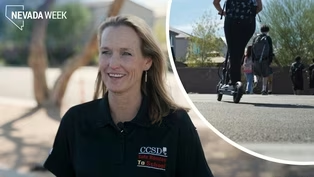
Safe Routes to School Education
Video has Closed Captions
Clip: S9 Ep12 | 1m 56s | Safe Routes to School reminds Southern Nevada drivers and students of active school zone rules. (1m 56s)
Providing Support for PBS.org
Learn Moreabout PBS online sponsorship New Episode
- News and Public Affairs

Top journalists deliver compelling original analysis of the hour's headlines.

- News and Public Affairs

Today's top journalists discuss Washington's current political events and public affairs.
 New Episode
 New Episode
 New Episode
 New Episode


 New Episode


Support for PBS provided by:
Nevada Week is a local public television program presented by Vegas PBS