Here and Now
Taylor Odle on the Universities of Wisconsin's Tuition Hikes
Clip: Season 2400 Episode 2448 | 5m 58sVideo has Closed Captions
Taylor Odle on what the Universities of Wisconsin increasing tuition means for the state.
UW-Madison educational policy professor Taylor Odle considers what the Universities of Wisconsin increasing tuition for the 2026-27 academic year means for students and higher education in the state.
Problems playing video? | Closed Captioning Feedback
Problems playing video? | Closed Captioning Feedback
Here and Now is a local public television program presented by PBS Wisconsin
Here and Now
Taylor Odle on the Universities of Wisconsin's Tuition Hikes
Clip: Season 2400 Episode 2448 | 5m 58sVideo has Closed Captions
UW-Madison educational policy professor Taylor Odle considers what the Universities of Wisconsin increasing tuition for the 2026-27 academic year means for students and higher education in the state.
Problems playing video? | Closed Captioning Feedback
How to Watch Here and Now
Here and Now is available to stream on pbs.org and the free PBS App, available on iPhone, Apple TV, Android TV, Android smartphones, Amazon Fire TV, Amazon Fire Tablet, Roku, Samsung Smart TV, LG TV, and Vizio.
Providing Support for PBS.org
Learn Moreabout PBS online sponsorshipWisconsinites are feeling like they help others and others help them when they're in need.
>> The cost of attending University of Wisconsin schools is going up in the fall.
This month, the UW Board of Regents approved a 2% tuition hike for in-state undergraduate students, plus roughly commensurate increases in fees and room and board that will put UW-Madison at $12,416 on the high end, and UW Parkside at 8851 at the lowest price point.
It's the fourth tuition increase in a row after a ten year freeze.
In the midst of increasing cost pressures on families, how reasonable is the tuition hike?
We're joined by professor in the UW-Madison Department of Education Policy, Taylor Odle, and thanks for being here.
>> Thanks for having me.
>> So a 2% tuition hike on paper seems really modest, but at a time, as we said, when people questioned the value of a college degree, does it turn some people away?
>> I think it's very important to acknowledge that a 2% increase is very real money for students and families.
I think at the same time, we also have to acknowledge that costs are going up for all of us, including organizations and businesses like the Universities of Wisconsin.
2% is relatively modest and predictable, and below the rate of inflation right now doesn't mean it doesn't, you know, have important conversations about dollars and cents at the end of the day.
But what students and families should really care about is the net price of college.
So when you quote that $12,000 or that $8,000, that's what we call the sticker price, what you see on the website.
But from that, we know people get grants and scholarships, and that pulls it down to what we call the net price, the check that you have to write at the end of the day to be able to enroll.
And that number has actually been relatively flat over the last several years because UW is taking money from these tuition back into financial aid.
>> With a 30% decline in highest paying international students and volatile federal research funding.
What is a university to do except use that tuition lever?
>> That's a great question.
UW the universities of Wisconsin have three primary revenue sources, right?
Federal grants, which we are among the top in the nation at securing.
We enroll students who pay tuition and fees, and we receive funding from the state.
State support has long stagnated, with the exception of a recent increase.
And so tuition dollars are a primary way of raising funds.
With a tuition freeze for many, many years, our ability to do that was hamstrung.
And so it quite literally strangled some of the campuses.
We benefit from having international students and even students from out of state who pay higher tuition rates because they can afford it.
They are mobile geographic for colleges with a decline in international student enrollment.
There aren't many other students that we can look to except for our in-state students, especially now because the state has begun to increasingly regulate our ability to even draw students from Minnesota and Iowa and other out-of-state partners.
>> So how kind of in jeopardy are the finances of the Universities of Wisconsin given all of these factors?
>> It's a very serious position, right?
We've already seen campus closures of many regional campuses.
We've seen cuts to academic programs.
We've seen staff and faculty restructurings.
And so no one wants to raise prices.
If you're a business owner, you don't want to walk out and show your customers raising prices.
The university doesn't want to do that either.
We want more people to access and have access to a college education.
Like you said, for upper social and economic mobility.
But when the state is no longer a primary funding partner, federal research and grants landscape is certainly uncertain.
Tuition is one of the only lovers left.
>> So some Republican state policymakers are super angry about this tuition increase, saying it's, you know, the fourth in a row after a state budget gave the system $256 million.
What about that persuasion?
>> Yeah, I think the average Wisconsinite should also be super angry about that characterization.
So 256 million is a big number and it's a very important investment.
It's however, a biennial increase.
So we have to divide that by two because it's going to be the 120 something million every year.
And just to put that in context, the university leverages its the state's largest public employer, and its operating budget is around $7 billion.
And so that increase is less than almost 1.5%, so substantially below inflation.
And more importantly, that $256 million came with a lot of important caveats.
Most importantly, an unfunded tuition or salary raise for faculty and staff across the institution.
So no other piece of state government has unfunded mandates in that same way.
So we're required to raise salaries by 2% for all faculty and staff.
But the state didn't put in the money to fully fund that raise.
And so the Regents have said that the tuition increase will predominantly fund faculty and staff salary increases mandated.
>> Well, that's another piece that some policymakers are unhappy about, because they say the number of staff has gone up, whereas the number of students has not.
>> So many people, when they think about staff increases on cross campus.
We use this federal survey where we report people in these huge buckets.
Do they teach?
Do they work?
Are they administrative in different ways?
It doesn't capture the granularity of what those staff are actually doing.
So if we hire more students to provide career exploration or oversee internships for students or help them get placements with employers, those are staff members and those are very valuable staff members.
I'd be happy to double or triple those numbers.
And so it's a really nuanced conversation, right?
Are there efficiencies to be had?
Of course, but we need to have better data and a more frank conversation around frank conversation around
 New
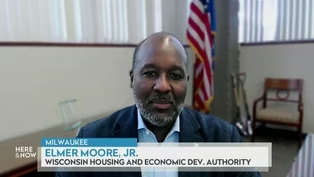
NewElmer Moore, Jr. on Rental Housing Tax Credits in Wisconsin
Video has Closed Captions
Clip: S2400 Ep2448 | 5m 29s | Elmer Moore, Jr. on nearly $50 million in tax credits to build affordable rental units. (5m 29s)
 New
NewHere & Now opening for June 12, 2026
Video has Closed Captions
Clip: S2400 Ep2448 | 1m | The introduction to the June 12, 2026 episode of Here & Now. (1m)
 New
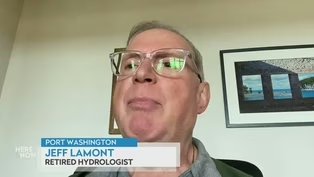
NewJeff Lamont on Wisconsin's PFAS Settlement with Tyco Fire
Video has Closed Captions
Clip: S2400 Ep2448 | 8m 33s | Jeff Lamont on terms of a settlement to address PFAS contamination in the Marinette area. (8m 33s)
 New
NewWisconsin's U.S. Senators on War with Iran and Inflation
Video has Closed Captions
Clip: S2400 Ep2448 | 1m 48s | Tammy Baldwin and Ron Johnson on the war in Iran and effects on fuel and fertilizer costs. (1m 48s)
 New
NewPaula Tran on the Health Challenges Facing Wisconsinites
Video has Closed Captions
Clip: S2400 Ep2448 | 5m 52s | Paula Tran on findings of the 2025 State Health Assessment for Wisconsin. (5m 52s)
Providing Support for PBS.org
Learn Moreabout PBS online sponsorship New Episode
- News and Public Affairs

Top journalists deliver compelling original analysis of the hour's headlines.
 New Episode
- News and Public Affairs

Today's top journalists discuss Washington's current political events and public affairs.
 New Episode
 New Episode
 New Episode
 New Episode
 New Episode
 New Episode
 New Episode
 New Episode
 New Episode
Support for PBS provided by:
Here and Now is a local public television program presented by PBS Wisconsin