
Ruby Duncan’s Legacy
Clip: Season 8 Episode 47 | 17m 55sVideo has Closed Captions
Ruby Duncan fought for Southern Nevada families in poverty. Where does that safety net stand?
Ruby Duncan fought for vital services and help for mothers and children living in poverty in Southern Nevada. Where does work for a social safety net stand today?
Problems playing video? | Closed Captioning Feedback
Problems playing video? | Closed Captioning Feedback
Nevada Week is a local public television program presented by Vegas PBS
Ruby Duncan’s Legacy
Clip: Season 8 Episode 47 | 17m 55sVideo has Closed Captions
Ruby Duncan fought for vital services and help for mothers and children living in poverty in Southern Nevada. Where does work for a social safety net stand today?
Problems playing video? | Closed Captioning Feedback
Where to Watch Nevada Week
Nevada Week is available to stream on pbs.org and the PBS app.
Providing Support for PBS.org
Learn Moreabout PBS online sponsorship-Duncan's fight against poverty and for the dignity of single mothers continues today.
Here to explore the state of those efforts are Erika Washington, Executive Director of Make It Work Nevada; Michael Flores, Founder of Nevada Youth Network; and Erica Vital-Lazare, co-Founder of the Obodo Collective.
Thank you all for joining us.
-Thank you.
-Erika Washington, Make It Work Nevada organizes around the experiences and challenges that black women and women of color face.
Ruby Duncan, you've called her a mentor.
When you spoke with her prior to her passing, what did she say about your efforts and what was going on in the world?
(Erika Washington) You know, I think I told you that it was one of the first times I had heard her sound even just a little bit down, because that enthusiasm has always been there.
She was a fighter until the end.
But she was seeing the amount of strain that we're, that we have in this country right now.
And so she just told me, You need to keep finding some more money, we need to keep telling people to vote, we need to keep pushing, we have to fight for what we want.
And I think what she was seeing was a repeat of some of the things that she experienced herself in the '60s and '70s.
And I think that is what was really causing her a little bit of heartache, to see how much work she put into it for us to have to fight for some of these same things all over again.
You know, the conversation around SNAP benefits being cut, you know, that was heartbreaking for her.
She understood that children need to eat and that, you know, pregnant women and mothers and fathers, that they need-- we need nutritious food.
And this shouldn't, this shouldn't be something that's ever on the table.
Hunger is not, it should not be a part of the chess pieces that we're playing with.
-Erica with the Obodo Collective, you are an urban farm in the west side of Las Vegas, providing fresh produce to the people there.
What do you think when you hear about what's being repeated from Ruby Duncan's time versus now?
What are you seeing about SNAP benefits, too?
How is it impacting you?
(Erica Vital-Lazare) Well, at the Obodo Collective, we have, like you said, an urban farm and also a small grocery.
And we've made it our mission to provide not only nutritious foods, nutrient-rich foods, but at a price that's affordable in a space that's inclusive.
And so our executive director, Tameka Henry, has implemented a program that not only accepts SNAP's benefits but also amplifies them, double-up food bucks, so that when you purchase through your SNAP benefits, you get double what your dollar might garner elsewhere.
I'd like to say that Obodo would not exist without Miss Ruby Duncan.
Miss Ruby's life is an American story, someone who saw inequity and did not just steep herself in it, did not just rest within the labels, activated the label so that "welfare mother" became a call to action.
-What is welfare mother?
What connotation does it carry with it currently?
Michael, I'll toss it to you, because the Nevada Youth Network, it is based within one of the public housing developments in the Westside.
And I guess technically these mothers would be considered welfare mothers.
What do they face?
(Michael Flores) Well, first, Amber, thank you for having this conversation.
I'm so glad we're able to talk about Ruby's legacy and everything she did, not just for our community, but for our country.
And you know, I see a lot of Ruby Duncans over in Sherman Gardens, on Weaver Street, still, where she lived at one point.
And I see a lot of moms who want better for their kids.
They want a better education.
They want to make sure their kids have the ability to achieve all their hopes and dreams, all the things that Ruby fought for.
But I think, unfortunately, there's a lot of political rhetoric out there that paint a different picture of these moms, who I wouldn't just categorize as welfare moms, but very hard working moms who are just trying to better their situation and provide a better life for their family.
-Erika, what did Ruby face in terms of being called the welfare queen, right, and does that stereotype exist today?
-I mean, I think the stereotype exists because there are certain entities that want to keep that alive, that they-- There is a sense.
There's always reasons that people want to belittle others or into other people instead of bringing them in so that everyone is belonging, because there are all sorts of people who have needed welfare in different forms over the years, whether that's Medicaid or TANF or SNAP.
For whatever reason, it's meant to be there.
Like when you think about the word "welfare," what does that mean?
It's for our well-being.
And if we have something that's supposed to be a safety net for our well-being collectively as a community, that shouldn't be a problem.
And so if we have to tap into it for a while, because things happen, that shouldn't be looked at as something negative.
I have mentioned on multiple occasions that I had food stamps.
I had Medicaid when my children were younger.
My mother had WIC when I was born.
She was 16 when I was born.
And so these things happen.
But now I do have college-educated children who are out exploring the world.
You know, I'm running a, a large nonprofit, and so these things are important for us so that we can move into the next step.
-One of the themes that was in this book about Ruby Duncan, Storming Caesars Palace, was the catch-22 of the welfare system.
For her and mothers like her, welfare wasn't enough to support their children, so they had to seek work elsewhere.
But then if they reported that, they were in danger of losing their benefits.
Tell me a story you told me recently about some of the mothers that you work with and their rental experience.
-Experience you just mentioned that Ruby described is something we're still seeing today.
We've had mothers.
I'll give you an example that you're referencing, where we had a mom of three that we worked with.
And when she wasn't working, she wasn't paying anything, any sort of rent.
And then when she started working, her rent went all the way up over $900.
And you know, as we're trying to help these mothers and families, you know, get onto a better situation, that is not a system that is set out for that right now.
-Does anyone want to add any other examples?
-Well, not an example.
Only to say that the fact that we would weaponize access to resources--shelter, roof over our heads, food on our table--I think it is a systemic ill that Ms.
Ruby hoped would be ameliorated in the 21st century by our time.
When she started in 1972, her battle here, my mother was raising us on assistance in Virginia.
My mother was also going to school at night and picking up jobs during the day and got a computer science degree and ended up working for NASA.
The little bit of assistance that she garnered in that time, as you said, Erika, made it possible to make some gains, to provide for our well-being.
When we look at the history of welfare in this country, you mentioned the welfare queen, which was another weaponized identity by the Reagan administration wanting to take away the true discussion about making sure that there is a safety net for all.
Very ironic most, historically and even now, most who benefit on the system of welfare are white women, our white sistren and brethren.
But when you think about the characterization, you see a black woman at the forefront getting more than what she deserves.
It's very punitive, and I think Ms.
Ruby's example is, again, you should not be punished for going through vulnerable times, for being among the most vulnerable in this nation.
This nation has so much wealth.
This is something that she would talk about time and time again.
It is shameless that we would obstruct anyone from being able to provide for themselves or their families.
-In the '60s and '70s when Ruby Duncan was very active advocating against poverty, the poverty rate was 1 in every 5 Americans, about 1 in every 5.
Currently, it's 1 in about every 10.
So there has been improvement.
On the SNAP discussion, Erika, what do you think Ruby would have thought of the work requirements that are being implemented in order to still receive SNAP benefits?
She wanted to work.
-She did.
She wanted to work, and I think most people want to work.
Most people want to do something that is meaningful to their life and to their family.
They want to be able to provide for their family.
That's not an anomaly.
It's just a matter of when you put these different specifications on it without seeing the big picture of where they can get a job and how many hours they're able to work if you put all these parameters around that they're not able to meet and then they lose what little benefits they have, the only people who suffer are usually the children.
You know, it's mostly children and then young single mothers.
-If I could piggyback off what Erika was saying, Ruby, she's a fighter.
She was feisty every single time, and I know she was pretty frustrated about this.
And she felt like we were taking steps back.
And I think we all have a responsibility to continue on her legacy by making sure that we're bringing to the forefront the needs of some of our most vulnerable in the community.
What Ruby-- One of her superpowers is, is that she made policy relatable to everyday people.
And I think that's what's missing right now is the human face to some of these policy issues that you're mentioning, and I hope in Ruby's legacy and remembering her that we're able to bring to light some of the families and moms and children that are being affected right now by some of the decisions that are being made.
-The Historic Westside is where she lived and worked, and that is where you have your urban farm.
Speaking of healthy food, is there a grocery store in that area still?
Does Mario's count?
What is going on there?
-Mario's definitely counts.
Our small grocer definitely counts.
We are not only feeding community but creating community, also creating space to keep legacies alive, such as Miss Ruby's legacy, to shine a light on the importance of nutrition in the home as a gateway to an abundant life.
We just heard that message during Miss Ruby's homegoing.
We have to be well fed in order to be well educated, to be present for the education that we need.
And once we have those things combined, we can make, we can gain traction to move quality of life ahead for everyone.
Miss Ruby always said, "Mothers, not colors."
Her work was for everyone, and I think we're missing a trick here when we obstruct those in need from getting what they need as a measure of, are you worthy?
do you deserve it?
do you strike this box?
have you jumped through this hoop?
Ms.
Ruby shared a story with me about being granted a nice bit of money from a foundation, and they were a little bit reluctant to give it to Operation Life.
They looked at the board.
They looked at those who are working.
They looked at Miss Ruby herself and said, Oh, none of you are college educated.
So though you're already doing this work, you've already been an advisor to Presidents, you've already been in those rooms, read policy, understood it better than policy makers, I can't grant you this money because you have not jumped through certain hoops to earn a degree.
And they had to find, find a face that had a piece of paper in order to gain a hold of what they'd already earned.
So as long as there are these obstructions, there's slow, plodding movement and then there's backwards of aggression to movement when we should all be moving forward.
-Can I mention on the grocery store, I love Mario's.
Mario's has the best catfish in the world, but I feel like there's been a number of grocery chains that have come in the community and they've tried to set up shop, and, for whatever reason, they've not been successful.
You know, the families that I work with over on Weaver Street, they don't have the ability to get to the Walmart up the street.
That's probably the closest area for groceries outside of Mario's.
And I think that, you know, we need to figure out from an economic development standpoint how we get more grocery stores and other types of businesses in that area that were thriving when Ruby was there.
She brought them there, right?
She, she went out and talked about the need.
Same thing, access to health care.
There's no, in my opinion, real access to health care in that area.
They still have to travel either to UMC or some of the neighboring areas.
There's nothing in the community since Operation Life.
You have Volunteers in Medicine, but they're coming out to folks for the most part.
And so I still think there's a big need in the area.
-Operation Life brought housing, help with housing, daycare, job training, I mean, a lot, and health care access.
Why did it end, Erika?
And what kind of void has it left?
-I think it left a large void, partially because those folks were like so deep into the work.
Something I was telling Michael is that the job that I have now is a job that I, that I found and then semi-created at the same time.
This wasn't something that Miss Ruby, like, looked through the classifieds to become the founder or the executive director of Operation Life, where now these are careers for a lot of us to rabble-rouse and to work on policy.
And so, you know, when there isn't a succession plan and you're not thinking long term-- partially because of grants.
You know, a lot of foundations only offer grants for maybe two years at a time.
Maybe you're lucky and get a three-year grant, but that's far and few between, so it keeps you also in a poverty mindset.
So it's hard to plan for the future and to keep things going and to keep hiring folks to do more work in the community if you don't have, you know, a stabilized financial, you know, outlook that you can work on for, you know, 10 years from now like, what were we working on, and how will we bring in, you know, more business, more industry, and more grocery stores, that sort of thing, and really thinking about what the community needs to grow.
It's a bunch of bandaids that we keep applying to things that are hemorrhaging instead of preventative medication, you know, in that sense.
-We are running out of time.
One more excerpt from the book I want to read about the women who were involved in Operation Life.
"They made mob bosses, casino owners, mayors, governors, and senators profoundly uncomfortable and remarkably responsive."
Is that happening today?
-"Remarkably responsive"?
Well, you know, I will say that we have some, we have some, some great politicians, you know, in various places across the country and including in Nevada, but they're far and few between.
And also it's more than just whoever is elected; it really is about the community.
Because Ms.
Ruby was about voting.
She want everyone needed to vote in every single election.
You needed to be, you need to participate.
But past that, we also have to hold folks accountable, and we also have to stay involved with those that we put into office, that we have to help them.
We have to also give them the information that they need on a regular basis to know what's happening in the community, because they can only see so much between here and Washington or Carson City or wherever.
They, they need all of us to constantly be working on the betterment of the community, and there's not enough of that.
-Yeah.
I think the magic of Ruby is what's missing.
Ruby forced these elected officials to listen and to pay attention.
When Mike O'Callaghan was running for governor, he needed her support.
It was a tight race, and so she said, Well, you need to come to my home.
So he came over to the projects, and she provided Kool-Aid and county cheese and made him sit there and listen to her and all her fellow moms on the issues they were facing.
And lo and behold, Mike O'Callaghan became governor a few days later after she mobilized all those moms in her community to come out and vote.
And that's how she really created power, and I think we're missing some of that today.
-All right.
She was a familiar face here on Vegas PBS as well.
And one of the recent interviews I saw of her, she said, "Roll me anywhere and I'll speak."
Right?
Video has Closed Captions
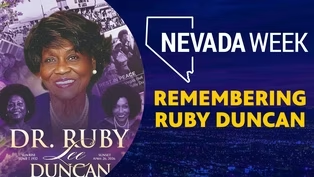
Clip: S8 Ep47 | 7m 22s | Family, friends and community members say goodbye to activist and Southern Nevada icon Ruby Duncan. (7m 22s)
Providing Support for PBS.org
Learn Moreabout PBS online sponsorship New Episode
- News and Public Affairs

Top journalists deliver compelling original analysis of the hour's headlines.
 New Episode
- News and Public Affairs

Today's top journalists discuss Washington's current political events and public affairs.



 New Episode
 New Episode
 New Episode


 New Episode
Support for PBS provided by:
Nevada Week is a local public television program presented by Vegas PBS