
Rep. Susie Lee on Affordability for Nevadans
Season 8 Episode 21 | 26m 46sVideo has Closed Captions
Conversations with Congresswoman Susie Lee and Three Square Food Bank CEO Beth Martino.
From affordable housing to keeping healthcare costs down, Congresswoman Susie Lee (D-NV) shares legislation she’s working on in Congress impacting Nevadans. We also talk to Beth Martino, CEO of Three Square Food Bank, on how the organization has dealt with federal funding cuts. She explains how the nonprofit has found other ways to feed thousands of Southern Nevadans living with food insecurity.
Problems playing video? | Closed Captioning Feedback
Problems playing video? | Closed Captioning Feedback
Nevada Week is a local public television program presented by Vegas PBS
Rep. Susie Lee on Affordability for Nevadans
Season 8 Episode 21 | 26m 46sVideo has Closed Captions
From affordable housing to keeping healthcare costs down, Congresswoman Susie Lee (D-NV) shares legislation she’s working on in Congress impacting Nevadans. We also talk to Beth Martino, CEO of Three Square Food Bank, on how the organization has dealt with federal funding cuts. She explains how the nonprofit has found other ways to feed thousands of Southern Nevadans living with food insecurity.
Problems playing video? | Closed Captioning Feedback
How to Watch Nevada Week
Nevada Week is available to stream on pbs.org and the free PBS App, available on iPhone, Apple TV, Android TV, Android smartphones, Amazon Fire TV, Amazon Fire Tablet, Roku, Samsung Smart TV, and Vizio.
Providing Support for PBS.org
Learn Moreabout PBS online sponsorshipThe cost of living... What can Congress actually do to ease the burden?
That's this week on Nevada Week.
♪♪ Support for Nevada Week is provided by Senator William H. Hernstadt.
-Welcome to Nevada Week.
I'm Amber Renee Dixon.
Inflation and federal funding cuts are hitting food banks hard, just as the demand for food assistance is soaring.
How Southern Nevada's largest hunger relief organization is keeping up, that's ahead.
But first, she voted no to reopen the government during its longest shutdown in US history, urging lawmakers to find a bipartisan solution to prevent health coverage costs from rising.
It's one of several cost-of-living issues top of mind for her constituents, and she joins us now to explain what she's doing about them.
Congresswoman Susie Lee, a Democrat representing Nevada's Third Congressional District, welcome back to Nevada Week.
-Thanks, Amber.
Great to be here.
-I'd like to start with housing.
There's a report from the Lied Center for Real Estate at UNLV.
It says that the Las Vegas housing market is largely unaffordable for much of the local population.
And among some of the recent action that you've taken to address this, you have called for more transparency into big corporate landlords.
You have also helped to reintroduce the Southern Nevada Economic Development and Conservation Act.
Of those two, which is priority for you?
(Congresswoman Susie Lee) Well, absolutely.
Listen, obviously the Lands Bill is such an important piece of legislation.
We have a housing crisis.
It's a supply and demand issue.
We just simply don't have enough supply of affordable housing in our state.
I just actually this morning had a round table with experts from banking, home building, from the nonprofit world, from city and local and state agencies as well talking about this very issue.
Basically, you know, we have got to get federal funding into our state, but we also have to cut some red tape and make sure that we're having processes where people can build affordable housing faster.
We've done plenty to bring funding to Southern Nevada.
I passed a bipartisan piece of legislation, the AACE Act, the Accelerating Appraisals Act, which has alleviated one piece of red tape-- -And that Republican Governor Joe Lombardo also supported.
-Joe Lombardo supported it as well.
And we just need to continue to have our eye on the prize; work together from a federal, state, and local agency framework; and continue to get housing built quickly and bring online.
So, yes.
-It's a complex issue, housing.
But one issue within Nevada specifically is that there is a lot of land owned by the federal government, and so this Act specifically would release 25,000 acres of public land in Southern Nevada.
This comes from Senator Catherine Cortez Masto.
She has tried to get through this legislation for many years.
This is the first year that you are now introducing or have introduced companion legislation.
Why now?
-Listen, I serve on the Natural Resources Committee, the committee with the jurisdiction over land issues.
This piece of legislation has been so instrumental for Southern Nevada, releasing about $368 million that's been used for water infrastructure, parks, other recreation facilities.
This is a prime piece of legislation that really serves as a model for the West.
In fact, the Secretary of the Interior, Burgum, was in front of my committee and highlighted this as a great piece of land use legislation.
That being said, at least in the House of Representatives, the Chairman of the Resource Committee doesn't seem to be willing to move forward any piece of legislation that has conservation in it, which is such a strong piece of part of the Lands Bill.
So we're going to continue--Mark Amodei has a Northern Nevada Lands Bill as well--continue to work with our colleagues to try to get this piece of legislation into something that can be accepted in a bipartisan manner.
Good signal?
We sort of get-- we're getting conflicting signals, obviously, from the Secretary seeming to endorse and support this legislation, but when it comes to getting it past the House, the Chairman of the Committee doesn't seem to be as in favor of that.
-Okay.
So in April, fellow Democrat and fellow Nevada Representative Dina Titus told the Nevada Current that she opposed the bill as written because she says it would make land available to developers to build more homes that average Nevadans cannot afford.
She says there are no guarantees in this legislation that what will be built on this land is affordable housing.
It could be, you know, mansions.
How do you respond to that?
-Well, I've been in contact with home builders, with agencies all across Southern Nevada.
And the number one issue with availability of housing is availability of land.
And you can't-- When you're spending years trying to get approvals for your project, that has cost to it, too.
So this is basically making this land available.
It is for-- There will be affordable housing in this bill.
And, again, many of the people in this sphere are really focused on making sure we have the land available, that we can actually build housing in a reasonable time frame so that-- because every time you have a delay, that has additional costs.
And that's what this bill will do.
-Are you saying language will be added to guarantee affordable housing is built?
-There is-- Availability of land is a key factor in rising prices for houses.
It's a supply and demand.
The less we don't build-- The less housing we build, the higher the prices go.
-About the corporate landlords, will you expand on what you're doing with that, and part of that is that you want the government to reveal who is, who these investors are that are buying 23% of all homes purchased in Las Vegas last year, that's according to the Lied Center for Real Estate.
If you get that information, what do you do with it?
-We want to make sure that homes in Nevada are purchased by residents of Nevada; that they're not purchased by equity investors who are coming in from out of state doing the, you know, buying these up as an investment and then jacking up the rent for individuals.
So part of the bill is, one, to understand the level of the problem, but, two, also create a fund where you find these entities that do that and then you can use that funding to then provide support for individuals.
-So charging those investors a fee or...?
-Well, if they-- If they are increasing rents egregiously, and but the first part of the bill is making sure that we're understanding who's actually doing this and what they're doing.
-Okay.
No tax on tips.
There is a version of it in the One Big Beautiful Bill Act.
I know that you call it with language that we should not use on public television, especially.
But that version of it that did pass, it got a little bit more clarification in recent weeks on how it's going to work.
The IRS says it will temporarily delay the enforcement of a provision that would have kept certain service workers from claiming the full $25,000 income deduction.
Is that enough for you?
-Listen, I am proud, you know, proud that we supported the Tips Act, which was passed unanimously in the Senate.
Unfortunately, Mike Johnson did not bring it up in the House.
-And this was back-- -I am glad that the President has taken our lead and that Republicans did include a provision of the no tax-- you know, provide no tax on tips in this bill.
But it's a start, in my opinion, and we can do so much more.
And that adjustment that you just mentioned is one example what can be done.
Also we, you know, these-- these tax breaks should be permanent.
-As it is, it's only-- -My one complaint about this is the tax breaks for the wealthiest Americans that was included in this bill, those are permanent.
But these, these tax breaks for our service employees, first of all, their income is, is capped.
So if you earn over $150,000 as a couple, you have a cap on that; whereas, if you earn, you know, the wealthiest Americans aren't seeing their tax breaks capped.
These sunset in 2028.
So we can make this better: making them permanent; making sure that we have guardrails so that people aren't reporting some type of investment income or, you know, just gaming the system, that it's really applying to true tipped workers; and then removing the caps and making sure that they have availability that this tax break applies to everyone.
So I think we-- This is a first start, first stage, and I think we can do better for our tip employees here in Nevada.
And that's what we included in the Tips Act, which had passed the Senate prior to this.
Mike Johnson failed to bring it up for a vote in the House and instead included these provisions.
So we can-- I think we can improve it, and that's exactly what we want to do.
-The cap you're talking about, $25,000 income deduction, phases out at $150,000 for individuals and $300,000 for married couples.
And, yes, it's important to make that clear because-- Well, there was this political article about Democrats taking-- believing that they are responsible for the initial discussion around no tax on tips and who gets to take credit for it.
Republicans believe they should.
It ended up with-- -It's a good bipartisan piece of, you know-- It's a good bipartisan issue.
I just said, let's make it better for our tipped employees.
-Okay.
The Affordable Care Act, the enhanced tax credits that are set to expire at the end of this year, there are 3 million people who live in Nevada, and of them, there are about 95,000 who currently use those expiring tax credits.
It's a small percentage, but it is the reason that you continue to vote no on reopening the federal government.
Was it worth it?
-Listen, this is an issue that's incredibly personal to me.
Before the Affordable Care Act, my father lost his job when he was 58, never was able to get a type of employment that had benefits.
My parents fell into the trap where because of pre-existing conditions, they could not afford health insurance, so they chose to go without it.
And like so many people who rely on these tax credits, without them, they are about to see their premiums go up three-fold, four-fold.
I have one woman who is a single mother has her premiums set to go up from $85 a month to $700 a month.
That's unaffordable.
And so what many of these people will do is make the decision to go without it and go without insurance.
And what that does is make insurance expensive for all of us, because, one, first of all, your risk pool changes.
The people who are healthiest, younger people, tend to just take the risk.
And so that changes the whole pricing model of insurance.
But you also have people who now will not take-- you know, have preventative care, will end up getting their care in emergency rooms, which is the most expensive type of health care you can get.
And we will all foot the bill for that.
And so, you know, this bill, in extending the ACA, while you say it's for a small proportion of Americans, it actually will impact the cost of insurance, which is already set to go up 20% in some cases here in Nevada.
That it will make insurances more expensive for all of us.
-Across the board.
You are echoing the same sentiment as Republican Representative Marjorie Taylor Greene of Georgia.
She said the same thing about these expiring ACA credits, that it would impact her family as well as several of her constituents.
Granted, about the Affordable Care Act as a whole, she also said that made health insurance unaffordable for her family.
So she's on both sides of this issue.
She has recently announced she's resigning from Congress.
Once a fierce ally of President Donald Trump, they've had, you know, a public back-and-forth, and now she's leaving.
What do you make of that, if anything?
-Listen, I don't know what makes Marjorie Taylor Greene tick, but she's made it clear that this is an issue.
We need to work together in a bipartisan manner.
Do you know that the Senate agreed to take a vote on a Democrat proposal for extending the ACA tax subsidies before the end of December?
That was part of the deal to reopen the government, but and then we have till the end of January.
And so we were discussing what it is we need to do.
Is it a two-year extension?
Is it putting some income limits on it?
Republicans seem to want some form of income caps on who qualifies for these.
They even have even suggested some, you know, buy-in that people have to put a little skin in the game and make a minimum payment.
So all these things are on the table.
I think that, you know, my frustration with the process with the shutdown was that Mike Johnson shut down the House of Representatives for 43 days.
Actually, it was almost two months, and that was related to other issues as well.
But not once did he open up a discussion in a bipartisan manner to deal with the ACA tax credits.
But now we're out of it.
We got to move forward.
I'm happy to see that the White House is indicating a willingness to negotiate.
Now we're starting to see how House Republicans negotiate and Senators, and so let's get to a plan where we can continue to support-- And again, there's a lot that needs to be reformed in our health care space.
There's PBM legislation on pharmaceutical pricing that maybe that's part of the bill.
Republicans are talking about instead of doing tax credits, providing savings accounts to individuals.
I'm not really sure I'm as big of a fan as that, because I think if you're really worried about reducing fraud, I think it may open up the door for additional avenues.
But let's have those conversations, which Mike Johnson did not do for almost two months on this issue.
And I find that a dereliction of his duty to the people of this country.
-Congresswoman Susie Lee, thank you for joining Nevada Week.
-Thanks, Amber.
-More Southern Nevadans are struggling with food insecurity, and some for the first time.
According to Three Square Food Bank, one in six people in our area are food insecure.
That's up nearly 40% since 2023.
And with federal funding cuts, inflation, and tariffs impacting Three Square and other nonprofits, the organization is calling on the community to help.
Beth Martino, President and CEO of Three Square Food Bank, is here to share more.
Beth, welcome back to Nevada Week.
-Hi.
Nice to be here.
-We first had you on when you first got this position back in mid-2023, and, wow, what a couple of years it's been for you, even just this year alone.
I want to start.
Let's go back to March, and that is when the US Department of Agriculture announced it would be cutting about a billion dollars in funding for two specific programs that provided food to schools and to food banks from farmers and ranchers.
Southern Nevada, in Southern Nevada you are the largest hunger relief organization.
So what did those cuts look like for you?
(Beth Martino) Well, at Three Square it meant that there was food we were expecting to receive at this time of year through the summer as well that we won't be receiving.
So we looked for ways to try to fill that gap, because we were expecting to have that food on our shelves, which meant that that would have been going out to food pantries and food programs all across Southern Nevada.
So we had to find ways to supplement that.
And for us, that meant calling for more donations and food drives and also buying more food from our own financial resources.
But it also meant for us that the farms that we had been working with and local farmers, growers, food manufacturers, may also be feeling that impact.
And so we wanted to look for ways that we could try to mitigate that, and we were really fortunate that the Nevada legislature took some steps to fund a program called Home Feeds Nevada, which buys food from local Nevada farmers.
So felt really good that we were able to put that together in time and make it through the session with that package and hopefully do a little to support the food banks, but also do a little bit to support local farmers and growers.
-When you talk about those federal cuts, how much food are we talking about that impacted you?
-Well, it was about 5 million pounds of food that we would have expected to receive over the course of a year that we were unsure how much we would receive.
And I think if there's one word that seems to characterize this entire calendar year, it's been "uncertainty."
And so that might have been the first piece of uncertainty that came to us at the food bank.
But then throughout the year, we've seen more waves of things that have just created uncertainty, both for the nonprofit community and the people that we serve.
-Are you referring to the government shutdown?
-Yeah.
So the government shutdown's not entirely unexpected in that we knew through the summer that there were some challenges in getting a federal budget passed, but I'm sure that none of us thought it would last as long as it did.
Certainly didn't expect that SNAP benefits would be disrupted in the way that they were.
And that affects the entire nonprofit community, but, more importantly, it affects our neighbors, the people that we serve every day.
It affects businesses and really the whole state economy.
-So and that brings more demand on to you when those SNAP payments are temporarily stopped, as they were.
And so then the governor's response to that was to give state money directly to food banks, yours and to another's in Northern Nevada.
He also deployed the National Guard to help with packaging and distribution, teaming up with you for that.
What were your takeaways from that experience?
-Well, the State was an incredible partner for the food banks trying to find ways to meet the need while also operating within the constraints that the federal government had set out.
So I think we were fortunate to have the State come to us and say, How can we support your emergency response at the two food banks?
And to be trusted to do that meant a lot to us, because we are out here working in collaboration with so many organizations every day, but to know that the State recognized that and that we had partners there that would help facilitate that work.
So both food banks were able to be out on November 1 serving neighbors that were impacted by those SNAP disruptions.
And earlier in October, we were able to meet the need of the federal workers whose pay had been delayed, and that's all really important, because those folks are counting on their pay, they're counting on their SNAP benefits.
And to be able to meet that need in the way that we have is, I think, a testament to our state and what we do in difficult times.
-When you're talking about the State operating under federal guidelines, are you referencing that they could not pay SNAP recipients directly, the federal government had said, if you do that, you risk not getting, I believe, further funding?
-That was our understanding.
And we were in close communication with the agency that pays SNAP benefits.
And I think they were being advised that paying benefits directly might have some repercussions for the state, so they were trying to operate out of an abundance of caution.
But ultimately at Three Square, what's most important to us is making sure that people have food on their tables.
So we were just always seeking a solution and what might that be.
-The 5 million pounds of food, have you been able to recuperate that?
-So one of the outcomes of the government shutdown is the funding we received from the state allowed us to purchase additional food, and that did put more food in the community at the time that we needed it during the shutdown.
So we are actually looking, in terms of the total amount of food that we would have available, looking a bit better than we thought we might.
But we've also seen the need rising.
Just over the summer alone, our data showed a 16% rise in the number of people coming into food pantries across Southern Nevada.
And most interestingly, 75% of that increase were first-time visitors.
So we're seeing people who had not experienced need before coming out looking for food assistance.
-The USDA, when asked why you are making these cuts to the two programs, said that they were short-term programs with no plan for longevity and that these moves were a return to long-term, fiscally responsible initiatives.
How would you respond to that?
-Well, it's true that some of the cuts that have been implemented were covid-era programs.
The challenge, however, is, we believe, many people believe that we recovered from some of the economic impacts of the pandemic, when, in fact, as you mentioned at the start of this segment, we've seen a 40% rise in food insecurity over the last couple of years.
So what that tells us is we actually aren't seeing things return to prepandemic levels, whether it's food insecurity, housing assistance.
Many other needs in our community have just continued to rise since the pandemic.
So to pull those programs back at a time when people need them is really challenging, and it's not just for Three Square but for many of the organizations that we work with as well and certainly for the people that we serve.
-Supply chain issues, inflation, those have been present since covid.
Add in tariffs, how big of an impact are tariffs making on you?
-Well, rising prices are affecting the people we serve at the grocery store.
So if you're going in to buy groceries and your dollar doesn't go as far, then that means you're looking to food assistance to try to fill that gap.
And whether that's a program like SNAP at the federal, state or federal level or whether that is a food pantry, you have to find a way to put food on the table.
And your dollar is just not going as far.
And tariffs have an impact on that as well.
But at Three Square, inflation and tariffs also means that we're paying more for food.
So at some point, our dollar might not go as far.
And so it really, when we see rising costs, it really affects all of us in different ways, and I think we have to be mindful of that.
-What about the quality of food you're able to provide amid these cuts?
We were talking about fresh produce.
Is that still available?
-We've actually been remarkably successful over the past few months in sourcing fresh produce.
There are certainly times when we are sourcing things that may not be the quality that we want, especially when we're trying to meet a need that has tripled overnight.
But generally what we have found is that we've been able to kind of circumvent a lot of supply chain issues.
We have a great team at Three Square that works really hard to make sure we're bringing in those kinds of things.
And last year, of the food that we distributed, which was about 48 million pounds of food, almost half of that was produce, meat, and dairy.
So more than half of what we're distributing kind of falls into what most people would traditionally classify as healthy foods.
-What do you want people watching to know?
-It's a time right now, heading into the holidays and the end of the year, when we see a lot of need in the community and for folks to take care of their neighbors.
And you can do that by checking on someone in your neighborhood, or you can do that by reaching out to organizations like Three Square.
If you're in a position to help, there are ways you can donate your time.
You can donate food or funding.
But on the flip side of that, if you're someone who needs help, I want folks to know they're not in this by themselves.
They're not in this alone.
You can turn to Three Square.
You could check our website and find where to go to get assistance.
And there are many other organizations that can help you through whatever the difficult time is you're having.
-All right.
Beth Martino with Three Square Food Bank, thank you so much for joining Nevada Week.
-Thanks for having me.
-For resources on today's show, including how to find food assistance in Southern Nevada, visit vegaspbs.org/nevadaweek.
And a quick programming note: Next week Vegas PBS is hosting Pledge for Vegas Thursday night from 7:00 to 10:00.
We invite you to join us for a night of Vegas flair with performances from the top talent in Las Vegas and appearances from surprise guests.
We'll also be taking pledge calls live on air in support of public media.
Nevada Week will instead air Sunday, December 7, at 5:30 p.m.
We'll see you then.
And in the meantime, we're wishing you a happy and safe Thanksgiving.
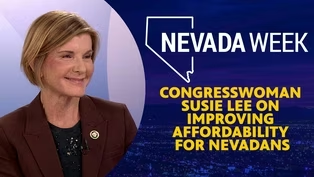
Congresswoman Susie Lee on improving affordability for Nevadans
Video has Closed Captions
Clip: S8 Ep21 | 15m 56s | NV Congresswoman Susie Lee discusses the work she’s doing on a wide array of subjects. (15m 56s)
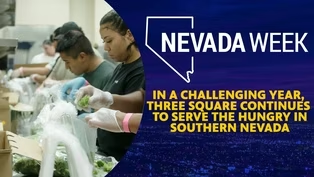
In a challenging year, Three Square continues to serve the hungry in Southern Nevada
Video has Closed Captions
Clip: S8 Ep21 | 9m 13s | Three Square Food Bank President and CEO Beth Martino sits down to discuss challenges. (9m 13s)
Providing Support for PBS.org
Learn Moreabout PBS online sponsorship
- News and Public Affairs

Top journalists deliver compelling original analysis of the hour's headlines.

- News and Public Affairs

FRONTLINE is investigative journalism that questions, explains and changes our world.











Support for PBS provided by:
Nevada Week is a local public television program presented by Vegas PBS