
Questions Surround Vegas Loop Project
Season 8 Episode 33 | 26m 46sVideo has Closed Captions
Vegas Loop faces safety questions and there is a new blood test for Alzheimer’s Disease.
The Vegas Loop is supposed to revolutionize transportation but concerns about oversight and safety are growing. A stand-alone art museum in Las Vegas is finally moving forward and a blood test for Alzheimer’s Disease a game-changer for patients and their families.
Problems playing video? | Closed Captioning Feedback
Problems playing video? | Closed Captioning Feedback
Nevada Week is a local public television program presented by Vegas PBS
Questions Surround Vegas Loop Project
Season 8 Episode 33 | 26m 46sVideo has Closed Captions
The Vegas Loop is supposed to revolutionize transportation but concerns about oversight and safety are growing. A stand-alone art museum in Las Vegas is finally moving forward and a blood test for Alzheimer’s Disease a game-changer for patients and their families.
Problems playing video? | Closed Captioning Feedback
How to Watch Nevada Week
Nevada Week is available to stream on pbs.org and the free PBS App, available on iPhone, Apple TV, Android TV, Android smartphones, Amazon Fire TV, Amazon Fire Tablet, Roku, Samsung Smart TV, and Vizio.
Providing Support for PBS.org
Learn Moreabout PBS online sponsorship(Amber Renee Dixon) Touted as transformative transportation, the Vegas Loop faces federal scrutiny for reported safety violations, plus... -For me, I looked at it and I said, this changes the world.
-Groundbreaking blood tests to help diagnose Alzheimer's disease.
How accessible is it, and what role UNLV played in its development, that's this week on Nevada Week.
♪♪ -Support for Nevada Week is provided by Senator William H. Hernstadt and other supporters.
-Welcome to Nevada Week.
I'm Amber Renee Dixon.
The Vegas Loop is a series of underground tunnels to transport people around Las Vegas via Teslas.
It's a project under Elon Musk's Boring Company and claims to have already transported more than 3 million passengers.
But as construction continues, concerns about oversight and safety have surfaced.
April Corbin Girnus of the Nevada Current has been covering these developments and joins us now.
April, welcome back to Nevada Week.
-Thanks for having me.
-Let's start with safety.
And among the reported violations, what are some of the more high-profile incidents that stand out to you?
(April Corbin Girnus) I think one of the most high profile ones that's happened there happened about a year ago, and it was two Clark County Fire Department firefighters received chemical burns while doing a training exercise down there.
And in addition to them, there were also other employees and workers that were down there that also reported having chemical burns, some of them quite severe and sort of maybe permanently scarring them.
-Okay.
So when workers are injured, or when someone is injured, OSHA will get involved, Occupational Safety and Health Administration.
And in this instance, it would be Nevada's OSHA.
What has happened with OSHA recently in Nevada that has drawn national headlines in relation to this case?
-So it's actually related to the firefighter incident, where, after that happened, state investigators with OSHA went into the Vegas Loop to look for-- to investigate and look at what was happening.
And they gave, they gave a citation and assessed about $400,000 worth of fines, saying that The Boring Company had had a willful violation, which is the highest level of-- It's the highest level of severity in terms of what they did wrong.
And then what happened after that is The Boring Company's CEO called someone in the governor's office, and then the governor's office facilitated at least two meetings.
And then shortly thereafter, like within 24 hours, OSHA Nevada pulled back and took away the violations and said, We're not going to do those anymore.
So they rescinded that.
And that has been widely debated and the sense of some controversy for that.
And that's where federal OSHA became involved.
They started to look into it, and then they recently released their findings that said that the State, Nevada State OSHA, was justified in rescinding and sort of pulling back those, that the legal justification for that willful violation status had not been met.
So they sort of cleared them on that front.
-Wow.
Okay.
So to recap, then, federal OSHA gets involved once they realized that Nevada OSHA had rescinded citations following meetings that had been set up between The Boring Company and the governor's office of Nevada and Nevada OSHA.
Okay.
But then says, You know what, they had every right to rescind those violations because of what?
-Oh, because the willful violation stand for, like-- There's a legal standard that they follow, that they have to meet certain requirements.
And it's something lawyers and stuff get very involved in.
And the OSHA, Nevada's attorney, did tell lawmakers that as soon as they looked at the file that sort of had the thing, that they recognized it immediately and said, This is not up to standard.
And so the federal OSHA kind of justified that.
And it's very technical in nature and stuff.
It's something that I think a lot of-- -Technicalities, I imagine, and exact language and what fits into that.
-And that matters a lot when it comes to situations like this.
-Okay.
So then the Nevada lawmakers who met following news of federal OSHA getting involved, will this decision from federal OSHA ease any of their concerns?
-You know, I don't think so.
I mean, even the attorney for the Nevada OSHA told the lawmakers that, Hey, I based my justification for rescinding this fine based off of what was in the paperwork that was filed.
But that doesn't encompass the entirety of the investigation.
There may be things that didn't get filed.
It could have been a paperwork issue rather than a actual violation.
She kind of left the door open to say, like, you know, this is a sort of technical issue that was addressed, that we addressed.
But that doesn't mean that the larger issues aren't still there.
And though this is focused on that one incident involving the firefighters, there are other injuries and other concerns with that related to workplace safety.
There was a crushing incident involving sort of a new, like an intern, I believe, who was sort of new to the industry.
Obviously, very dangerous situation there when you're dealing with huge construction equipment.
That's the boring tunnels and things.
But also with environmental protection and stuff.
So we're talking about a history that has hundreds of citations for environmental, and that's not hyperbole.
That's, I think, ProPublica had reported over a year ago that it was up nearly 800 citations related to the environmental concerns.
So it's an ongoing issue.
-What about the ability of The Boring Company to get a meeting with someone in the governor's office within a matter of days?
Is that typical for companies who have OSHA violations against them?
Are they able to have that access?
-You know, that's one of the questions that Assembly Member Howard Watts, who really led the charge in questioning some of the state administrators about this, he wanted to ask the governor that.
The governor's office declined to go to that legislative hearings, so they did not answer those questions.
But that was one of his questions was what-- or, Do you extend this to everybody who has a potential OSHA violation, or is this reserved for that?
And there's been a lot of reporting about how The Boring Company CEO, the person that he called in the governor's office was not the governor himself, but it was a director at the time who had previously worked for Tesla, which is, of course, also connected to Elon Musk and those sort of companies.
So there is some questions about, you know, favoritism there for certain companies.
-So the governor did not show up.
Did he say why?
And has he responded to allegations from Democrats that he's giving favors to big companies like Elon Musk's.
-He hasn't addressed that issue.
He did address the reporting about the meeting and the sort of suggestion that he may have had a role in that.
His chief of staff wrote a letter to the lawmakers declining the invite to their meeting and said that, We've already explained this, that all we did was facilitate a meeting between a company and administrators, and that's it.
That's nothing.
We've already explained this, this is fine, and that they sort of alleged no wrongdoing in terms of they say they've had no pressure on terms of telling OSHA and what to do, and all that they were was just a facilitator.
-Okay.
So the governor did not show up to that meeting.
Did anyone from The Boring Company?
-The Boring Company also did not show up to the meeting, much to the frustration and anger of the lawmakers that were there.
They also sent a sort of prepared statement to that where they offered-- They offered lawmakers tours of The Boring Companies, which offended Assembly Member Watts.
And he told me after the meeting that they need to not offer us tours; they need to offer us answers to these questions.
So they are frustrated with their lack of transparency about this whole thing.
-Okay.
And then Senator Fabian Donate said, quote, To what extent are we sacrificing our workers and our communities at the expense of our taxpayers to subsidize or support a company without essential oversight?
That was at that meeting, and it made me think, what is he talking about with taxpayer money?
There's no taxpayer money involved in this project.
-Yeah.
There is to-- It's not to the same level of something like Allegiant Stadium or the baseball stadium that's currently underway, but there is a relationship there.
The current tunnels that exist, about four miles of them, are all under the Convention Center, which, of course, operated by the Las Vegas Visitor Convention and Visitors Authority.
And they do have a financial and sort of relationship partnership with The Boring Company.
And they've also, aside from having stations at the Convention Center, they have also been huge cheerleaders of this.
I mean, you have directors of the LVCVA saying that this is a transformative project that's going to change the entire valley, and this is the future of Las Vegas.
So they're very big champions of that, which I think is what Donate is criticizing there.
It's not just a financial relationship; it is also just how much, how in bed do we want to be with this company when they have hundreds of outstanding violations and things like that going on?
-And the LVCVA was at this interim legislative meeting to defend, is that an accurate word, defend The Boring Company?
-Basically, they did.
You know, they, the director that appeared there said that, Hey, we have talked to Boring about this.
LVCVA said, We are going to take a more proactive approach to all of this and that though we don't have any legal responsibility for that--they were very clear on that front, you know, This is a Boring Company's construction--but we are going to, because we care so much, are going to be involved in sort of doing our own oversight and working with that.
So they, they've said-- They've tried to calm down the concerns and say that, Hey, Boring is on board.
They know they need to improve upon their safety.
We also want that, and we're all on the same page.
-Lastly, Elon Musk owns The Boring Company and has said what about environmental violations in the past?
-Yeah.
There's a quote that floated around.
It's on YouTube.
It's a-- It's a-- It's out there.
He, Elon Musk, has said that he has been very critical of environmental protection process.
So I think the quote goes something like, We always have to ask for permission to do everything.
And that system is faulty, and I don't think it should work like that.
I think it should, we should be able to do what we want.
And if we mess something up, then we'll pay a fine, we'll fix it, but don't let me ask for permission first, which I think for lawmakers is very troubling, because they don't want these violations and these safety concerns to be just the cost of doing business in Nevada.
They want upfront transparency.
They want to follow the law and then reduce any sort of incidents.
-April Corbin Girnus of Nevada Current, thank you for joining Nevada Week.
-Thank you.
-We move now to health news.
According to the Alzheimer's Association, early diagnosis of Alzheimer's disease improves your chances of benefiting from treatment.
But getting that diagnosis can be costly and time consuming.
That's why researchers at UNLV are so excited about a new blood test to help diagnose the disease.
Those researchers provided data that helped earn FDA approval of the test last year, and Nevada Week spoke with them about the breakthrough in this month's "Your Brain Health Matters."
♪♪ (Dr.
Jeffrey Cummings) For me, I looked at it and I said, this changes the world.
Because until now, the diagnosis of Alzheimer's disease has been just based on clinical interview, which is often wrong or very expensive brain scans.
And all of a sudden we had a blood test for Alzheimer's disease.
And that would have been unimaginable even five years ago.
And I think an important aspect of this is it's approved for people who have symptoms that are consistent with Alzheimer's disease.
So somebody who is 65 years old and feels like their memory is failing or their spouse thinks that their memory is failing, that's the appropriate candidate for this, for this blood test.
So it has a reasonably specific indication of people who have beginning mild symptoms, and they are also the ones who are candidates for the new treatments.
So there's a very important relationship between the blood test and the availability of the new treatments.
-The candidates you are talking about, how likely is it that they are going to their doctors and being prescribed to take this test?
Or is that a year down the road, years down the road, where that becomes commonplace?
(Dr.
Jefferson Kinney) Yeah.
I think that it's starting to happen now and is going to steadily increase.
As news of its approval came out, there's a lot of physicians that are trying to determine how and when to use it.
But I think over time, we're going to see a really, really large increase.
-And I think it's important to say that it's slow to change behavior in a healthcare system.
So it will be a while before this becomes a routine part of practice in the way that it should be.
And there's also still some clarification that's needed on the reimbursement for the test.
It's so new that we don't know exactly how CMS is going to reimburse it, that is Medicare, and we don't know how insurance companies are going to regard it.
-What can speed that process up?
-Information about what the test can do, information about how it can be used, and the adoption.
The more that the research community advances the information about this, the better.
But it's really going to come, as Dr.
Cummings highlighted, it's going to come down to how readily are people going to deploy it in their clinical practice?
-And I think the educational strategies, like the one we're doing right now with Vegas PBS, is so important because we have to get the word out, both to families and to early patients and to their doctors so that this becomes a part of the conversation of what health care of older individuals is about.
-Well, and that's what I was wondering.
If there's someone watching at home who thinks their parent perhaps could use this test, do they need to go to that doctor themselves and say, Hey, are you making this available?
How can we get this test?
Would that help?
-Absolutely, yes.
That's really what we need, because we know that the doctors are so busy and they're being asked to do so many things, that the patient has to be their own advocate.
And advocating for this blood test is an important part of the health care interchange for someone who has a memory impairment.
-Can you describe the physical process of this test?
-Yeah.
So everybody goes to their physician every year, hopefully, and they have a blood draw done.
And it's simply taking the blood that's drawn normally by a physician, and it goes through about three different processing steps and then directly into a well-established protocol.
And what comes out is basically a reading on two plasma-based biomarkers, which is just a fancy way of seeing two targets that are in the blood and the amount that's there.
And those two put together equals a score.
And where that score lands equals positive for Alzheimer's disease, negative in a very small indeterminate zone that needs a little bit more testing.
But it's very, very straightforward.
It's very cost-effective, and probably its best feature is that hundreds can be done in a day, as opposed to other methods that preceded this that it took long durations to get a test scheduled.
It took a long time for the processing.
This is very quick, very rapid, and very deployable.
-And then what happens once someone is found to be positive for Alzheimer's?
-I think at that point the interaction is to begin discussing the treatment options and what would be required for these treatments.
The new treatments that we have for patients with early disease are complicated, and they require confirmation with MRI beyond the blood test, for example.
And so the patient has to be willing, and the family has to be willing to enter the therapeutic contract.
And so that discussion begins at the time that the blood test is positive.
So that's the start of the journey that the patient might be on for therapy.
-Down the road, could someone get this test without being 65 years old, just for their own sake to know?
Do you foresee it getting that advanced to be able to predict far ahead?
-Well, I think that's our dream, that someone would come in and get an annual blood test, probably beginning around age 50, and if it changed and we know that the blood test changes before the patient gets symptoms.
So at that point, we hope to have drugs available that will be able to prevent the emergence of Alzheimer's disease.
Right now we have drugs to treat Alzheimer's disease, but not to prevent the occurrence of the symptoms of the disease.
But we're working on that already.
So what we want is to have the test administered, to have the therapy administered, and for people never to have Alzheimer's disease.
-Dr.
Cummings says he hopes the blood tests will get patients into clinical trials quicker and at a lower cost.
He says a scan for Alzheimer's can cost $6,000; whereas, a blood test can cost between $300 and $500.
To watch more from our series, "Your Brain Health Matters," go to our website, vegaspbs.org/nevadaweek.
And now to art and efforts to establish the very first stand-alone fine arts museum in Las Vegas.
Organizers aim to open the Las Vegas Museum of Art in Symphony Park in 2029.
The project is expected to cost $150 million.
Before passing away in 2025, esteemed business woman, philanthropist, and arts patron Elaine Wynn called this museum a personal legacy project.
A long-time donor to and board member of the Los Angeles County Museum of Art, also known as LACMA, Wynn enlisted LACMA to help develop the Las Vegas museum.
Heather Harmon is its executive director, and in a recent interview shared how this partnership came to be.
(Heather Harmon) The project really was galvanized in the end of 2022 where LACMA was accomplishing such major milestones, including fundraising milestones, that it just felt like now is the time to advance the Las Vegas Museum of Art.
-And there has been some pushback from LACMA, the Los Angeles County Museum of Art, from its patrons.
Why are you going to take funding and its artwork and bring it to Las Vegas instead of keeping it in Southern California?
-So we're not taking funding.
We're partners.
So the Las Vegas Museum of Art is autonomous.
It has a separate board, a separate governance structure.
We fundraise for our efforts.
-And you're still fundraising, right?
-We are still fundraising.
But what will work with LACMA is a deep partnership that really stems from programming.
LACMA is the largest institution in the Western United States.
They have over 140,000 works of art to share.
And by and large, most museums cannot even show a fraction of their collection at any given time.
And so part of LACMA's mission is to expand access to art.
And this expansion of access and accessibility was something that really resonated deeply with Elaine and especially in this community.
And that means that we can design exhibitions that are specifically for our community.
And in addition to the programmatic threads, we can also learn from their guidance on educational programming.
We can adapt programs to our community.
And something they do very beautifully that I think is important for us to recognize is not everyone can come to you.
And so how do you go out in the community?
And how do we, as an institution, partner with schools, educational institutions, and bring the museum to a classroom?
So we're really excited to have their leadership and their guidance and that stewardship so that we can turn that inward to our community and give that same level of care.
-What are your thoughts when you hear people say, I'm not sure the Las Vegas community will support an art museum?
-I think that the Las Vegas community has expanded well beyond anyone's wildest dreams.
We have accomplished so much.
I think one of the things that we don't yet do in the way that we can is celebrate.
We are a young city, and everything we've done as a young city is extraordinary.
And I think the more we grow, and I know this is very important to our mission, is that we give this cultural grounding to the millions of people that make the magic of Las Vegas happen.
And so I think very intentionally, we wanted to be in Symphony Park.
And Symphony Park, to us, is that space where you have the Philharmonic and you have the ballet and you have the Discovery Children's Museum and the Smith Center, which is such a beacon for us all.
That is a perfect space to have a museum to complement the cultural amenities that are flourishing in our community, and we should be bringing more.
-Elaine Wynn has said this is going to be her legacy.
What does that mean to you?
What kind of expectations does she have, did she have?
-Elaine was so extraordinary.
She really valued education, and she valued this community.
And we love to continue that people-forward, that caring space that she created.
And we want to see that legacy unfold.
We want it to be represented in the architecture.
We want it to be represented in how welcoming the institution is, and we want it represented in the level of care that we give to our community, a community that she loved so much.
-Tell me about the architecture.
Did she have her fingerprints on that?
It's beautiful.
-She did.
She selected the most extraordinary value and mission-aligned architect that we could-- -So she selected him?
- --ever have dreamed of.
Elaine, along with the board, chose Francis Kéré to design the building.
And Francis is a Pritzker laureate, which is essentially the highest level of award you could receive in excellence for architecture.
He is from Burkina Faso in Africa, and he lives and works in Berlin.
But he really started his career building schools and education spaces and spaces for people and spaces for community.
And he had such a strong sustainability grounding.
And he's such an incredible listener, that the architecture itself is a response to our community.
When he came on his first visit to Las Vegas, he just saw so many things, from Hoover Dam to Valley of Fire to Red Rock to the Guardian Angel Cathedral.
He had this amazing sense of absorption of Southern Nevada, and specifically Las Vegas, because it was his intent to build a building that we would feel we could see ourselves in.
-Did he know about the architect behind the cathedral?
-So he, when he came, it was his first visit to Las Vegas, and we were able to share with him the history of Paul Revere Williams, which he immediately responded to.
And Paul Revere Williams is such an icon of modernist architecture.
And for us to have such a significant work of his here in Las Vegas--and that is a space that we take visitors--and we enjoy giving tours of it.
And I think when people see it, they are, it's unexpected.
They get a different perspective of Las Vegas.
And Las Vegas is such an image.
Everybody globally has an idea of what Las Vegas is.
And I think what a cultural institution has the possibility of doing is writing that story for us, is giving us a space and a place where we can message out who we are, and we can start to participate in the narrative.
-Groundbreaking on the Las Vegas Museum of Art is set for 2027 with a grand opening in 2029.
To learn more about the museum or any of the other resources discussed in this show, go to vegaspbs.org/nevadaweek.
And I'll see you next week on Nevada Week.
♪♪♪
New Blood Test for Alzheimer’s Disease Offers Quicker, Cheaper Diagnosis
Video has Closed Captions
Clip: S8 Ep33 | 7m 37s | New Alzheimer’s blood test speeds diagnosis, backed by UNLV Brain Health research data. (7m 37s)
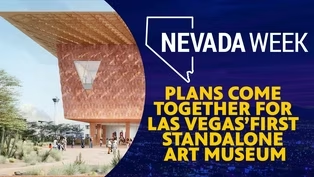
Plans Come Together for Las Vegas’ First Standalone Art Museum
Video has Closed Captions
Clip: S8 Ep33 | 7m 33s | Las Vegas’ first standalone art museum advances as Director Heather Harmon details the vision ahead. (7m 33s)
Video has Closed Captions
Clip: S8 Ep33 | 10m 25s | Vegas Loop aims to transform Las Vegas transit, but safety and oversight concerns persist today now. (10m 25s)
Providing Support for PBS.org
Learn Moreabout PBS online sponsorship
- News and Public Affairs

Top journalists deliver compelling original analysis of the hour's headlines.

- News and Public Affairs

FRONTLINE is investigative journalism that questions, explains and changes our world.











Support for PBS provided by:
Nevada Week is a local public television program presented by Vegas PBS