
October 13, 2026 - PBS News Hour full episode
10/13/2026 | 57m 46sVideo has Closed Captions
October 13, 2026 - PBS News Hour full episode
October 13, 2026 - PBS News Hour full episode
Problems playing video? | Closed Captioning Feedback
Problems playing video? | Closed Captioning Feedback
Major corporate funding for the PBS News Hour is provided by BDO, BNSF, Consumer Cellular, American Cruise Lines, and Raymond James. Funding for the PBS NewsHour Weekend is provided by...
October 13, 2026 - PBS News Hour full episode
10/13/2026 | 57m 46sVideo has Closed Captions
October 13, 2026 - PBS News Hour full episode
Problems playing video? | Closed Captioning Feedback
Where to Watch PBS News Hour
PBS News Hour is available to stream on pbs.org and the PBS app.
Providing Support for PBS.org
Learn Moreabout PBS online sponsorshipGEOFF BENNETT: Good evening.
I'm Geoff Bennett.
AMNA NAWAZ: And I'm Amna Nawaz.
On the "NewsHour" tonight: The U.S.
ambassador to Greece is forced out, as a new press secretary starts at the White House.
The latest on shifts within the Trump administration.
GEOFF BENNETT: The conflict between Saudi Arabia and Yemen's Houthi rebels escalates, with new strikes on oil facilities.
AMNA NAWAZ: The Vatican announces Pope Leo has lung cancer.
What we know about his diagnosis.
GEOFF BENNETT: And we check in with a 96-year-old grandmother traveling the world with her grandson.
JOY RYAN, Grandmother of Brad Ryan: Hey, never say no.
Somebody asks you to go somewhere, grab your bag and go (BREAK) AMNA NAWAZ: Welcome to the "News Hour."
On her first day at the podium, the new White House press secretary, Katie Zacharia, made news.
GEOFF BENNETT: That was by announcing that President Trump had asked Kimberly Guilfoyle, his ambassador to Greece, to resign.
The move follows allegations that Guilfoyle asked the political donor to pay a $100,000 credit card bill in exchange for access to senior administration officials.
Our White House correspondent, Liz Landers, was at the briefing today and joins us now.
So, Liz, the news of the Guilfoyle resignation operates on two levels.
There's what led to the resignation and the fact that President Trump was willing to part ways with this official, when he has so often stood by others accused of using their public office for personal gain.
What more should we know?
LIZ LANDERS: This was a surprising announcement today from this new White House press secretary, who made this announcement from the podium, and then two hours later, on social media, Ambassador Guilfoyle confirmed that she was resigning.
She wrote that she called the allegations against her false and said that "I intend to vigorously defend my name, my reputation, and my integrity."
She went on to say: "I will not allow false accusations to define my decades of public service."
She also said that she will continue to support President Trump.
But all of this comes in light of that bombshell Wall Street Journal reporting that came out last week that said that Guilfoyle had engaged in possible improper conduct.
Most notably of that was a political donor who said and accused her of trying to bribe him to pay off a $100,000 credit card statement.
And she promised him access to administration officials if he did.
The president was asked about this on his way out of the White House today.
And he said "I didn't like what I was reading" about what Kim Guilfoyle had been doing.
But this may not be over for Guilfoyle, though.
PBS News obtained last week this letter from the Democrats -- the top Democrat on the House Oversight Committee, who had already sent her a letter saying, please preserve your records related to this, and saying that they wanted to investigate this.
GEOFF BENNETT: And, of course, we learned about her parting ways with the administration, her resignation, by way of a very brief White House briefing today, the debut of the new press secretary.
You were there.
Tell us about it and the new press secretary.
LIZ LANDERS: Yes, so Katie Zacharia is most recently an adviser to the Trump Media and Technology Group, which runs the president's social media company, TRUTH Social.
She's also worked briefly at the Department of Homeland Security.
She's also been a frequent conservative commentator on FOX News and sometimes on CNN.
And she's been an ardent defender of President Trump, and she is a MAGA loyalist.
She has promoted the falsehood that the 2020 election was stolen.
And CNN also found some now deleted social media posts of hers making baseless accusations about Democrats being engaged in pedophilia.
GEOFF BENNETT: And what else stood out from her briefing?
LIZ LANDERS: It was only 14 minutes long, and she only took a handful of questions towards the end.
Zacharia says that she sees her job as highlighting the administration's policy wins for the American people and promoting the president's message.
KATIE ZACHARIA, White House Press Secretary: My goal is to be able to communicate that in complete tandem with the president, as he is his own best spokesperson and will absolutely be leading the way as with that.
LIZ LANDERS: President Trump, as they left the White House, was asked what he thought about her performance at the podium.
He said he thought she did a great job.
And in that exchange, he was also asked about her credentials.
She says that she has been an attorney, and she had to kind of clarify and explain that she has been a practicing lawyer in China before, but she does have her law degree from Pepperdine's law school.
I want to ask you as we wrap up our conversation here about this moment last night.
It was at a Trump rally in Ohio.
There was a protester.
You see her there physically assaulted, physically assaulted by a man, by the way.
And rather than condemn the violence, the president mocked the protester.
That's hard to watch.
I mean, what more do we know about what happened?
LIZ LANDERS: We're increasingly seeing these protesters interrupting the president's midterm rallies, and this happened yesterday in Youngstown, Ohio.
That woman was wearing a shirt that said 'Release the Epstein Files."
And right beside her, this man starts punching her, hitting her directly in the face before law enforcement steps in.
Something like this also occurred in San Antonio, Texas, last week at another Trump rally, where protesters were getting beat up.
And actually the sheriff there put out an announcement and said if anybody has any information about these people that were potentially assaulting protesters, please come forward.
GEOFF BENNETT: All right, Liz Landers, our thanks to you, as always.
LIZ LANDERS: Of course.
GEOFF BENNETT: The threat of a wider war in the Arabian Peninsula is growing tonight.
Houthi rebels in Yemen are once again targeting Saudi military installations and critical infrastructure, raising fears of a broader regional conflict that could draw in other powers.
AMNA NAWAZ: The Saudi-led coalition launched new airstrikes on oil facilities across Houthi-controlled Yemen in response to a deadly attack on an international airport in the Saudi capital of Riyadh.
That attack over the weekend killed at least 13 people and wounded more than 300.
Ali Rogin has this report.
ALI ROGIN: Today in Yemen's principal port city on the Red Sea coast, plumes of smoke engulfed blue skies, all part of a Saudi-led bombing campaign targeting Houthi-controlled territory and oil facilities.
And, in Eastern Saudi Arabia, loud booms echoed in the night skies.
Saudi officials said fragments of an intercepted missile launched by the Houthis fell in a residential area.
This follows weekend attacks by the Iran-backed Houthis that turned a crowded airport in Riyadh into chaos.
Saturday's attack at King Khalid International Airport killed at least 13 people and injured more than 300, among the dead, an Egyptian flight attendant who was 28 years old and a Jordanian father of two who worked at a coffee shop inside the airport.
His father called the death an indescribable loss.
HASSAN AL-BARQAWI, Father of Airport Attack Victim (through translator): I hope that no other human being ever experiences what I have gone through, because no one can understand this loss except the one who has suffered it.
ALI ROGIN: For Saudi Arabia, the failure of its air defenses to intercept the incoming missiles and drones has further raised fears and questions on how far the kingdom is prepared to go in response, a sentiment the Saudi energy minister echoed yesterday.
PRINCE ABDULAZIZ BIN SALMAN, Saudi Arabian Energy Minister: The events of recent weeks are serious.
Our response must be equally serious.
For Saudi Arabia, these circumstances have tested our infrastructure, our institution, our people, and our resilience.
ALI ROGIN: Earlier today, the Houthis renewed their warning against using Saudi airspace, calling the country the -- quote -- "kingdom of the horn of Satan" and released footage allegedly showing attacks on Saudi-backed government forces northeast of Yemen's capital, Sanaa.
Saudi allies, including Turkey, called for the Houthis to immediately halt such strikes.
RECEP TAYYIP ERDOGAN, Turkish President (through translator): Turkey stands with Saudi Arabia and its Saudi brothers in the face of unlawful and inhumane attacks.
ALI ROGIN: Turkey's President Recep Erdogan also said he would submit a defense pact struck among Saudi Arabia, Turkey, and Pakistan to the Parliament for ratification in the coming days.
This comes as Saudi Arabia is pushing Washington for more direct military support.
DONALD TRUMP, President of the United States: The Houthis have acted very badly.
ALI ROGIN: Today, President Trump weighed in, saying he talked with the Saudi crown prince.
QUESTION: Did you speak to the Saudi crown prince?
DONALD TRUMP: I did, yes.
I spoke to him.
ALI ROGIN: And what did you offer him?
DONALD TRUMP: Well, I can't tell you that.
Do you really think I could tell you that?
I'd love to tell you, but I'm not going to tell you that.
ALI ROGIN: But the U.S.
has stopped short of sending military assets to attack Yemen, which could further threaten shipping through the Bab al-Mandab, a vital shipping route and southern gateway to the Red Sea that is especially key for oil exports from Saudi Arabia, which the Houthis have targeted.
In the meantime, as threats grow, the consequences are already visible, a Yemeni town engulfed in smoke, an airport turned to rubble, and mounting funerals for civilians caught in the crossfire.
For the "PBS News Hour," I'm Ali Rogin.
AMNA NAWAZ: For perspective on the escalating war between Houthis in Yemen and Saudi Arabia, we turn now to Michael Ratney.
He served as U.S.
ambassador to Saudi Arabia during the Biden administration.
He's now a senior adviser at the Center for Strategic and International Studies.
Ambassador, welcome back to the show.
It's worth reminding people there was actually an informal cease-fire in place between the Saudis and the Houthis in Yemen until just July of this year.
What do you make of how dramatically and how quickly this conflict has escalated?
MICHAEL RATNEY, Center for Strategic and International Studies: So what began as a six-month truce a few years ago was extended into a de facto cease-fire really until just a few months ago, as you point out.
And it seems as though, at that point, the Houthis, who had more or less been in abeyance since the start of the Iran war at the end of February, got into the fight.
The Iranians were helping them, seemingly transporting advisers and weapons.
The Saudis felt they needed to respond.
The Houthis, in a sort of lightning campaign, took coastal positions on the Bab al-Mandab that threatened shipping of oil.
It threatened Saudi energy infrastructure.
And from there, things have just deteriorated badly.
AMNA NAWAZ: It's also worth pointing out Saudi Arabia is the largest customer for U.S.
arms exports.
They spend tens of billions of dollars for U.S.
warplanes and air defense systems.
Why have they not been able to intercept or repel these Houthi attacks?
MICHAEL RATNEY: So the Saudis have considerable air defenses, a lot of it U.S.-origin Patriots, for example, but it's stretched thin.
You can imagine they're prioritizing their energy infrastructure, which is still the lifeblood of their economy, and they need more.
And the Houthis are able to attack in a very asymmetric way, sometimes in ways that defy conventional air defense systems.
So they do have air defenses.
They need more.
And that attack, that brutal attack on the airport just a few days ago, is really evidence.
AMNA NAWAZ: You were just in Saudi Arabia recently.
What was the mood on the ground there?
MICHAEL RATNEY: So I was there last week, and there was a first attack on the airport the day after I got there, and it created some anxiety.
And then this really horrific attack in which multiple people died and many, many casualties was the day after I left.
And you had the sense that the Saudi people were, on the one hand, in solidarity.
They were angry at what the Houthis were doing, but I think they were somewhat anxious about the direction of this conflict.
It's one thing for the Saudis to strike Houthis targets in Yemen, which they're doing in force today, but it's pretty clear that the Houthis have this ability to respond asymmetrically in really, really horrible ways, not just attacking infrastructure, but really targeting civilians, trying to murder civilians in Riyadh and elsewhere.
AMNA NAWAZ: You heard President Trump there say he's been in contact with Saudi Crown Prince Mohammed bin Salman.
He said he's weighing joining in on this fight.
There's also reporting that he rejected a request from Mohammed bin Salman last month to do so.
What do you see happening here?
Do you see the U.S.
joining in this fight?
MICHAEL RATNEY: So I sense the Saudis are pretty frustrated.
We and they have invested decades in this military partnership, and one of the expectations is, when the chips are down, when the country is under attack, that the U.S.
would support them.
Now, there's credible reports that the U.S.
is offering some assistance in the form of intelligence sharing or targeting and planning.
But what the Saudis really want and need are U.S.
airstrikes that can seriously degrade the Houthis' ability to launch these strikes.
Trump has been ambivalent about that.
The president at times has said that he's supportive of the Saudis, but it seems like, either because of limitations on U.S.
military capacity or because, as a political matter, he doesn't want to open another front in the war, he's been really reluctant to get involved further.
AMNA NAWAZ: What are the Saudi options for dealing with the Houthis at this point and what has to happen in order for this conflict not to escalate further?
MICHAEL RATNEY: There's no real good options at this point.
This was the inevitable, predictable escalation of the Iran war that started months ago.
And I think the Saudis and others in the Gulf knew that this would happen eventually.
The Houthis, although in some sense are a proxy of the Iranians, are also quite independent-minded or are not necessarily controlled by them.
So I think for the moment the Saudi options are take the gloves off, and they're doing that with some concerted airstrikes against the Houthis.
But I think ultimately they have to get back to some kind of uncomfortable, imperfect diplomacy to de-escalate this, because the implications not just for global energy markets, for the Saudi economy, for the Saudi public, are pretty dire.
AMNA NAWAZ: That is the former U.S.
Ambassador to Saudi Arabia Michael Ratney joining us tonight.
Ambassador, thank you so much for your time.
MICHAEL RATNEY: Any time.
GEOFF BENNETT: The Vatican says that Pope Leo has lung cancer and that doctors removed the lower lobe of his right lung today in a surgery that lasted roughly 90 minutes.
In a statement, the Vatican called the operation successful and said there were no complications.
For more on the pope's prognosis, we're joined by Dr.
Omer Awan.
He's a radiologist and a senior public health contributor for "Forbes."
Thank you for being with us.
First, explain what particular type of lung cancer this is and how serious the diagnosis this is.
DR.
OMER AWAN, Radiologist: Sure, Geoff.
So the pope was diagnosed with adenocarcinoma.
That's the most common type of lung cancer.
It produces some substances in the lung like mucus, for example.
This cancer can be seen in both smokers and nonsmokers.
I'm somewhat optimistic about this because they did say that it was localized.
It was a localized form of lung cancer.
And that means presumably it hasn't spread to other parts of the body.
We don't know that definitively, but presumably that's what that means.
And also the size of this lesion, we know, before it was removed, it was a nodule.
By definition, a nodule is three centimeters of size or less.
A mass would be greater than three centimeters.
So those are all positive features of this lung cancer.
GEOFF BENNETT: Is removing an affected portion of the lung, is that curative, or would someone with this diagnosis typically need treatment, such as radiation or chemotherapy?
DR.
OMER AWAN: That, Geoff, will really depend on some of the features that we see on pathology, which is the report that's given once they have run tests on the tumor once they have removed it.
So, for example, were the surgical margins clear?
And what we mean by that is, is there any residual tumors still left in the lung after they have removed it?
Has it spread to other parts of the body?
That's going to be important because that would be an ominous sign.
And also the biological characteristics of the tumor, some features can increase the risk of recurrence.
So all that information really needs to be seen and understood before we can really understand the prognosis of the tumor.
And that will be given once the pathology report is seen.
GEOFF BENNETT: The pope is 71 years old.
He maintains a demanding schedule, to say the least.
What does recovery from this type of surgery typically involve?
DR.
OMER AWAN: Well, they have removed one lobe of the lung, and the right lung has three lobes.
So they removed one out of the three lobes.
So that can certainly reduce the function and capacity of the lung, but the lung does compensate and expands with time.
So initially the pope is going to deal with just walking around, eating, making sure he can go to the bathroom.
But then, with time, after a week or so, they will have to work on his lung function, breathing exercises, his stamina.
Leaving the hospital is very different than fully recovering, because he does have a very demanding schedule.
So he may leave the hospital, but he may not be fully recovered.
And that's going to take weeks, perhaps even months, depending on his underlying health and his underlying lung function and stamina, as he does more breathing exercises with his medical team.
GEOFF BENNETT: Dr.
Omer Awan, thank you for being with us.
We appreciate your insights.
DR.
OMER AWAN: My pleasure.
Thanks.
AMNA NAWAZ: We start the day's other headlines in New York.
Cornell University is banning parties and other social events at fraternities for the rest of the academic year.
The Ivy League school is also giving state police a role in investigating sex crimes on campus, among other measures.
Cornell's president says the steps are aimed at providing time to evaluate whether Greek life there can continue and to find out what he called safe social alternatives.
The school has faced an uproar both on campus and around the country over its handling of allegations that a female student known as Jane Doe was gang-raped at a fraternity house in 2024.
All seven men she's accused have denied any wrongdoing.
In Georgia, police have identified the man who fell to his death while riding a roller coaster at a Six Flags amusement park outside of Atlanta; 42-year-old Hassan Jihad Ibn Kariem was an employee at an Atlanta charter school, according to local school officials.
He was found unresponsive when investigators arrived on the scene yesterday afternoon at the Goliath.
That's the tallest roller coaster at Six Flags Over Georgia.
Authorities say his body struck and injured other riders despite efforts by fellow passengers to save him.
WOMAN: He turns, sideways and he's flipping in the air.
He comes down.
He slams down on our cart.
People reached out trying to grab him.
Like, everybody tried to save this man.
And we couldn't.
Like, we couldn't.
MAN: We literally could not.
There was no -- there was too much force to grab him.
AMNA NAWAZ: Aerial footage shows people on the next train evacuating mid-ride.
Six Flags says it is temporarily closing a number of similar roller coasters across the U.S.
and Canada as a precaution.
The U.S.
Supreme Court says it will hear a case over access to DOGE records.
A watchdog group argues that the agency, once run by Elon Musk and officially known as the Department of Government Efficiency, should be subject to Freedom of Information Act requests.
The Trump administration says it is exempt from that access as a presidential advisory body.
Oral arguments are expected early next year.
Also today, the court said it would consider whether a Nigerian man who cooked for terrorists can be denied asylum in the U.S.
The case could expand how officials view what counts as terrorist activity under U.S.
immigration law.
In Las Vegas, a former gang leader was sentenced to 40 years to life in prison today for orchestrating the murder of rap icon Tupac Shakur in 1996.
WOMAN: The world never forgot about him and his death, and neither did Las Vegas.
It took us 30 years, but, at this time, you are going to face justice for what you did on September 7, 1996.
AMNA NAWAZ: Duane "Keffe D" Davis showed little emotion in court as the judge delivered his sentence.
The 63-year-old was convicted of first-degree murder in August.
Shakur was the victim of a drive-by shooting off the Vegas Strip and later died in a hospital.
Until Davis was arrested in 2023, the murder was one of the nation's most notorious cold cases.
And legal questions remain over who actually pulled the trigger.
A bipartisan group of senators is condemning President Trump's diesel deal with Russia.
In a letter to the president, six Republicans and six Democrats write that -- quote -- "This deal is a gift to our adversary and a betrayal of our allies.
It should be rescinded."
Last week, President Trump said Russia would -- quote -- "immediately supply diesel fuel to global markets," including the possibility of the U.S.
In their letter, the senators argued that this would have a negligible impact on energy prices and would instead help to fuel Russia's war machine.
In France, police and protesters clashed today as demonstrators once again took to the streets to call for improvements to the country's education system.
In Paris, authorities used water cannons and tear gas to try to clear the crowds.
The country's Interior Ministry estimates that more than 160,000 people took part in demonstrations nationwide today.
The protests started last month over a lack of staff and poor school conditions.
Since then, hundreds have been injured and the police have made thousands of arrests.
The U.S.
Treasury Department is fining Bank of America $1.2 billion over alleged money laundering and sanctions violations.
The penalty is the third largest in the department's history.
Officials say the bank failed to report billions of dollars in suspicious transactions.
A company spokesperson said in a statement that -- quote -- "Financial crime compliance is serious" and that the bank is working on getting it right.
In the meantime, it was a lackluster day for stocks on Wall Street as the first batch of quarterly earnings rolled in.
The Dow Jones industrial average slipped nearly 200 points.
The Nasdaq fell about 40 points.
The S&P 500 ended virtually unchanged.
And NASA's Perseverance rover is now the robotic record holder for driving farther on Mars than any other vehicle.
As of this week, the six-wheeled scientist has traveled more than 28 miles, as seen in this animated NASA map.
It took Perseverance less than six years to beat the prior record, which was set by the Opportunity rover, which took nearly 15 years to travel about the same distance.
Scientists credit the latest rover's self-driving capabilities for its success, and it's not done yet.
Still to come on the "News Hour": why the rules for so-called Trump Accounts for kids are raising eyebrows; food banks struggle to fill the gap left by the Trump administration's cuts to food stamps; and climate change gives an unexpected boost to Swedish wine.
The Treasury Department has now created Trump Accounts for every eligible child, automatically enrolling more than 60 million children.
That adds to the roughly seven million children whose parents already opted in since the program launched this July.
But the expansion also comes with changes to how the program works.
Donors can now donate individual stocks to the accounts, stocks that families can't choose or reject and must keep for five years.
Direct donations can also be made to specific groups of children based on location or age.
For more on all of this, I'm joined now by Wall Street Journal reporter Richard Rubin.
Good to see you.
Thanks for being here.
RICHARD RUBIN, The Wall Street Journal: Hi.
Thanks for having me.
AMNA NAWAZ: So how different are these new rules, these changes that came with the enrollment expansion from what was originally in place with Trump Accounts?
RICHARD RUBIN: Oh, they're totally different.
So, auto-enrollment really expands this program and makes it a universal savings account for kids.
So parents who didn't sign up originally who may not have wanted one or didn't know about it, everyone is now in it, so it's universal for kids with Social Security numbers.
And then the stock donations are also a big change.
The original idea and what Congress had written was that this money was going into low-cost index funds, and that's what parent contributions and employer contributions still go into.
But now you have these donors who are able to put in individual stocks and keep them in there for five years.
AMNA NAWAZ: And just to clarify, when we say donors here, who are we talking about?
RICHARD RUBIN: So money has to go through a nonprofit and the Treasury Department has to approve any money that can come in.
But what everyone is expecting is for wealthy individuals to do this.
So we have seen this happen with cash donations.
Michael Dell and his wife, Susan, have donated more than $6 billion dollars in $250 chunks.
Those are cash donations, not stock donations.
But Treasury officials have said that they expect more of those to come and that the change to stock donations will encourage some of those donors who might not have otherwise given.
AMNA NAWAZ: Well, so this is part of the argument from the Treasury Department, right, that it will incentivize private donors and companies to contribute more.
They also say that these kind of automatic enrollment benefits children in lower income groups.
Is there evidence of that?
Is there data to back it up?
RICHARD RUBIN: Yes, there's definitely been data over time in that lower-income households may be more confused by this financial product, may not know about it, and may not -- may be busy with other things and not necessarily enrolling their kids.
And so the automatic enrollment is something that I think has been sought on the left and the right.
I think, for progressives, they really see auto-enrollment as a way to expand access for lower-income households to make sure every kid has starting with something in an investment account that turns into an IRA.
For conservatives, I think it ends up being much more of a wealth-building, financial literacy kind of teaching moment.
And that's, I think, what's drawn donors and support from lawmakers on that side.
AMNA NAWAZ: I want to ask you more about these individual stock donations.
Now, as we mentioned, the families have to keep these stocks.
They can't choose them.
They can't reject them.
They have to hold them four or five years.
The Treasury Department says this is going to help families to feel more invested in the companies.
What do the experts you talk to say about this and what could be problematic here?
RICHARD RUBIN: Yes, so there are definitely some concerns that have come up.
The Treasury Department has signaled that they're open to rules that might allow opt-outs and they have asked for comments on those.
But for now, there are no opt-outs.
And so you have some odd situations that could emerge.
The Treasury Department really did say the goal of this was to encourage more donations because they wanted kids and their families to have a stake, not just in America broadly, investing in America, but really in these particular companies.
RICHARD RUBIN: So you could imagine a whole bunch of scenarios.
We can go through some.
AMNA NAWAZ: Well, what are some of those scenarios?
RICHARD RUBIN: So, you could imagine something where it becomes part of a political or policy debate.
If a company is able to ensure that every 9-year-old in a particular state owns a share of their company, then when the state says we want to increase regulations, we want to raise your taxes, you could see companies or CEOs dangle this as an incentive or a reward.
So, say a company is trying to get approval for a data center.
They could say, oh, well, if you approve this, we will put two shares of stock in every kid's account in the town, and which auto-enrollment allows them to reach more broadly.
And I think you also will have issues with conflicts of interest for -- again, because it's so broad and automatic, for federal regulators, state regulators, people who have policies and rules at their employers that prevent their minor children from owning stocks in entities that they're responsible for now may have those.
And so there's a number of things that will come up and that may come up and that the Treasury Department is going to have to think about as these roll out and as they approve each of these donations.
AMNA NAWAZ: Since the Trump Accounts launched through to the automatic enrollment expansion that was earlier in October, there were only about seven million sign-ups, as we mentioned.
What do you make of those numbers?
I mean, I know this is a new kind of program, but was that low?
Do you feel like there's hesitation in signing up for these?
RICHARD RUBIN: So it was relatively high in one subgroup, which is families that have newborns, kids born from 2025 or 2026, because the accounts come with $1,000 from the government if you open it up.
And there was pretty good take-up among that group.
I think for some people it was just an education thing, not knowing about it.
For other people, they didn't necessarily want to contribute, right?
So if they weren't going to put money in, the government wasn't going to put money in, they weren't yet hearing whether their employer was going to put money in, they weren't going ahead and creating it.
And so that kind of left a narrower pool for these other donors to come in.
And then I think for some of the population, the fact that these are called Trump Accounts is a problem for people, and they don't want to be involved with something that has the president's name on it.
So you have seen some banks and financial institutions refer to these by their other name, which is the Section 530(a) accounts.
AMNA NAWAZ: OK, about 30 seconds left, but I have to ask, because of these new rules, the new language and some of the new rules around the expansion, do you expect legal challenges to this?
RICHARD RUBIN: So that's a very open question.
I think it's often difficult to challenge tax rules.
You would need -- the people who would be opposed to this would need to find someone who's harmed in some way by these donations coming in.
And these really are donations.
So these are -- it's not like -- there are some strings attached, but there is a real gift that's happening in real wealth building that's going to happen, at least in this undiversified way, for these households.
AMNA NAWAZ: Richard Rubin, Wall Street Journal, great to have you here.
Thank you.
RICHARD RUBIN: Thank you.
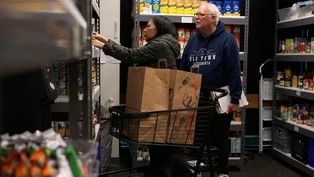
GEOFF BENNETT: More than five million people have lost their Supplemental Nutrition Assistance Program, or SNAP, benefits since President Trump's so-called One Big Beautiful Bill passed last year.
The bill cut SNAP funding, expanded work requirements, and recently pushed more program costs to states.
And, as Stephanie Sy reports, that's meant many more people are turning to food banks for support.
STEPHANIE SY: Seventy-year-old Joan Steenburgh rarely misses her weekly trips to the food pantry.
In rural Hanover, Virginia, she visits Moments of Hope to supplement SNAP benefits for herself and the two children she cares for.
JOAN STEENBURGH, SNAP Recipient: Now my food stamps have been cut from $500 a month to $300.
I would expect the most people that are politicians, $300 meal would be nothing to them.
But you expect for us to raise two healthy children for $300 a month.
It's no way possible that you can do that unless you have help.
STEPHANIE SY: More than 100,000 Virginians have lost their SNAP benefits in the last year.
And in Central Virginia, SNAP participation is down more than 15 percent.
DENNIS HATCHETT, CEO, Feed More: When SNAP changes, people are forced to either not eat or access food banks.
STEPHANIE SY: Dennis Hatchett is the head of hunger relief organization Feed More supporting food pantries across the region.
He says, in the last year, he's seen a 20 percent increase in visits to local food pantries.
DENNIS HATCHETT: Can food banks be a substitution for SNAP?
I'd have to tell you, absolutely not.
They're meant to work in conjunction.
SNAP is the single most effective means of fighting food insecurity, and food banks are here to provide a supplement at the end of the month.
STEPHANIE SY: President Trump's One Big Beautiful Bill is projected to cut $186 billion in federal spending on SNAP over the next decade.
DONALD TRUMP, President of the United States: In one year, we have lifted 2.4 million Americans, a record off, of food stamps.
STEPHANIE SY: The law raised the age limit to be exempt from SNAP work requirements from 55 to 65 and increased the amount of paperwork required to stay enrolled.
And starting next year, states with higher SNAP error rates will lose federal funding and have to pick up part of the benefit costs.
In the last year, almost every state has seen a decline in people enrolled in SNAP.
And many still eligible are receiving much lower benefits.
BETTY HAYES, Moments of Hope Food Pantry: We have people that are getting as low as $17 a month in food stamps or SNAP benefits.
STEPHANIE SY: Betty Hayes runs Moments of Hope Food Pantry.
She says client visits have doubled in the last two years, but her neighbors' support will help them get by.
BETTY HAYES: At the beginning of the year in my back warehouse, I had enough surplus, a two-month window.
So if I could not get any more food, I had two months' worth of nonperishable items that I could make it through with the clients that we had.
I have two weeks' worth of food in the back warehouse.
I think the community will step in because the community has stepped in before.
And I have never run out of food.
We just keep on going.
STEPHANIE SY: The Trump administration says the changes will cut waste and fraud and decrease dependency on government assistance, a stance echoed by Republican lawmakers.
REP.
MIKE JOHNSON (R-LA): I make this very clear.
We are not cutting Medicaid.
We are not cutting SNAP.
We're working on the elements of fraud, waste and abuse.
REP.
TIM BURCHETT (R-TN): Every dollar from this program is intended to help feed eligible individuals in need.
That's not where every dollar goes, not by a long shot.
REP.
RANDY FINE (R-FL): These programs have massive waste, fraud, and abuse in them.
Democrats don't want to tackle them.
Republicans do.
STEPHANIE SY: But Dennis Hatchett says the people Feed More serves rely on SNAP to put food on the table.
DENNIS HATCHETT: There's this misconception that people who are on SNAP don't need SNAP.
What we're finding is that the vast majority of people who are accessing SNAP are working.
They're asset-limited, income-constrained, employed people.
We have got stats that show as many as you know 50, 60 percent of the people who are accessing our food banks are people who are working one, two, even three jobs.
STEPHANIE SY: And Joan Steenburgh, a former nurse, says with less money for food, she now may have to go back to work.
JOAN STEENBURGH: Well, I have worked for all, what are you talking about, 30 years in nursing or taking care of people.
And now, instead of me sitting back and enjoying life, I have got to get a job to be able to raise enough money and be 70 years old and have to get a part-time job at this point in your life again to be able to make ends meet.
STEPHANIE SY: For the "PBS News Hour," I'm Stephanie Sy.
AMNA NAWAZ: Record high temperatures this year forced European wine producers to harvest grapes much earlier than usual.
French wineries fear heat and drought will lead to the worst season in 30 years.
But Nordic newcomers to the world of wine are toasting what they believe will be a vintage harvest, thanks in no small part to climate change.
From Southern Sweden, special correspondent Malcolm Brabant reports.
MALCOLM BRABANT: This is the last day of harvesting at the Astad Vineyard in Klagshamn, Southern Sweden.
These grapes are destined to become sparkling wine.
Klagshamn sits at 55.5 degrees latitude, some 6.5 degrees or 450 miles north of the Champagne region of France, whose harvest took place some three weeks earlier.
The wine world is at a crossroads.
Scientists say that 90 percent of all wine-producing regions in Southern Europe could vanish by the end of the century if climate change continues.
France is the most prominent nation facing potential disaster.
But while the Mediterranean is in crisis, Scandinavia is starting to boom.
NILS MELLBIN, Vineyard Manager, Astad Vineyard: We had great weather conditions during the flowering.
We have a very good fruit set on the vines.
And then we had a very dry summer with quite low disease pressure.
So, the grapes are looking really, really well.
MALCOLM BRABANT: Nils Mellbin is the vineyard manager for the Astad company, which makes sparkling wine.
NILS MELLBIN: On average, we get warmer weather, of course.
And it makes the growing season longer.
So it it's -- in general, you can say that it's easier to ripen grapes in Sweden.
But we also get more extremes, like in terms of hail and spring frost and drought, and then, when the rain comes, it comes too much.
MALCOLM BRABANT: These are young vines planted two years ago.
They will reach their full potential in two to three years' time.
They produce the solaris grape, which is suited to cooler climates and isn't grown in traditional regions.
So this is the solaris grape, which is sort of special for Scandinavia.
NILS MELLBIN: Exactly.
MALCOLM BRABANT: Why is it special?
NILS MELLBIN: Because it ripens so well in our climate, yes.
And it needs a shorter growing season to ripen.
MALCOLM BRABANT: Let's just have a taste.
It's beautifully sweet.
NILS MELLBIN: Yes.
There's sugar and there's acidity.
There's nice aromatics, nice fruit flavors.
MALCOLM BRABANT: Well, the only fruit flavor I can detect is grape.
NILS MELLBIN: Grape.
MALCOLM BRABANT: But what do you detect?
NILS MELLBIN: Now it's getting riper, so now I detect some tropical fruits, almost like mango passion fruit.
MALCOLM BRABANT: Can you really taste that?
NILS MELLBIN: Yes, yes, yes.
MALCOLM BRABANT: Contrast that optimism with the angst endured by Champagne wine growers in Northern France.
Warmer weather means the harvest now takes place in mid-August instead of September.
Yields this year were down by 30 percent because of spring frost, heat and drought.
KIMBERLY NICHOLAS, Lund University: The impacts of climate change are unequivocally bad around the world.
MALCOLM BRABANT: Kimberly Nicholas was born and raised in Sonoma, Californian wine country, and now studies climate solutions at Lund University in Southern Sweden.
KIMBERLY NICHOLAS: We're already seeing in traditional wine-growing regions it's more difficult to grow the varieties and the quality of grapes that's been grown there, even in places that might benefit in some sense from warmer temperatures like these northern latitudes.
Climate change increases variability and makes it much more difficult to grow crops.
MALCOLM BRABANT: Meanwhile, 130 miles up the Swedish coast, it's what the winemakers call game day, the pressing, the next stage in production, where juice is extracted and separated from skins, seeds, and stems.
CLAES BARTOLDSSON, Winemaker, Astad Vineyard: want to make be a part of making Sweden a wine country, not for Swedes, but for the rest of the world.
MALCOLM BRABANT: Winemaker Claes Bartoldsson has been with this family-run vintner for 17 years.
CLAES BARTOLDSSON: Last year, we produced about 20,000 bottles.
This year, we are getting grapes for 70,000 bottles.
So we're building a new winery for 300,000 bottles starting this winter.
MALCOLM BRABANT: This wine is not intended to compete against Champagne because it comes from a different grape.
But just minutes into the pressing, Bartoldsson is upbeat about producing a palatable alternative.
CLAES BARTOLDSSON: So this is like the freshest, precious juice, and I think it looks great today, really pure.
So the acidity is like up here, but the sugar is perfect, so, yes, it's going to be a great vintage.
And we can't wait to taste this in a couple of years.
MALCOLM BRABANT: The belief that Swedish wine is coming of age was reinforced last December at a Nobel Prize banquet when a local vintage was chosen to refresh the laureates' palates.
The wine came from the Kullabergs Vineyard on the coast, across the water from Denmark, and run by chief executive Victor Dahl.
VICTOR DAHL, CEO, Kullabergs Vineyard: We see that this is a very good place to be in order to grow grapes.
We should be able to adapt to the future.
We can make elegant wine with very nice aromatic, which the gastronomy is asking for, actually.
MALCOLM BRABANT: Although the Swedish wine sector is booming, the state retains what critics regard as an eccentric, outdated monopoly on alcohol sales.
It's designed to limit consumption and to minimize the impact on society.
Murat Sofrakis is helping his neighbors while waiting to harvest grapes that he will turn into a still white wine, which, like other varieties, is subject to sales restrictions.
MURAT SOFRAKIS, Owner, Klagshamn Wine: If you come to our vineyard, you need to pay for the visit.
And after you paid, and I talk for 30 minutes, then you will be able to buy three liters of wine, so four bottles.
You can't just drop in and buy a bottle of wine in Sweden, you know.
MALCOLM BRABANT: We tracked down a bottle of Sofrakis' vintage in a wine bar in the city of Malmo on Sweden's southwestern coast.
The price was a shade north of $30.
Wine journalist and sommelier Karin Ericson gave her verdict.
KARIN ERICSON, Sommelier: Here is a really aromatic wine, and like peach and bananas and the pears and some nuttiness to it, also, like a developed wine.
MALCOLM BRABANT: That smells pretty good.
I can't taste all of the tropical fruits that the experts seem to be able to find, but then I'm no expert.
Let's just have a taste.
Different.
I haven't tasted anything like that before, but good luck to it.
KARIN ERICSON: I don't think it's going to be a mass market, and I don't think it should be either, because if you say Swedish vineyards are quite small, and you always handpick.
Then you have low yields.
And also one other part of it is that we protect the workers.
So we have laws in Sweden that gives them a good salary, that gives them a good quality of the work, which makes wines more expensive to do.
MALCOLM BRABANT: The Swedes are relishing what they call their honeymoon period.
So far, they have avoided some of the diseases that have afflicted vines in traditional European regions.
Now they're hoping that the warmer weather can uncork a new successful era.
For the "PBS News Hour," I'm Malcolm Brabant in Southern Sweden.
GEOFF BENNETT: Eleven years ago, Brad Ryan took his then 85-year-old grandmother, Joy, camping in the Smoky Mountains after hearing that she had never seen a mountain herself.
One trip to a national park turned into dozens.
And eventually, what they called Grandma Joy's road trip took them to every single one, making Joy Ryan the oldest person to begin and finish visiting every U.S.
national park.
We spoke with Brad and Grandma Joy back in 2022 for "PBS News Weekend."
JOY RYAN, Grandmother of Brad Ryan: Well, I have lived in the same district, in the same house for 67 years, and you just hardly imagine all the beautiful, wonderful things that you find outside.
And it just made -- it's just been miraculous.
And I have enjoyed every minute of it.
And it'll give me something, when I get old, that I can sit and talk about.
GEOFF BENNETT: Joy Ryan has plenty more to talk about now.
She and Brad have since completed trips to all seven continents.
I spoke with them after they got back from Thailand and Australia, where they traveled with Road Scholar.
That's a nonprofit that organizes educational trips around the world.
Brad and Joy Ryan, welcome to the "News Hour."
JOY RYAN: Thank you for bringing us.
BRAD RYAN, Author: It's good to see you.
GEOFF BENNETT: Yes, you as well.
So, what made you decide that, after visiting all of the national parks, all 63 of them, that the next adventure had to be all seven continents?
BRAD RYAN: Well, American Samoa is 7,000 miles from her front porch.
It's a U.S.
territory, but they have their own immigration system.
So we had to get passports to go to our last national park in American Samoa.
And while we were there, we flew across the International Dateline to Western Samoa.
So we had one stamp.
And then we just realized that we still had a lot of adventure left ahead of us, I think, more chapters to write.
And the truth is that our followers on social media kind of ganged up on me.
And they were like, we want to see more of these adventures.
Where are you taking Grandma Joy next?
(LAUGHTER) BRAD RYAN: Three national parks was not enough.
And I thought, seven continents, that's a grand adventure that a lot of people strive to accomplish, and maybe we might pull that off.
GEOFF BENNETT: And you just got back from Australia.
Is that right?
JOY RYAN: Yes.
Uh-huh.
GEOFF BENNETT: Of all that you have seen now and experienced, what amazes you the most?
JOY RYAN: It's amazing how many people are different, but yet underneath they're all just the same, whatever.
You can't beat that.
When you're in the national park, everybody is just one big group.
BRAD RYAN: Yes.
JOY RYAN: And it's amazing.
GEOFF BENNETT: And you were saying earlier that when you were in Africa... JOY RYAN: Yes.
GEOFF BENNETT: ... in the Maasai village, that in many ways reminded you of the way that you grew up.
JOY RYAN: Oh, yes.
They all live in this little hut, and I lived in a chicken house that made into a house.
And we didn't have any electric.
We didn't have -- we had outside bathroom.
All of our neighbors was just the same, so we didn't feel like we was poor.
And over there, they didn't feel like they were poor either.
They dressed in real bright red and orange and yellow outfits, and all the little kids just laughed and played and jumped and just had the best time.
So, money isn't everything.
GEOFF BENNETT: Since we last spoke, Brad, you wrote the book "Grandma Joy and Me: A Journey of Healing, One National Park at a Time."
And you write very openly about how the two of you for a time had lost touch and that there were things left unsaid.
BRAD RYAN: Yes.
GEOFF BENNETT: How has the traveling together, how has that for you been a healing process?
BRAD RYAN: You know, when you're on your normal life path, I think in America, at least, we know our grandparents casually, but then we go to college and we go off and we have our careers and our families, and I don't think most people take the time to really learn the origin story of their family and look for those threads that go through the generations.
And when you're in a vehicle driving for -- we have driven over 100,000 miles at this point, but to all the U.S.
national parks, we drove about 70,000.
And there's really not much you can do sometimes when you're on these long stretches of highway, and you get hypnotized by that yellow line coming at you, and all these questions sort of come to the surface, and there's nowhere to go.
And that's what we did.
We looked at those things that I think a lot of families choose to keep hidden because it's uncomfortable, it's traumatic.
And, ultimately, what we found is that, although those conversations were painful at times, it was necessary to move us forward as a family and to find that ultimate place of healing.
GEOFF BENNETT: And, Mrs.
Ryan, what was it like for you to reconnect with your grandson in this way?
JOY RYAN: Oh.
Oh, we found out things about each other that we didn't know over the years.
And it was great to have a comforting hand next to me when I needed it while I felt down in the dumps.
And it was a wonderful outcoming for him and for me to have him with me.
GEOFF BENNETT: And, Mrs.
Ryan, at 96, these aren't small trips.
Brad, how are you organizing these trips so that they're comfortable and safe?
BRAD RYAN: Yes, I mean, really, you have to remember always that it's about slowing down, staying in the moment, and that's something that I used to do not so well, because I was an Appalachian Trail thru-hiker, and my relationship to the great outdoors was seeing how fast I could get to the summit.
And then suddenly I'm walking at the pace of 87-year-old, now 96-year-old.
And so she speeds up more than she probably would, and I slow down, and we just -- we find this beautiful place in the middle to just be present and enjoy the moment.
GEOFF BENNETT: Do you ever look at the itinerary and think, Brad, this is a bit too much, or are you game for all of it?
JOY RYAN: Right.
Well, one thing about it, kiddo, I'm getting close to the end.
You only go around once, so you better stop and take -- smell the roses.
(LAUGHTER) GEOFF BENNETT: That's true.
That's true.
BRAD RYAN: I mean, I really -- I have learned to just make sure that we leave -- we leave plenty of space in the itinerary for spontaneity.
And that's been a big part of the journey is just seeing what's down this random side road.
And so we don't -- we don't pack the itinerary like we used to.
GEOFF BENNETT: There are people watching who would love to travel like you do, who would love to just go for a hike, but they might not know where to start.
What advice would you give them?
JOY RYAN: Hey, never say no.
If somebody asks you to go somewhere, grab your bag and go.
Don't ever say no.
The next day, you will regret it.
GEOFF BENNETT: That's great advice.
How has this changed you?
BRAD RYAN: Well, the beginning of the journey that I detail in the book, it's in the first chapter, is that I was in my fourth year of veterinary school and I was in the throes of a of a chronic depression, and I was struggling with suicidal ideation.
It's not in any self-help book that when you're at a low point like that you should take an 85-year-old woman camping.
And that was what my heart told me I needed to do in that moment.
I needed to be in nature, and I needed to be with somebody who I knew loved me unconditionally.
And, thankfully, when I called her at age 85, she was willing to come along for the ride.
And I know I have become a stronger person because of the time that I spent with her and the example that she set for me.
I mean, yes, we journeyed to all the U.S.
national parks, and that's a beautiful thing to have experienced in life.
But all of the roads in between these national parks were where the real magic happened, because those were the conversations where we went back in time and I really learned who she is and what she's made of, the grit and just the beauty of a soul that can experience so much grief and tragedy and still choose to show up for their life and say, I'm going to let joy tip the scale.
And so it put my circumstance into perspective.
And she was able to help me out of that low point with my mental health.
And I never really did look back.
I was a different person even after that first road trip.
And then to be able to continue to 63 U.S.
national parks and watch her break a world record, and then step foot on every continent in the world, it's opened up infinite possibilities for how my life is going to unfold.
I have a really high bar to meet.
GEOFF BENNETT: All of the parks, all of the continents, dare I ask what's next?
JOY RYAN: I don't know.
You better ask him.
He's the one that pops up with these ideas.
(LAUGHTER) BRAD RYAN: Space travel, Geoff, that's the answer.
GEOFF BENNETT: Yes.
Well, you will have to come back once you have completed that.
GEOFF BENNETT: Brad Ryan, Grandma Joy Ryan, a real delight to speak with you both.
Thank you so much.
BRAD RYAN: It's so good to see you.
JOY RYAN: Oh, thanks for having us.
We really enjoy coming here.
BRAD RYAN: Yes.
GEOFF BENNETT: And that's the "News Hour" for tonight.
I'm Geoff Bennett.
AMNA NAWAZ: And I'm Amna Nawaz.
On behalf of the entire "News Hour" team, thank you for joining us.
 New
NewClimate change gives Swedish winemakers an unexpected boost
Video has Closed Captions
Climate change gives Swedish winemakers an unexpected boost (7m 37s)
 New
NewCuts to SNAP benefits push many to seek help from food banks
Video has Closed Captions
Cuts to SNAP benefits push many Americans to seek help from food banks (5m 12s)
 New
NewEx-ambassador on Saudi struggle to defend against Houthis
Video has Closed Captions
Former U.S. ambassador on Saudi Arabia's struggle to defend against Houthi attacks (4m 59s)
 New
New'Grandma Joy and Me' follows journey to every national park
Video has Closed Captions
Grandma Joy and Me' follows a grandmother and grandson's journey to every national park (9m 17s)
 New
NewNews Wrap: Cornell bans fraternity parties for academic year
Video has Closed Captions
News Wrap: Cornell bans fraternity parties for rest of academic year (6m 1s)
 New
NewNew White House press secretary announces Guilfoyle's exit
Video has Closed Captions
White House press secretary's debut brings news of Guilfoyle's exit (4m 49s)
 New
NewSaudi conflict with Houthis escalates with new strikes
Video has Closed Captions
Saudi conflict with Houthis escalates with new strikes (3m 41s)
 New
NewTrump Account expansion and new rules raise questions
Video has Closed Captions
Trump Accounts expand to millions of children, but new rules raise questions (6m 37s)
 New
NewWhat we know about Pope Leo's lung cancer and prognosis
Video has Closed Captions
What we know about Pope Leo's lung cancer and prognosis (3m 28s)
Providing Support for PBS.org
Learn Moreabout PBS online sponsorship New Episode
- News and Public Affairs

FRONTLINE is investigative journalism that questions, explains and changes our world.
 New Episode
- News and Public Affairs

Today's top journalists discuss Washington's current political events and public affairs.
 New Season
 New Episode
 New Episode
 New Episode
 New Episode


 New Episode
 New Episode
 New Episode
Support for PBS provided by:
Major corporate funding for the PBS News Hour is provided by BDO, BNSF, Consumer Cellular, American Cruise Lines, and Raymond James. Funding for the PBS NewsHour Weekend is provided by...