
NV starting 2026 with Major Public Safety Reform
Season 8 Episode 23 | 26m 46sVideo has Closed Captions
What changes in NV when the newly-passed crime bill goes into effect? Our panel explains.
Governor Joe Lombardo’s newly passed crime bill goes into effect at the start of the year. We look at the many elements it covers with lawmakers who voted for and against the bill, as well as how The Second Look Act could change a crime’s review process. We also explore the role mining plays in Nevada’s economy and how critical minerals mined in this state impact our country’s national security.
Problems playing video? | Closed Captioning Feedback
Problems playing video? | Closed Captioning Feedback
Nevada Week is a local public television program presented by Vegas PBS
NV starting 2026 with Major Public Safety Reform
Season 8 Episode 23 | 26m 46sVideo has Closed Captions
Governor Joe Lombardo’s newly passed crime bill goes into effect at the start of the year. We look at the many elements it covers with lawmakers who voted for and against the bill, as well as how The Second Look Act could change a crime’s review process. We also explore the role mining plays in Nevada’s economy and how critical minerals mined in this state impact our country’s national security.
Problems playing video? | Closed Captioning Feedback
How to Watch Nevada Week
Nevada Week is available to stream on pbs.org and the free PBS App, available on iPhone, Apple TV, Android TV, Android smartphones, Amazon Fire TV, Amazon Fire Tablet, Roku, Samsung Smart TV, and Vizio.
Providing Support for PBS.org
Learn Moreabout PBS online sponsorshipThe US is looking to Nevada to reduce its dependance on critical minerals from other countries, plus Governor Joe Lombardo's Comprehensive Crime bill will soon go into effect.
The impacts it's expected to have lawmakers who voted for and against it join us in studio.
And that was my idea.
I wanted to empower these kids and kind of animate within them an image of themselves as leaders to their.
A new children's book explores Nevada's legislative process, and its author is incarcerated.
What legislation he wants the state to pass.
That's this week on Nevada Week.
Support for Nevada Week is provided by Senator William H. Hern, stead.
Welcome to Nevada week.
I'm Amber Renee Dixon.
Nevada Governor Joe Lombardo is celebrating the passage of his wide ranging tough on crime bill.
The former Las Vegas Metropolitan Police Department sheriff called a special legislative session to get it through and on social media, called it the strongest public safety reform package Nevada has delivered in a generation.
The bill's key components include reestablishing a resort corridor caught specifically for crimes committed on the Las Vegas Strip, and increasing penalties for assaults on hospitality workers, for DUIs, in deadly crashes, and for retail thefts involving property damage.
There are also provisions expanding what constitutes stalking and domestic violence.
But the Republican governor did make concessions regarding immigration, most notably when the democratically controlled legislature returned his bill with an amendment prohibiting school districts from allowing law enforcement like Ice on school campuses without a lawful order.
He went ahead and signed it despite vetoing a similar measure in the regular session.
The bill goes into effect at the start of next year.
And here to explain their votes on it are Nevada Assemblyman Joe Van Jackson, a Democrat representing district six, and Nevada Assemblywoman Lisa Kolbe, a Republican representing district four.
Thank you both for joining us.
That was a long list of what that bill includes.
Assemblywoman, I want to start with you.
You voted for it.
Why?
So I think you did a really good job of summarizing most of the key parts of it.
It did a lot of other things as well.
It's I think, what, 50 or 60 some pages and some 73 pages.
And there were actually a lot of provisions that were stricken from it in the original bill.
But, I voted for it because at the end of the day, when we were out there knocking and talking to voters in our districts, we all heard that crime was a big issue for people.
And so this was an important thing for me to say.
We need to do something about this and to stand behind our governor and, and really try to protect, Okay.
Assemblyman Jackson, this bill did have bipartisan support, but you voted against it.
Why?
In 2019, we passed AB 236, which was a smart on crime approach.
It was evidence based.
It was data driven.
It was uplifted by the community.
There was community involvement.
This legislation actually reduce crime.
And this legislation actually saved the state millions of dollars.
I feel that this crime bill doesn't do that.
I feel that it's not evidence base, that there's not enough data back, in the bill and that there are other ways to deter crime, like investing in resources, investing in mental health, investing in housing, housing.
So those are, my main reasons for voting no on the bill.
And you come at this from a unique perspective in that you are believed to be the first formerly incarcerated person to be a lawmaker in the state of Nevada.
What do you think this bill does for the issue of prisons and overpopulation?
I think this bill doesn't address the root causes.
Like you said, I'm the first formerly incarcerated person to be elected official.
That means I have lived experiences.
When I went through my incarceration, through my crisis, I was dealing with mental health issues.
And I know if there was more resources, more places for me to go get free mental health services, that would deter me from committing a crime.
Getting the help that I need, would have prevented me from committing a crime.
Not necessarily harsher penalties or, Felony offenses, being charged to my record.
That would not deter me from a crime, but actually providing resources in the community.
That's why I think is efficient.
The smash and grab that is the retail theft that involves property damage as well.
And that will be a category C felony and ultimately lead to more people going into the prison system.
However, the state argues that this bill will also end up saving the state money.
How is that Assemblywoman?
Absolutely.
And so there is a provision in the bill that we haven't discussed yet, which is a provision about early release.
So it is a look at somebodys, criminal history and where they are in the prison system.
How much time they've served, have they done all of the good things and, you know, worked programs inside and maybe they're working a trade program.
And giving them an opportunity to get out early.
And so there will be an offset there.
And then I think one of the other things that you have to consider in law, and I'm an attorney, I know we haven't talked about backgrounds, but I'm an attorney.
And one of the things that you learn is criminal laws have a very important deterrent effect.
And so what I would say is that it doesn't necessarily mean that more people will go to jail or prison because of this bill.
They just don't have to commit the crime.
Assemblyman Jackson, do you want to respond to that?
Thank you for the question.
The smash and grabs are a concern in the community, and I feel obviously, these individuals are having some type of financial burden and invest in some type of, you know, workforce.
Job creation will be a better solution.
Placing a felony on their record is only going to make it more difficult for them to find employment.
Some of them.
What did you think about the resort corridor aspect?
I know most of the people arrested in that area are people that are experienced homelessness houses in this.
And it is unfortunate that we have normalized criminalizing the homeless for not having a home.
And I think, moreover, it's, a waste of taxpayer dollars because when you arrest someone for being a homeless, it just creates a revolving door.
We arrest these individuals for being houseless, for not having a home, and then we literally spend hundreds of dollars that they're in jail.
You know, wasting taxpayer dollars.
And then they're released to the same environment, and the cycle just repeats.
I don't think that it's an either or situation, right.
Like, I think that we need to have the increased penalties and we have that now.
And we also do need to make investments into mental health and helping people.
The the intent of the the order out corridor in the court is not really to focus on the unhoused.
I mean, certainly there will be some people that that get swept up into that.
But the focus is really on the repeat offenders.
It's the people that and there have been documented, provable instances of somebody violating and trespassing 700 times, like one person 700 times.
It's that kind of repeat situation that they were trying to address.
And that is, you know, a trespass seems like it's a no big deal.
Right?
But the trespass was a result of something else that happened.
They were maybe assaulting or, yelling at somebody, a patron, a hospitality worker.
It was it was a big situation.
Right.
And you have to look at that context.
But I completely agree with you.
We need to do more on mental health.
So we should bring a bill together.
I would love that.
Last topic, Assemblywoman, for you for your thoughts on the governor signing this bill that included the immigration measure I mentioned that prohibits law enforcement from going onto a school campus without a lawful order.
Right.
And I appreciate the question.
I would so you had mentioned that in the regular session, this bill did come forward, and, the governor had vetoed it.
Right?
I was a no on the vote.
I think it was a pretty straight line.
A Republican.
No.
In large part, I was concerned about the expansion, what the federal government was doing already.
Right.
So a lawful order or a warrant going into into a school building is what the federal law was doing, and it was expanding that to also include the school grounds.
I think what's important for us to realize is, is that Immigration and Customs Enforcement doesn't go into the school to capture a child, right?
Like, it sounds like school must be a child.
It's not necessarily anything to do with the child.
It could be a person that's working there, and it could be a person that's been working there.
And they have a violent criminal past against children.
And so I think it's really important for us to work, in concert with law enforcement.
I know that the governor's team worked very hard to get out of the quote unquote, sanctuary state situation.
And that involved a memorandum of understanding with the federal government.
And as I understand it, the governor's team worked really hard to make sure that this bill, the section that was amended in, did not go against what that MOU said.
So I think that we should be able to stay within that non sanctuary state status, which is important for us.
Assemblyman, I respect the Assembly woman's perspective.
I will say that we have a federal administration that has been making their own rules, and I think it's important that we protect our children as school.
All right.
Next, I want to talk about legislation that could come back in the 2027 session.
Assembly Bill 91, also known as the Second Look Act, would allow Nevada's parole board to take a second look at certain people in prison for possible early release.
The second look reviews would be available to people convicted of category A or B felonies, but only if they were not sentenced to death, do not pose a significant risk to public safety and have already served at least ten years.
The bill would also expand parole eligibility for people who committed their crimes before turning 25.
The measure passed the Assembly but stalled in the Senate and Assemblywoman Cecilia Gonzalez says she hopes to revive it next session.
It's legislation she's proud to have crafted with Ricky Slaughter, an activist, author and inmate.
That's the voice of Ricky Slaughter in a message he recorded for the children at Donna Street Community Center in North Las Vegas.
When they got copies of his book titled Kehlani and NAS Go to the legislature, slaughter wrote the book from behind bars at High Desert State Prison and spoke to Nevada Week using a tablet.
The prison provided.
my biological father was incarcerated for 30 years.
You know, I have some of my earliest childhood memories are me getting on the city bus with my mother and going down to visitation.
And so visiting Ricky, it wasn't.
You know, I've been here before.
category A felonies could include rape.
How do you justify that?
That should be part of this.
I think that at the end of the day, I see every person as a human being, and we are not our worst days or the worst things that we do.
I'm also a survivor of domestic violence and sexual assault as a child, and so as somebody who is a victim myself, I don't think that my abuser the penalty should be death or life incarcerated.
Right.Like, I think that we have this idea where because somebody does something egregious or harmful or something as intense as brooder, right, or felony murder, that we just throw them away.
They are still a human being that some where somehow got lost in the cracks of whatever that led them to that moment.
That doesn't mean that we get to throw them away just because we think what they did was horrible.
Do people that commit category and category B felonies deserve to be held accountable?
Absolutely.
But we're talking about young people here, people that make mistakes that maybe didn't have other parts of their lives.
When you pull back the whole curtain, right, that now we just throw away forever.
It costs us taxpayers money, right?
That's money that could be going to education, that could be paying teacher salaries, that could be paying into afterschool youth programs.
According to the Sentencing Project, 15 state legislatures have passed some form of second look legislation.
It did not get through Nevada's legislature in this past session.
Assemblywoman, you voted no on it.
Why?
So I think any time that you're dealing with reforming in the criminal justice system and especially early release of prisoners, you have to be very balanced and nuanced in your approach because you have the rights of the people who are incarcerated, and you have the rights of the victims of their crimes.
And I think you have to be very careful to tread lightly there and make sure that you're not, overcompensating in one way or another.
I also think when you look at category A or category B felonies, it seems like that's sort of an easy thing, right?
Like a general population.
What does that mean?
We're talking about the worst crimes that are committed in the state, like the harshest laws.
And I actually I pulled some information from the research division of the LCB Legislative Council Bureau and found that there are four pages worth of category A felonies, including first degree murder, second degree murder.
Kidnaping with substantial bodily harm, and then category B felonies.
12 pages worth.
And so I think, you know, if we're going to craft some legislation, if this does come back, I would like us to take a more nuanced approach.
And of the 3 or 4 pages of category A, maybe pick some of the ones that are the least violent and the smallest amount of time that they would be doing anyway.
And look at those for for adding and expanding.
Because what we're expanding on is a program that was meant for geriatric release, right.
And I think when we're looking at, in general from a public policy standpoint, someone who is aged 65 or more and I'm, I'm 52, almost.
Right, like in my viewpoint of old age changes.
But when you're 65 or older, just you're physically less likely to be able to commit violent crimes.
And so it makes a lot of sense from a public policy standpoint, and also from the age of 18 and younger, if you're charged as an adult, you know, your brain isn't fully functioning and you know all of those things, it's not fully formed and you're not making good decisions, right?
But my son just turned 25, and I can tell you the difference between him and 18 to 25 is a big difference.
And so maybe 18 to 19 we could look at that, but not the 25. will say that, you know, the justice system does make mistakes, mistakes, and there are fault in our justice system, and people have been wrongly convicted.
So giving someone opportunity for their case just to be looked at again, I think is a great opportunity.
It doesn't mean that they're going to release that, you know, they still go through the due process.
People review the case, and if there was an error in the case or if there has been some substantial change, that this individual will be eligible for release.
And I think they do deserve that.
Their second chance.
All right.
Assemblyman Jovan Jackson and Assemblywoman Lisa Cole, thank you so much for joining Nevada Week.
We move now to mining, with Nevada in the national spotlight as a potential answer to the problem of the United States overdependence on other countries for critical minerals.
Here now to explain are Amanda Hilton, president of the Nevada mining Association, and Rob Gallery, administrator for the Nevada Division of Minerals.
Thank you both for joining Nevada Week.
Amanda, I want to start with you.
How serious is this issue of the overdependence on other countries for critical minerals?
This is a national security issue.
I it is very important that our country start evaluating and developing ways that we can have a more secure domestic supply chain.
In the last several months, I've had a lot of opportunities to actually speak with military officials, including a meeting at the Pentagon.
And in all of those conversations, I've learned that it is imperative that we have more, domestic production of minerals that are needed for things like steel, aircraft carriers, ships, armor for our personnel.
So Nevada is uniquely positioned because many of the minerals that the military is looking for, we have in the ground in Nevada and to the federal government, reach out to you for these meetings.
Yes.
So, Nevada is the leader of mining in our country, and Nevada is well positioned to be able to answer and provide solutions for these problems that the military has today.
And right now, Nevada is the only state where lithium is being mined.
For those who are unfamiliar with this, Rob, can you explain to our viewers how the U.S.
got into this position in the first place?
So the US has been a mining country for a very long time, especially the state of Nevada.
However, when it came to processing, the processing technologies started to move overseas in the last 20, 30 years.
And since then, new processing facilities haven't been built and put online within the United States for a very long period of time.
And the ones that are still in operation, a lot of them are older, antiquated technologies and need significant investment into them to be able to come up with the standards and quality needed for environmental protection that we have on the United States.
Talking about processing plants, both of you worked together on a recent report about copper, and the goal of it is to create a copper processing plant here in Nevada.
Correct.
What would that take?
that report identified several locations that it would be possible sites to construct a facility like this.
But the reality is the permitting timeline would be decades, and it would be hundreds of millions of dollars, if not billions of dollars for a company to invest in this sort of facility.
But what we're seeing is the US government is recognizing all of the hurdles that companies have in the U.S.. So in order to build a mine, build a processing facility.
And so we are having a lot of conversations with governmental officials to see how they may be able to better support the investment in a technology like this.
Right.
I mean, right now the U.S.
government is actually taking stakes in mining companies, including one here in Nevada.
Rob, how would you describe this moment in time for mining in the country and in Nevada?
We haven't seen the government involvement in mining like this since, really the Second World War.
I mean, it has been a long, long period of time where the government is realizing that we are so far behind in getting some of these operations up and running and getting to the process for the critical minerals needed every day that we use them.
The investment is into lithium companies.
Lithium is used for everything we look at and hold in our hands, with cell phones to computers and everything else.
So we we see that need for it.
And the fact that there was over $8 billion set aside under the big, beautiful bill that was recently passed towards mining and processing and recent Department of Energy grant opportunities for mining the future, and opportunities for developing technologies to process it not only to process, but process better, more environmentally friendly, and to get them in the U.S.
we haven't seen this in a very long time.
Amanda, what would you tell people who live near mineral deposits, copper, for example, what can they expect to happen in the area they live in?
I'm a good person to ask.
I live ten miles from the state's largest copper mine.
I live in Ely, which is just outside the Robinson mine, and the Robinson mine plays such a critical role in that local community.
One of the reasons I live in Ely is because of the clean air and the clean water.
And so when people talk to me about concerns like that, I can share my own personal examples of I choose to live near that operating mine because they take such good care of ensuring things like the water in the air remain clean.
Yeah, the water being tainted is a significant issue, among others.
Lastly, the workforce in mining, does it exist right now in Nevada to fill the demand?
Yeah, currently, there's nearly 20,000 dedicated Pers air employees to mining itself.
And then if you look at indirect jobs, you're looking at over 40,000 people in the mining industry in the state.
Nevada Nevada has one of the very few mining schools at the University of Nevada, Reno, at the McKee School of Mines, that actually has the career paths for a lot of the technical aspects.
But mining isn't just geologists and mining engineers.
There is a lot of opportunities in every aspect.
You need accountants.
You need security.
You need health and safety.
You need assay labs.
There's a lot of jobs outside of just the traditional geology, mining, engineering that are needed every day in the mining world.
So yeah, right now in rural communities, there's some counties in state Nevada where mining is the largest employer in that county.
Amanda, you had mentioned to me that there is a large portion of this workforce set to retire soon.
There is.
What's your level of concern about that in the next five years?
A high percentage of our experienced employees at the mine site are projected to retire.
They will be out of retirement age.
So our member companies are working hard to recruit and build that workforce of tomorrow.
The Nevada mining Association has recently, implemented a video campaign where we are highlighting five different careers within the industry, and we're sharing that across Nevada because we want all Nevadans to know about the opportunities within the industry.
These are great jobs.
The average salary is $120,000 a year.
And it doesn't matter if you have a GED or a PhD.
There is a role for you in our industry.
Amanda Hilton and Rob Guillory, thank you for joining Nevada Week.
Thank you.
And thank you for watching.
For any of the resources discussed.
Go to Vegas, PBS.org, and I'll see you next week on Nevada Week.

Governor Lombardo’s signature “tough on crime” bill goes into effect start of 2026
Video has Closed Captions
Clip: S8 Ep23 | 9m 28s | Governor Lombardo signed his sweeping crime package into law after a Special Legislative Session. (9m 28s)
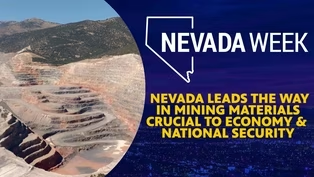
Nevada leads the way in mining materials crucial to economy & national security
Video has Closed Captions
Clip: S8 Ep23 | 6m 56s | We look at how our state’s mining industry is playing a role in national security. (6m 56s)

“Second Look Act” could offer fresh perspectives and new procedures to review older crimes
Video has Closed Captions
Clip: S8 Ep23 | 8m 59s | Assy Bill 91, or the “Second Look Act” did not pass in time during Nevada’s 2025 Legislative Session (8m 59s)
Providing Support for PBS.org
Learn Moreabout PBS online sponsorship
- News and Public Affairs

Top journalists deliver compelling original analysis of the hour's headlines.

- News and Public Affairs

FRONTLINE is investigative journalism that questions, explains and changes our world.











Support for PBS provided by:
Nevada Week is a local public television program presented by Vegas PBS