
NV Secretary of State on Election Integrity, Voter ID Laws
Season 8 Episode 36 | 26m 46sVideo has Closed Captions
Nevada Secretary of State Francisco Aguilar on election integrity and voter ID laws.
A proposed federal law would require people to show proof of citizenship when registering to vote and would require people to show photo ID when voting in person. Nevada Secretary of State Francisco Aguilar explains his opinion on the proposed law and other issues impacting Nevada’s midterm elections.
Problems playing video? | Closed Captioning Feedback
Problems playing video? | Closed Captioning Feedback
Nevada Week is a local public television program presented by Vegas PBS
NV Secretary of State on Election Integrity, Voter ID Laws
Season 8 Episode 36 | 26m 46sVideo has Closed Captions
A proposed federal law would require people to show proof of citizenship when registering to vote and would require people to show photo ID when voting in person. Nevada Secretary of State Francisco Aguilar explains his opinion on the proposed law and other issues impacting Nevada’s midterm elections.
Problems playing video? | Closed Captioning Feedback
How to Watch Nevada Week
Nevada Week is available to stream on pbs.org and the free PBS App, available on iPhone, Apple TV, Android TV, Android smartphones, Amazon Fire TV, Amazon Fire Tablet, Roku, Samsung Smart TV, and Vizio.
Providing Support for PBS.org
Learn Moreabout PBS online sponsorshipWhat Nevada's Secretary of State is doing to fend off federal interference in the midterm elections, plus... -Everybody's looking at their documents trying to remember where my marriage license was from, and do I know how to get these things.
So there's a certain level of panic that they might not be able to vote in this election cycle.
(Amber Renee Dixon) The SAVE America Act could prevent several Americans from registering to vote.
How likely it is to become law, that's this week on Nevada Week.
♪♪ -Support for Nevada Week is provided by Senator William H. Hernstadt and other supporters.
-Welcome to Nevada Week.
I'm Amber Renee Dixon.
Article I, Section 4 of the U.S.
Constitution says states are responsible for running elections.
But right now, several states say the Trump administration is threatening that constitutional authority.
Nevada, for example, is one of more than 20 states that the U.S.
Department of Justice is suing for not providing certain voter information.
Nevada Secretary of State Francisco Aguilar is a defendant in that case and joins us now.
Secretary, thank you for joining Nevada Week.
(Francisco Aguilar) Thank you for having me, Amber.
It's always good to be here.
-Okay.
So the Department of Justice says that you are violating federal law by not providing the U.S.
Attorney General with the records that she needs to investigate whether Nevada is in compliance with federal election law.
What is your response to that?
-First of all, I think they're misinterpreting the federal law.
If you read Nevada law, it's very clear.
As a Nevada elected official, it is my responsibility to adhere to Nevada law, and Nevada law is very clear on Nevadan residents' privacy protections.
And we will figure out who's in the right on this issue when we go before a judge, which I look forward to, because any opportunity to make sure that I'm protecting the data privacy of Nevadans across the state is a responsibility I must do.
I-- You know, I took a pledge to the Nevada Constitution, took pledge to the U.S.
Constitution.
The U.S.
Constitution and federal law is not as clear as they say it is when you look at it in whole.
-The DOJ is citing the Civil Rights Act of 1960 as empowering the U.S.
Attorney General to request this information.
Why do you laugh?
-Because I think it's a-- They're conflating the law and misinterpreting what the actual intent of the Civil Rights Act is.
And to use the Civil Rights Act to be able to illegally obtain Nevada's private information is pretty laughable.
-In the complaint, it lists exactly what they want.
The current electronic copy of Nevada's computerized statewide voter registration list with all fields, including each voter's full name, date of birth, address, and either their state driver's license number or the last four digits of their Social Security number.
-I think we have to step back a little bit and understand that when we received this request, we complied with it.
We gave them what we were legally obligated to give and what's publicly available to everybody.
It's their name, it's minus the driver's license number, Social Security information.
That's where we held back the information because that's very particular to a certain individual.
When Nevadans registered to vote with the state of Nevada, they agreed to give us that information.
They didn't authorize the Secretary of State's office to provide that information to a third party.
But, again, when we received this request, we didn't respond with no.
We said, explain to us how this information is going to be used, who's going to be responsible for maintaining it, and how is it going to be secured so that we know that Nevadans are protected.
We never received a response.
Our response was a lawsuit.
And shortly after the lawsuit was a motion to compel, which was usurping their actual litigation to force me to give them information.
-If they get this information, if a judge orders that you provide it, what do you think they're going to do with it?
What is your concern there?
-You know, my concern is it'll be used in a way that will hurt Nevadans across the state, and that's where I asked for clarification.
But also, too, where are they storing this and what type of database?
The state suffered a pretty significant cyber attack a few months ago, one of the biggest in the history of this country.
And we have to be even more diligent about protecting the privacy of our citizens across the state.
-Another topic, you bring up that cyber attack, and we have the Primary coming up-- -Yes.
- --a big election.
How prepared is the State in that regard, after that cyber attack?
-After that cyber attack, we have worked extremely hard over the last three years to ensure the systems in the Secretary of State's office are secure.
We have air gapped them.
We have put in process and procedures.
We have constant monitoring of the system, not only by our internal teams, but professionals externally.
We have some of the best groups helping us maintain our information and our systems.
If we had to run an election during the cyber attack, voters would have not known the difference between a regular election and an election during a cyber attack.
And the fact that Nevada is a battleground state, we are at the forefront of our elections in this country, where foreign actors are interested in what Nevada is doing and how we're actually maintaining the security of our systems.
-Back to the Trump administration, which has said that Republicans should nationalize elections.
Could that happen?
Could Republicans even do that?
-Well, first of all, I think the Constitution, as you stated at the beginning of the show, the Constitution is very clear about state responsibility.
You know, the Constitution is a complicated document.
There are a lot of legal scholars who debate certain phrases, certain clauses in the Constitution.
But the Constitution about granting elections to the States is very clear, and it is in plain language.
And until someone else makes an amendment to the Constitution, but a single individual cannot make a change to our election systems across this country.
There is a reason why a single individual does not have full control of our elections.
-What about in the case of a national emergency?
Because there have been reports that perhaps that would be something the President could declare in order to change-- -Well, the national emergency that he wants to declare is related to 2020.
The 2020 election has been litigated almost 70 times across this country.
It's also been litigated in the court of public opinion in the '22 election.
And I can say, from a Secretary of State perspective, every Secretary of State that ran against the election denier in this country won.
And I think that was the public speaking to saying-- And also, too, it's important to know that Republicans who are not election deniers won their elections.
So it's not a Republican or Democratic issue.
It's the public saying we are over this issue, we are done with this issue, let's move on and let's run this country.
-But are you over the issue of foreign interference in elections, because that's what everyone-- -Never.
- --relates to.
He wants to, potentially-- -If they really do truly cared about that, they would be investing in our systems.
They would give in-- be giving us funding.
They wouldn't be decreasing funding for cyber attack, cyber attack protections.
-Do you think there is foreign interference in elections?
-No.
I mean, they attempt to.
But the fact that we are designed to protect ourselves against it, I don't think it's happening.
-Okay.
And-- -Again, let me say this.
I say it constantly-- -But can you also let our viewers know what we're talking about.
The claim is in relation to China's alleged interference in the 2020 elections.
That would be the reason that the Trump administration would potentially declare a-- -Right, but we've had an election in '22.
We have a presidential election in '24 where he was the winner of that election.
So all of a sudden, you know, 2020, which was almost six years ago, we've been through several cycles of an election.
Our systems have been upgraded.
Our systems have improved.
Nevada made significant investments in investing in a top-down voter registration and election management system.
We are, have the most advanced technology to protect us from a cyber security attack or foreign intervention.
-Are there any circumstances in which a national emergency can be declared and it will affect the elections?
-I think it's detrimental to the voters of this country.
I think it's bad decision to make that.
Instead of-- -But you're saying it is possible?
-No.
I don't-- I don't understand where the national emergency exists.
I don't see one.
Yes, we're at war, but I don't think that war is going to impact our ability to manage an election.
Our elections are decentralized for a reason, and that's why the Constitution is very clear about states having that responsibility.
And even within the state, they're decentralized.
I only have certain responsibilities.
We have 17 clerks across the state who have a major role in our elections process.
Thirteen of those 17 clerks are Republicans.
They do a hell of a job of administering our elections.
They live in those communities.
They know their voters.
They have a very, very hard job that has zero room for error.
-You talked about Nevada's investment in the election systems.
I wonder what you think about this.
Nevada Governor Joe Lombardo, a Republican, was recently interviewed by Jon Ralston, CEO of The Nevada Independent.
And Jon Ralston asked him for his perspective on election security.
Let's listen to that now.
(Jon Ralston) Will you say here tonight that there's no evidence that our elections are insecure?
(Joe Lombardo) There's no evidence that our...?
-Elections are insecure, the integrity of our elections?
-No, I can't say that.
I can't say that.
-Why not?
-Because.
We just said there's been some prosecutions.
You know, it's just like criminal activity.
Just because we arrested somebody doesn't, you know, for one item doesn't mean you didn't do 20 items, right?
And you have-- -So-- -You have to take that into consideration.
And why not put mechanisms in place to secure that confidence that everything-- -The confidence has been shaken.
- --that we've done everything we can.
-The confidence has been shaken by Donald Trump and his enablers.
Nobody else has shaken the confidence, and isn't it-- -And that's-- Don't say, nobody else, Jon.
That's not accurate.
You can't say nobody else.
I just heard somebody cheer on elections that it wasn't, here in your audience.
So there's people that, whether it's right, wrong or indifferent, or perceived or not, they're frustrated.
And they want-- Why not give them the ability to feel better about the system?
-So you have worked under Governor Lombardo your entire time as Secretary of State.
Were you aware of this stance?
-I was not.
We've been working with him over the last three years to make a significant investment in our elections process.
What I'd like to understand is where in the process he thinks we need to beef it up.
We built the infrastructure now with the implementation of the Voter Registration Election Management System that gives us a lot of transparency into the process.
It brings uniformity across all 17 counties.
It also gives us the security you need from a cyber security perspective.
But to understand exactly-- And I don't know if he's referring to Question 7, which is voter ID--which we know Nevadans have passed overwhelmingly in the '24 election.
It's on the '26 ballot again--or what part of the process is it?
Is it-- You know, I know his policy position on receiving mail ballots after Election Day, but what we really need to focus on is making sure we build that transparency, that voters actually understand where the mail ballot is in real time.
And we are working with the counties to build a dashboard to be able to provide that data.
The other priority, too, if we really want to talk about the security of the process in the system, is making sure the counties have the capacity to count mail ballots.
Less than 1.8% of mail ballots arrive after Election Day.
It's a pretty minimal number.
-In Nevada?
-In Nevada.
98% of mail ballots, or all ballots, are in the possession of the counties on election night.
In '24, the counties were able to process 90% of those ballots election night.
8% was the bottleneck.
That 8% are the mail ballots received on Election Day at a polling location in a drop box.
The counties leave those ballots in those drop boxes throughout the day.
And at the end of the day, they go to the polling location, pick up the mail ballots, bring them to the election center for processing.
We need to figure out a way to make sure that the highest-- the large volume of mail ballots we receive at polling locations are having multiple pickups so those processing can start earlier in the day and alleviate that bottleneck.
If he really wanted-- And I proposed this to him, and I proposed this to the legislature.
I said, here are the bottlenecks.
And I also proposed legislation to say a county must process a mail ballot within four hours of receipt.
That would drive the security of the process even higher.
That bill got vetoed.
Also, too, they didn't appropriate the funding to be able to allow the county.
So the counties are trying to figure out, how do we meet this goal and expectation of the Secretary.
County Clerks have a hard job.
They have a hard job because they have the pressure of the public, they have the pressure of the voters, they had the pressure of the Secretary of State's office to meet certain expectations.
And so-- -The funding you need is for people, for workers?
-It's for workers and it's for systems, yes.
-Okay.
What do you think right now about, as you prepare for elections, do you have enough election workers?
-So that's a great question.
And fortunately, this state stepped up big time.
We are a model state when it comes to the rest of the country.
We passed an election protection bill that gave protections to election workers and to poll workers.
Our poll workers are unsung heroes of our democracy.
They make sure the polling location works, they make sure the processing works, and we need to make sure that they feel safe in those environments.
Also, too, a large majority of poll workers are women.
Those are mothers, daughters, wives, grandmothers, sisters, who have stepped up.
And, you know, we are celebrating International Month of Women.
I think women should be proud of the fact that they make our elections work, and we should recognize that.
And so building a safe environment, in '24 we saw a pretty calm election process.
And hopefully we understand that.
But there's also other initiatives.
You know, high schoolers can be poll workers.
The earlier we can get people involved in the elections process I think is better, because they truly get to learn how the system works.
-And you were recruiting veterans last election.
-Yes.
We have a great partnership with Vet the Vote.
They do an amazing job of getting veterans to understand why our elections process is so critical.
They fought and defended this country in some very tough environments.
They, they sacrificed their lives for us.
And the fact that they're willing to understand and engage in the election process is pretty incredible.
-At this point do you know if Nevada has enough election workers?
-I have not heard it rise to a priority among the clerks at this moment.
But, again, we're still early.
But I understand people are really stepping up, and that's really a good thing.
And when you go to a polling location, please thank them, because they're doing something we need them all to do.
-There has been talk that there could be ICE agents at polls this year.
What do you think about that?
-You know, it's something-- It's unfortunate that we even have to think about it.
But I think, do I think it's appropriate?
Absolutely not.
-How much of a reality do you think that is?
-Because, again, we do not have noncitizens voting in our elections.
The Heritage Foundation did a study of Nevada.
And over the last 10 years, I believe they found 11 instances of that occurring.
Remember, there are 2.1 million registered voters in Nevada.
We had 1.4 million turnout in '24.
The number of votes versus the number that participate-- And those people need to be held accountable for violating law.
It is a felony to register to vote as a noncitizen, and so we need to make sure that we are continuing our prosecutions and holding people accountable for that issue.
But, again, noncitizens are not voting in our elections.
And what it is doing is creating chatter within a Latino community about this occurring and scaring them from participating to vote.
When you do that, that's detrimental to a democracy, especially in a state like Nevada where 30% of the electorate is Latino.
And they are a swing vote.
So they're not just hurting Democrats, they're potentially hurting Republicans, because we need every single voter that's eligible to vote to turn out and have a voice in the future of our state and the future of our country.
-So Governor Lombardo mentioned there should be more mechanisms in place to secure voter confidence, and proponents of the SAVE America Act say it will do just that by keeping noncitizens from voting.
President Trump is a strong supporter of the SAVE America Act and right now says he will not sign any legislation until Congress passes it.
The House passed the bill last month, but it's stuck in the Senate, where Republican leadership says there aren't enough votes to get it through.
If it became law, the SAVE America Act would impact people who are registering to vote in a federal election by requiring them to provide documentary proof of United States citizenship.
The bill lists several documents that people can use, including a passport or birth certificate.
But according to research from the Brennan Center for Justice, more than 21 million Americans lack ready access to those documents, and roughly half of Americans don't even have a passport.
Sondra Cosgrove is a history professor at the College of Southern Nevada.
(Sondra Cosgrove) So if you fall into the category that you have to prove your citizenship, you're going to have to have a certified copy of your birth certificate.
If your name that's on your ID does not match the name that's on your birth certificate, which happens because you get married or you get divorced, then you also need to have a certified copy of your marriage license or from your divorce decree.
And so there are going to be a lot of women, especially, who are going to be negatively impacted if this was to pass, because they're going to have to make sure that either their birth certificate gets changed or they get their birth certificate and their marriage license and divorce decree.
There's just a lot of burden on them to get the documentation needed to prove citizenship.
-That burden is causing some people to panic.
Cosgrove says she sees concerns all over social media and says politicians are helping fuel the fire.
-Because both of the political parties try to scare people to get them to turn out to vote or, more likely, to give them money.
And so you get text messages saying, being afraid, be upset, be angry.
I'm going to push your buttons, and then I want you to give us some money.
They need to knock that off.
You're terrifying people.
Stop it.
-And to those who are worried about the SAVE America Act, she has this message: -To calm down, take a breath for a number of reasons.
If you're following along the national news about the SAVE Act, it is now saying it passed the House of Representatives but most likely will not make it through the Senate because of the filibuster.
So the Democrats have already come out and said they will filibuster.
And if they filibuster, it requires 60 votes to pass.
There's not 60 votes there.
So while we need to have conversations about why would anybody even propose this when it's not a real problem--we don't have noncitizens voting--why would you do this?
So we need to be talking to folks that are running for election this cycle about did you support this and why but not panicking about this election cycle, because it's not going to pass.
-Okay.
So when Sondra Cosgrove says that noncitizens are not voting, there are people out there who will point to a recent case from the Department of Homeland Security.
They report arresting a criminal illegal alien who voted in seven federal elections since 2008, so it happens.
But your argument is it's not widespread?
-It's not.
And I'm going to tell you Nevada runs some of the safest, most secure, and accessible elections in the country.
And we will continue to improve upon our systems and our processes to make sure we are catching people who should not be registered to vote.
You know, we work diligently with the DMV.
The DMV is diligent about making sure that people are registered to vote through the automatic voter registration process are the citizens that are qualified to vote.
And then there is a review process, too, by the local County Clerks to make sure that the people they are registering are qualified to vote.
-It's important, I think, for the SAVE America Act to again repeat that this would impact people registering to vote-- -Correct.
- --not people who are already registered.
-Well, there's some discussion about, too, making reverification a process.
Again, they want people who are registering to vote to verify in person.
We do have a verification of identity during the registration process.
People have to prove identity of who they are in order to register to vote in Nevada.
-There is also a request from the President that the SAVE America Act be changed in order to rule out mail ballots.
Your thoughts on that?
Isn't that where this all kind of stemmed from, the allegations of voter fraud, people can mail in ballots?
-It's really interesting because Nevadans have chosen mail ballots as their preferred choice of voting.
52% of Nevadans participated in our election in '24 through mail ballot.
Nye County and Douglas County, some of our reddest counties, are the highest adopters of mail ballots.
This is about accessibility.
This is not about a party.
Because some people in Nevada live in extremely rural areas, and they would have to drive hours to participate in the process.
Also it impacts our tribal communities.
And our tribal communities deserve to have a voice, just as every other, every other person does in our state.
What is the process for verifying that you are getting a mail ballot from the person that is listed on there with their signature.
There's lots of controls in place.
One is the signature is a big part of it.
We, you know, we have access to the DMV signature on the ID.
We have access to the voter registration signature.
We have access to the signature used in past elections.
There is a verification process that is scanned and then if it is rejected, it goes to a bipartisan review.
And if it's rejected by that bipartisan review, it goes into a signature cure issue, which was an issue in '24 among our younger voters, because our younger voters traditionally don't have a signature.
And there are ways to verify this process where a person has to prove that it is their actual ballot.
People talk about double votes.
Yes, we do have those, but it's a really unique situation.
Because when you have a father and son with the same name, the father decides to vote in person, the son is in a hurry, he votes his father's mail ballot, the system catches it and flags it immediately, and it is clarified.
So there are checks and balances.
The system does work as intended to make sure that the mail ballot is connected to the correct voter.
-For someone really committed to committing voter fraud, they could learn someone's signature, right?
-They could, and then that's a fraud.
But also, too, it'll get flagged, because if that person has their ballot, we will communicate to them that-- And also, too, that's why we were asking-- This is a two-way road, right?
We need voters to engage in the process.
We ask people to go into their portal and make sure their information is up to date, their address is correct, and then also, too, to sign up for the notification system.
Because if you get a notification that, hey, my mail ballot was voted, but I voted in person, they can call the county or they can call the Secretary of State's office.
We'll open an investigation immediately, and we'll start to figure out what occurred on this ballot, or the ballot will be held to before it is counted.
-What will this look like if Nevada votes again for voter ID this election cycle?
It has to pass two election cycles, right?
So if that happens this year, it's Ballot Question 7, right?
What will that look like for mail ballots?
-It'll add an additional identifier, which we did work during the legislative session in '25 to try to get that passed in '25.
My concern as Secretary of State is this is going to go to voters.
It's most likely going to pass.
It's going to go to the '27 legislature.
The '27 legislature is going to hand it to the Secretary's office in July of '27.
Our first election is going to be in February of '28, and we're going to have to update our systems.
We're going to have to update the processes.
We're going to have to do a significant amount of voter education.
We're going to have to work with DMV to make sure that people know that they have to get an ID to participate in the elections.
There are a lot of things that have to go into place that I'm already starting to think about because my job, as Secretary, as the chief elections officer, is to anticipate concerns or issues and try to address them now so that the amount of impact on the voter is pretty minimal.
I mean-- -Then here's my idea.
This is just what I'm imagining.
Someone has to make a photocopy of their license and mail it in with the ballot?
-No.
There will be a way.
There will be to add additional information, like your birth date, the last four of your social, your driver's license number in a secure environment on the mail ballot so that, when it does come through, it verifies with that second identifier.
-It's still an ID that's being presented in that case?
-Yeah, because you'll have your ID on file with the DMV.
And so they'll-- If you put-- You sign it and then you put your driver's license number, it'll verify both.
-Okay, last question.
You brought up-- -But I think there are ways to be really smart about this, and it's looking at the way the technology that exists.
DMV has a lot of data and a lot of information on voters.
One is we should be really talking about a mobile ID in Nevada, and the legislature should really look at that.
And the DMV should present that at the '27 session so that somebody can-- We all live off of our phones, especially young voters.
The other thing is the technology that exists in our airports now, the amount of biometric information that DMV has when you get a driver's license or a Real ID, can be used to make the process streamlined at an actual polling location.
Imagine, I know, when you walk into this country through Global Entry, or now when you go into the airport and you fly Southwest, you don't even need an ID.
There is just a photo machine, and it's quick and it's fast.
Imagine if we could do that to build that efficiency so if somebody did forget their ID, they can still vote in the process, and they're not, you know, burdened.
-Nevada Secretary of State Francisco Aguilar, thank you for joining Nevada Week.
-Thank you, Amber, for having me.
-And thank you for watching.
For any of the resources discussed, go to vegaspbs.org/nevadaweek.
And I'll see you next week on Nevada Week.
♪♪
 New
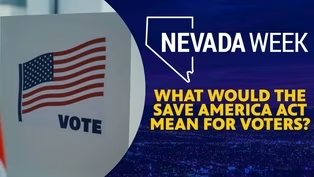
NewWhat Would the SAVE America Act Mean for Voters?
Video has Closed Captions
Clip: S8 Ep36 | 6m 45s | President Trump wants the SAVE America Act passed immediately, but what would it mean for voters? (6m 45s)
Providing Support for PBS.org
Learn Moreabout PBS online sponsorship
- News and Public Affairs

Top journalists deliver compelling original analysis of the hour's headlines.

- News and Public Affairs

FRONTLINE is investigative journalism that questions, explains and changes our world.











Support for PBS provided by:
Nevada Week is a local public television program presented by Vegas PBS