
NV Energy Rate Changes Explained
Season 8 Episode 40 | 26m 46sVideo has Closed Captions
NV Energy rate changes and a push to permanently end taxes on tips.
NV Energy is changing how it charges customers but what do those changes mean? Tipped workers are getting a break on their taxes this year and one Nevada congressman wants to make that break permanent.
Problems playing video? | Closed Captioning Feedback
Problems playing video? | Closed Captioning Feedback
Nevada Week is a local public television program presented by Vegas PBS
NV Energy Rate Changes Explained
Season 8 Episode 40 | 26m 46sVideo has Closed Captions
NV Energy is changing how it charges customers but what do those changes mean? Tipped workers are getting a break on their taxes this year and one Nevada congressman wants to make that break permanent.
Problems playing video? | Closed Captioning Feedback
How to Watch Nevada Week
Nevada Week is available to stream on pbs.org and the free PBS App, available on iPhone, Apple TV, Android TV, Android smartphones, Amazon Fire TV, Amazon Fire Tablet, Roku, Samsung Smart TV, and Vizio.
Providing Support for PBS.org
Learn Moreabout PBS online sponsorshipNo taxes on tips.
Head of tax day.
We explore its impact on Las Vegas and the efforts to make that policy permanent.
Plus this will more than double my monthly electricity bill.
I ask you is that fair?
An unpopular proposal to change how your energy bill is calculated gets delayed again.
Why and what's next?
That's this week on Nevada Week.
Support for Nevada Week is provided by Senator William H. Hearn, STAT and other supporters.
Welcome to Nevada Week.
I'm Amber Renee Dixon.
Tipped workers will get a break this tax season thanks to the federal no tax on tips policy, but that break expires after 2028.
Congressman Steven Horsford joins us to explain why he wants to make that tax break permanent.
But first, a plan to change how any energy calculates your power bill is now on hold until January 1st.
The delay comes as confusion grows over why the rates are changing and what it means for customers here.
To break it down is Emerson Druce, business reporter for the Las Vegas Review-Journal.
Emerson, welcome.
Thank you so much for having me.
So before we attempt to explain how this new charge would work, will you tell our viewers why its implementation was pushed back to January of 2027?
Well, I think the reason it's implementation was pushed back is the same reason that I'm here today.
Customers are very confused.
and a lot of people have many questions.
It feels like I'm just constantly being bombarded by my family and friends asking me about it.
So what this is going to be doing is charging you based on two prongs.
So they see three prongs to introduce the basic service charge.
So you have to pay which is 1850 but it's two prongs.
So it's going to be per kilowatt hours and per kilowatt which is what the demand charges.
So in your house you have an energy meter.
And it measures energy based off of 15 minutes per day.
It can only measure it based off of every 15 minutes.
Some do 30 minutes in Nevada here it's every 15 minutes.
So let's say you come home from around five, you come home, you go take a shower.
You blow dry your hair, plug in your blow dryer, then you go start the dishwasher.
You start the microwave and you start your you put in a load of laundry and you start your dryer.
So within a certain 15 minutes, your usage is going to go up the amount of kilowatts you just use, not per kilowatt hour is the amount of kilowatts you just use goes up.
Now for this demonstration I'm just going to say you use let's say you use two kilowatts within that 15 minutes.
What actually is going to happen is they're going to use the demand rate, which is going to be now $0.14.
two times 14 equals $0.28.
Now that is your daily demand charge for let's say that's January 1st.
The very first day of the demand charge is implemented January 2nd.
You might use three kilowatts within your highest 15 minutes.
January 3rd, you might use four kilowatts.
And then January 4th, you might use, let's say goes back down to one kilowatt.
All of those cents are going to be added up, and that's what will be added to the end of your bill.
So and then obviously you'll have you will still have your per kilowatt hour charge.
Now, right now it's at around like the eight $0.09.
It should be going down to around $0.07 to make up for the new demand charge.
And the energy says that this is a way for customers to be able to space out their energy usage and give them more control over their bill.
I believe they are rolling out some kind of demonstrative tool for customers to use, where they can put in their energy bill now and then calculate it for what their energy bill will be with the demand charge.
I mean, they have.
That's exactly what I was looking for on their website.
But here you are explaining it instead of envy.
Energy has envy energy confirmed that this is how it will work?
No, I'm very confident in my explanation.
I've spoken to many people on record, off record about this and there are some other websites that explain this the exact same way as me.
Demand charges are not new for industrial and large commercial customers like casinos have been paying demand charges, but this will be new for small business or small commercial customers and residential customers.
If casinos are already utilizing it, one might think, hey, this is probably in their best interest.
They'll get a better a lower cost, which and the energy says, yes, this is going to not impact non solar customers at all, but if anything it will lower their bill but it will impact solar customers.
Yes.
How so.
Typically solar customers I mean the big draw for people to get solar, even though you might have a $15,000 loan you have to pay back, is that you will have essentially $0 on your utility bill, or you might pay $1, or you might pay $2.
And that's specifically because of net energy metering credits.
So the sun goes on to your solar panels, generates energy for your house, and whatever energy your household doesn't use gets sent back to the grid for then other customers to use, and then you are then reimbursed using the energy metering credits, which then shows up on your bill.
So it will offset the cost of energy that you are using throughout the day.
What the demand charge will do is it will not allow net energy meeting net energy metering credits to be used on the bill to offset, the costs, the amount of energy that you are sending back.
So They will have to pay the mandatory daily demand charge.
They cannot get any kind of credits back for the amount of energy that they send back to the grid.
And so we have heard from solar customers about the potential impact of this on them.
We have some sound bites from some solar customers who spoke at a meeting in October against these changes, and then someone who spoke in favor of them.
Let's listen to it now.
We recently, install solar panel because we start, driving electric vehicle.
So we try to reduce like to be more environmental friendly.
But then when you charge to EV, it's about seven eight kilowatt hour.
So that means we get punished it driving AEP.
So this the main charges of punishing people try to be environmentally friendly.
It is clear to those of us who prudently planned ahead for our retirement years by installing solar, now being punished by you and NV energy, changing the rules and finding a different method to get back at us.
The demand charge helps ensure steady investment and upgrades, maintenance and modernization of work.
The kind of work that keeps our grids strong and our continuous communities powered.
So the last person that we heard from in that clip was IBEW 396.
That's a local union representing skilled electrical workers.
Are there other unions supporting this that you have come in contact with?
And can you give us some insight into why this union would be supporting it?
I haven't seen other unions, not that they don't exist, but I can definitely see why IBEW would be in support of this.
Unions are obviously very pro-worker.
So obviously they want to be rallying for their workers to have reliable jobs, save jobs and well-paying jobs for them to be able to support their family and then support the wider economy.
It makes a lot of sense for them.
Grids do need 24 seven maintenance and 24 seven oversight for them to be cleaned so that sun can go on them constantly and so that you can get the best energy as possible.
It does make a lot of sense because they want to constantly be supporting their workers as well as supporting their craft.
They don't want their craft to be, you know, diminished because of poor maintenance.
And so why does envy energy say this change is necessary then?
it is because of solar.
So they say that the main reason this is necessary is because they've lost around.
I believe it was $400 million from 2019 to 2024 and serving solar customers.
So when you get solar panels, you're not buying them from Envy Energy.
You're probably buying them from a 17 year old door to door solar salesman, and then you're paying that loan off with them.
You're not paying any kind of loan off at the end of the energy for your solar panels.
So they aren't making much money off of solar customers because you're not buying the solar panels from them.
And they're getting that energy metering credits.
So they're not no one's paying their utility bill from solar customers.
So that's not to say that solar customers don't pay a utility bill, but that is the main draw, as you can get a pretty large discount.
And so when the energy says it needs to have some more funding from solar customers in order to maintain that grid, right?
Yes, ma'am.
Okay.
Well, to be continued.
Emerson Prince with the Las Vegas Review-Journal.
Thank you so much for joining us.
Thank you.
We move now to no taxes on tips of federal policies set to make a significant impact in Nevada.
According to a 2024 report from the Tax Policy Center.
Tipped workers make up more than 5% of the state's workforce.
That's nearly three times the national average.
And with tax season wrapping up, volunteer tax preparers at the Nevada Tax Free Coalition say they're seeing several clients benefit.
No taxes on tips is up to $25,000.
So we do get people who come in and get an extra 20,000 like deducted because they have larger tips working on the strip.
So that is it makes a huge difference.
Someone who may be single but has maybe $10,000 worth of tip income gets an extra $10,000 deducted on top of their.
So it does make a difference.
I'm always amazed when I see somebody who's a dealer at a casino, and their tips are more than their wages sometimes, and that's so for those individuals that it's certainly a real benefit.
Well, the other day I did a tax return where the person received, $15,000 in tips, which probably saved them about $1,500.
While the bill is helping some tipped workers, it does have an expiration date.
The no tax on tips, provisions, sunsets in 2028.
And that is just one aspect of the measure that Nevada Congressman Steven Horsford hopes to change.
He joins us now to talk about that and more.
Congressman, welcome back to Nevada Week.
Thanks for having me.
So the legislation that you have introduced is called the Tip Improvement Act.
And if it becomes law, there would be some changes to what it is now in its current form.
Why those changes and what they are.
What are they.
Well, I've always believed that you have to center the workers in any discussion about, the money in their pockets.
This is not about party or partizanship.
It's about pocketbook issues.
And so tip workers I represent here in Southern Nevada, the largest share of tip workers in the country.
And what those tip workers have told me, and I've said to them is get the deduction that you are entitled to based on what was approved in the law last July.
But to be clear, this law doesn't go far enough.
And there are major shortcomings.
For example, the video talked about the $25,000 of deduction that has to be itemized.
Many tip workers don't itemize their taxes in order to get that deduction.
Secondly, it only provides the deduction for one tipped earner in most cases.
Here in Southern Nevada we have two tipped earner households.
They only get $25,000 deduction not the 50,000 like my bill calls for.
met with Leslie, who is a bartender in Las Vegas.
She she said, look, I made those tips and I'm married, but I want to claim that deduction for myself and my benefit.
It's a marriage penalty for her because her husband, her spouse earned more money.
So he claimed the deduction and got the money, not her.
So your change would allow both husband and wife to and to eliminate the the marriage penalty.
It would, address automatic gratuities.
Where now you go to a restaurant or to a banquet?
Gratuities are automatically included.
That's not included in the legislation that was approved last year.
And the biggest issue is it's sunsets.
So the relief is not there to give tipped workers more of their hard earned money back.
You introduced a similar measure in 2024 that died in committee, and I wonder what was the biggest opposition to it that you found?
Well, actually, most of the provisions that I fought for in my bill were included.
I worked with Republicans on the Ways and Means Committee, which I'm a member, to include several of my provisions.
Unfortunately, these other areas that I also offered, they left on the cutting board.
That's why we've brought forward the Tips Improvement Act to finish what was left behind in the bill that was passed.
One important aspect of what you're proposing is the elimination of the federal tipped minimum wage.
That is still in effect in many states across the country, not here in Nevada.
Nevada is one of seven states where that's not happening, but what is happening.
A lot of places, restaurant owners are paying about $2 an hour to their servers, with the idea that those servers are going to make the majority of their income off of tips.
So the opposition says if you put that new requirement on to employers, restaurant owners, to pay that increased cost of an hourly wage, they are going to have to make cuts elsewhere, cut other people's pay, or perhaps pass increased costs on to the consumer.
What do you think about that?
How do you respond?
I really appreciate you bringing this up.
Across the country, there are 7 million tip workers who make as little as $2.13 an hour.
That's right, $2.13 an hour.
In fact, that Subminimum wage has not been increased since 1991.
That's the year I graduated high school from Clark High School.
It's a just to me that we have not raised the wages for all workers, but especially for tip workers who are making as little as $2.13 an hour.
Now, the proof that this is not a burden is here in Nevada.
We are one of seven states that pay tipped workers at or above that minimum wage.
And our, restaurants and our establishments are thriving.
Why?
Because when their workers have the money that they need, they provide great hospitality, great service, great food.
It's an experience that's part of what we sell here in Las Vegas.
And when workers are valued, when they're respected, that's how all people can be lifted up.
And that's why my bill calls for an increase of that subminimum wage to the working wage that I call it, the livable wage that families need to to survive and not just to survive, but to thrive in this economy, that it's getting harder and harder and more expensive.
We did have a panel of restaurant owners recently on the show, and some did express that it's been difficult to add that extra wage to pay their servers $12 an hour.
Now, where before it was around 213, I think.
Have you you haven't gotten any of that feed?
Well, and I've met with our restaurant association here and obviously I want all of our businesses and small businesses here in Nevada and Southern Nevada to succeed.
We need them to thrive.
But as we've seen, you can both pay workers what they're worth and make sure that those companies do well.
And one way to do that is by eliminating the sub minimum wage, where workers get paid as little as $2.13 an hour in 2026, a wage that hasn't been raised since 1991.
7 million tipped workers, 70% of them are women, predominantly women of color.
To me, that's unacceptable.
And it's why my bill addresses it.
Okay.
And when we talk about proposed legislation, I imagine there are viewers out there who say, you know, Congress sure hasn't gotten much passed lately outside of must pass funding legislation.
What would you say to those who are dismayed about the likelihood of this bill, even getting out of committee?
Well, my Tips Improvement Act, I'm on the Ways and Means Committee, so I'm going to push every day in every opportunity.
When my colleagues came to Las Vegas and tried to have a hearing to celebrate the one big, beautiful bill, I said, if it's beautiful, let's talk about the elements that got left out And so I'm going to find every opportunity to make this policy more than a slogan, to make it reality and make it work.
with Congress being how it is currently.
How do you find you are most effective right now as a Congress person?
My job is to listen, to listen to the people, to learn from what they are focused on and what their needs are, and then to lift up those concerns and to fight on their behalf one of the things that I've done, I've launched this congressman on the job series where I have been shadowing workers on their job site.
Listening directly to what it is they're facing, not at a town hall, but at their work site, at a break room.
In a union hall.
And what I've found from this experience, whether it's being a stocker in a grocery store, I was a bartender, at a local bar in the Arts District.
I shadowed state workers who are dealing with the work requirement, burden, provisions that are coming out of this bill and other things that I've seen.
We need to value the dignity of work, and we need to respect the worker.
And most importantly, we need to reward work and not just wealth.
That is what I've learned.
That is by listening to my constituents, And those are the people who I fight for every single day because they're the people who make Nevada work.
I want to move to the war with Iran now.
You represent Nevada's fourth congressional district, which includes Nellis Air Force Base, Creech Air Force Base, and Hawthorne Army Depot.
How is this war impacting those military installations, to your knowledge?
Well, first, I want to always start with the service members who put themselves in harm's way every single day to protect our freedoms and the rights that we have as Americans.
And unfortunately, we've already lost, service members in this.
I believe it's a war of choice, that the administration has undertaken without a clear strategy for the long term, without an exit plan, and without putting in the proper coalition so that the United States is not standing alone without our allies with us.
That is a great responsibility to the service members at Nellis and at Creech, and at the Nevada Test and Training Range and Hawthorne, all of whom play a critical role not only in defending our safety here, but all over the world.
What I'm most concerned about at the moment is that in addition to this administration failing to have a strategy, they've now asked for $1.5 trillion, the largest ever budget for the military that the Department of Defense and another $200 billion for bombs for foreign wars, while at the same time they just cut $1 trillion out of health care.
$300 billion out of nutrition assistance programs.
The president just said the federal government can't do one thing for childcare for working people in America, but they can find billions, if not trillions of dollars for foreign wars of choice that put our service members in harm's way.
And so I'm going to continue to do everything I can as I have to make sure that our service members have the tools, the resources, the equipment to to defend and to protect us and themselves.
But as the administration, we need to hold them accountable and not just give them a blank check to to endless wars that the American people simply don't want.
As we speak, it is Tuesday, April 7th, which, according to President Trump in a post on Truth Social, will be, quote, power plant Day and Bridge Day all wrapped up in one in Iran.
This is his threat to the Iranian power plants and bridges strikes from the U.S.
if the Strait of Hormuz is not reopened.
He posted that on Easter Sunday.
And your fellow congresswoman Marjorie Taylor Green, responded in part, quote, everyone in his administration that claims to be a Christian needs to fall on their knees and beg forgiveness from God and stop worshiping the president and intervene in Trump's madness.
I know all of you and him, and he has gone insane, and all of you are complicit.
And quote.
She was once a tremendous ally of the president who campaigned on his behalf.
What do you think of how she's describing the president?
Well, I'm not going to use Marjorie Taylor Greene words or her perspective to define my position.
My position is based on a lack of accountability that we're seeing, from my colleagues, my Republican colleagues in the House and the Senate who, quite frankly, are capitulating and bending the knee and without question, are giving this administration a blank check with no accountability or no transparency.
We I've had classified briefings on this subject.
There are things that we've asked in private that they could not answer.
And that to me is alarming.
This we are in a very dangerous moment.
I do agree, that there needs to be, an account of an account for the threat that the United States has now been placed in.
And to be clear, our Iran is dangerous and a dangerous regime that must be held accountable.
I am not excusing that, but the lack of a plan, a military plan with long term, metrics for success and an exit strategy is a failure by this commander in chief.
If you acknowledge that the U.S.
is in a very dangerous moment, then how can you justify continuing not to fully fund the Department of Homeland Security, which protects the country?
Well, I have voted to fund all lawful agencies within the Department of Homeland Security, including the TSA, cyber security and other elements of the Department of Homeland Security that do their job every day to keep our homeland, our domestic homeland, safe.
What Republicans have failed to do is to work to rein in one rogue agency within Homeland Security that has threatened the lives of law abiding U.S.
citizens, and undocumented individuals.
And to me, that is unacceptable, that Republicans refuse to come to the table to negotiate commonsense reforms and accountability measures to make Ice perform like every other state and local law enforcement agency.
We're not asking anything more of Ice and those agents than we expect from Metro or our Nevada State Police.
The bill that is currently in the House from the Senate does fund the rest of DHS, but it excludes Ice and Customs and Border Patrol.
Do you think Customs Border Patrol is important for homeland security?
It is.
And and there is a way to get to.
Yes, but speaker Mike Johnson refused to bring up a bill that was passed unanimously by the Senate in a bipartisan, action.
Instead, he's playing politics and sent over another bill that isn't being brought up by the Senate.
And therefore, Republicans have caused this shutdown, which is now exceeding over 50 days.
Will you be voting yes on that bill from the Senate that's now in the House?
If that bill from the Senate comes to the House and Speaker Johnson brings it up, it will fund all the legal, law abiding aspects of homeland security.
And I would vote yes on that bill.
Thank you for joining Nevada Week, and thank you for watching.
and thank you for watching.
One quick note we want to make NV energy is a financial supporter of Vegas PBS.
For any of the resources discussed in this show, go to Vegas PBS.org and I'll see you next week on Nevada Week.
 New
NewNV Energy Changing Rates: Will It Impact You?
Video has Closed Captions
Clip: S8 Ep40 | 8m 16s | NV Energy’s new demand charge starts in Jan. Learn why some bills will go up while others decrease (8m 16s)
 New
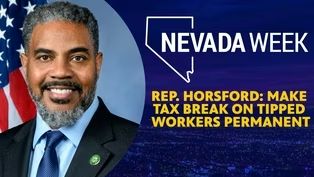
NewRep. Horsford: Make Tax Break on Tipped Workers Permanent
Video has Closed Captions
Clip: S8 Ep40 | 17m 14s | With a temporary tax break on tips in place, Rep. Horsford introduces a bill to make it permanent. (17m 14s)
Providing Support for PBS.org
Learn Moreabout PBS online sponsorship
- News and Public Affairs

Top journalists deliver compelling original analysis of the hour's headlines.

- News and Public Affairs

FRONTLINE is investigative journalism that questions, explains and changes our world.











Support for PBS provided by:
Nevada Week is a local public television program presented by Vegas PBS