
Nevada’s Veterans
Season 5 Episode 17 | 26m 46sVideo has Closed Captions
A look at the issues that are most impacting Nevada’s veterans.
A look at issues impacting Nevada’s veterans and efforts to address some of those issues.
Problems playing video? | Closed Captioning Feedback
Problems playing video? | Closed Captioning Feedback
Nevada Week is a local public television program presented by Vegas PBS
Nevada’s Veterans
Season 5 Episode 17 | 26m 46sVideo has Closed Captions
A look at issues impacting Nevada’s veterans and efforts to address some of those issues.
Problems playing video? | Closed Captioning Feedback
How to Watch Nevada Week
Nevada Week is available to stream on pbs.org and the free PBS App, available on iPhone, Apple TV, Android TV, Android smartphones, Amazon Fire TV, Amazon Fire Tablet, Roku, Samsung Smart TV, and Vizio.
Providing Support for PBS.org
Learn Moreabout PBS online sponsorshipFrom health problems related to burn pits and feelings of disillusionment as to whether their military service was worth it, a look at the issues impacting our veterans right now.
That's this week on Nevada Week .
♪♪♪ Support for Nevada Week is provided by Senator William H. Hernstadt.
Welcome to Nevada Week .
I'm Amber Renee Dixon.
Ahead of Veterans Day, a check on our vets who sometimes struggle returning to civilian life.
We discussed the problems they're facing, one of which is incarceration.
According to Veterans Treatment Court, there are 700,000 veterans in the criminal justice system, several of them arrested on charges related to trauma, addiction, and mental illness.
Nevada Week recently visited Veterans Treatment Court, where the first in-person graduation since COVID was held at the Regional Justice Center.
The yearlong program helps veterans avoid jail time while addressing issues of unemployment and homelessness.
At Veterans Treatment Court in October, the Quilts of Valor Foundation gifted graduating veterans with these elaborate handmade creations.
The quilts, a symbol of the security vets now have after completing the program.
(U.S.
Veteran) Put me on the right path.
Now I have my own apartment and no more troubles.
(U.S.
Veteran) I got arrested.
Pretty much later, I was dying.
And now I'm back over 200 pounds.
But I'm healthy.
I'm mentally stable.
(U.S.
Veteran) When I needed it the most, the court was here for me.
And for that I am forever grateful.
Today I have the support and love of my family.
And now I have a chance to be healthy and happy in their lives.
And for that I am forever grateful.
So thank you all very much.
(applause) (Shelly Berkley) What I did not realize until I started serving in Congress was that so many of the wounds are not physical.
-Former Congresswoman Shelley Berkley was the keynote speaker.
(Judge Harmony Letizia) Some of these people start out completely homeless.
They come to us, and they're dirty and they're heavily addicted.
-Judge Harmony Letizia presides over Veterans Treatment Court.
-Many of them start out with serious felony offenses.
And it's up to the District Attorney's office to negotiate those cases down to misdemeanor offenses in order to be eligible for this program.
You'll see oftentimes battery, domestic violence charges, many DUIs, obviously the substance abuse is rampant with this particular population.
(U.S.
Veteran) I don't drink alcohol anymore.
It's been the biggest savior, I think, for me, because that really did, you know, open up some scars.
-This is a yearlong program.
They are calling every single day to find out if they're called to get randomly drug tested.
And when they do, they have to stop everything in their lives and head across town to submit to a drug test.
They're involved in group counseling and individual counseling and therapy and VA appointments.
And it's not a break in any way.
The break would be to do the jail time and be done with it.
But really, we're putting them through the wringer so that they come out the other side with all the tools that they need to succeed.
(Veteran Darren Haile) I feel pretty prepared.
Everything in life worth having is not going to come easy.
I do know that.
However, my plans, next semester I will be starting up school again to go for Sports and Health Sciences because, ultimately, I want to get my doctorate in physical therapy.
-In order to graduate, veterans like Darren Haile had to develop goals, find housing, be financially stable, and drug and alcohol free.
What did you find most challenging about the program?
-The most challenging thing about the program, I think, was having to not drink for an entire year cold turkey.
-A struggle for Haile who says he developed a drinking problem which led to a DUI after an experience he had while serving in South Korea.
-Ultimately, one night of having indulging in beverages, somebody followed me back to my room, and I told them I was, like, getting ready to go to bed.
And as they were shutting the door and I had blacked out, they came back in and ultimately took advantage of me.
-We are starting to address more than military sexual trauma.
And I think that that's something that was never mentioned before.
I think that that's something that came with a lot of shame and does so much damage, and they get into this program and they actually are able to identify that that's the reason for the trauma.
-Without this program, I think I'd be probably more depressed and stressed out, being like I would have to pay extra money for, like, car insurance.
My license would probably still be suspended.
And ultimately that-- People need to get to and from work, and I'm just glad, you know, that it provided me the chance to get better.
-Haile hopes to become part of the 96% success rate Judge Letizia says the program has.
-The way I explained that is 96% of the people who graduate from this program never reoffend against our community ever again.
-That rate she also attributes to the support the court provides even after commencement.
-We are not leaving you just because you're leaving this program.
I hope you always know that.
(applause) -Veterans Treatment Court is just one of several programs helping veterans.
Others include Merging Vets and Players, whose Las Vegas Program Coordinator, Bruno Moya, joins us now; along with Shalimar Cabrera, Executive Director of U.S. Vets Las Vegas; and Charles Ramey, with the Department of Veterans Affairs, Southern Nevada Healthcare System.
Thank you all for sharing your time.
Before we jump into what each of you is seeing as far as issues that veterans are facing right now, I want to address something from the story we just saw about the increase in sexual trauma being reported, which Judge Letizia attested to and the Department of Defense says, also, there has been a significant increase in the prevalence of sexual assault in the military.
Charles, what do you think is behind this?
(Charles Ramey) Well, I think a lot of it has to do, there may not--and this is a personal perspective --it may not be a prevalence of more sexual trauma within the military as is there's more reporting, because the Department of Defense has spent a considerable amount of time and expense in making sure that people are educated and informed on what sexual harassment and sexual assault are, how to report that, and making sure people are connected to resources and making sure that they feel comfortable reporting sexual assault.
So I think I attribute it a lot to that.
I know at the Department of Veterans Affairs, as we saw, we heard the one gentleman in the story about, you know, a sexual assault probably could have spiraled that individual down a, you know, a path that he found himself on, and thankfully the Veterans Treatment Court helped them out.
But I think that getting connected to resources, you know, as quickly as possible is probably the most important thing.
And I know we do that at VA. We have a myriad of resources to deal with sexual assaults.
So I think it's very important that people report it and they find connection to address that as soon as possible.
-Shalimar.
(Shalimar Cabrera) Yeah.
Hearing about military sexual trauma as one of the reasons why someone's life can take a turn is certainly something in our organization that we see.
It's one of many different reasons why veterans come to our organization, which helps veterans who are experiencing homelessness or who are at risk of homelessness.
I think that that brings to light that so many veterans go through some type of trauma, whether it's military sexual trauma being one of them, trauma from, you know, post-traumatic stress, even trauma of being homeless in itself, right, can lead to life going a different direction.
And I think what I loved about the video, too, was it's acknowledging where they have been and meeting them with it.
And the key is we're seeing the community is really wrapping so many different types of support around a veteran, recognizing what they've been through, that they're not the same as what they-- who they were when they left, is what our veterans tell us often, and so the support for them when they're coming home needs to look different too.
And so the approach of the Veterans Treatment Court, who is a wonderful partner of ours, and so many different community partners really need to focus on, What are all the things we need to wrap around the veteran, all the comprehensive support services, to help them get back on their feet and transition successfully.
-I'd like to open it up for each of you.
What issue is top of mind for you right now that veterans are facing from your experience?
Bruno.
(Bruno Moya) Well, for one of the things that I see that I've been working with and just experiencing in the community is really just the trauma of, you know, if you look at these past four wars, the way that we've been exiting from, you know, Afghanistan, Iraq, Iraq again, Vietnam, just the way that we exit and then the accountability from our leadership up top, you know, you get out of the system, you get out of the military, you reflect on your service and all the trauma that you've incurred in the service, the way that we exit out of the these conflicts, you just start to realize, like, what was it all for?
Really, you know, especially right now, with so much division within our political system, it's just now it's become to where it's like one side is almost, is the language of our enemy, right?
And so you get out and you're like, Well, I fought for this country, why are we talking like this from all the way top, you know, the President, all the way on down.
And so you reflect on that, and it's just is like, Well, I put my life at risk for those, you know, for those military members that were in the frontlines, you know, you put your life at risk and then, you know, these guys that are-- these guys and gals that are, you know, running the country, can't even get along.
What is it for?
And so that's one of the things that I'm seeing within the community that we talked to is just the, We're tired of so much division, the way that we talk to each other, the way that the media portrays all of this, you know, from everything, you know, from all these different political ideologies.
And then, you know, you're trying to get services to try to get yourself better; but then all of a sudden, it's like all this media is being portrayed.
You know, Your neighbor is voting for Biden, or He voted for Trump, and all this stuff.
And this is like, Well, how can I get help when all of this stuff is being thrown at me?
So that's something that I see consistently in the people that I work with.
And most of the guys that I work with are men.
And so it's something that, that it's-- it's like it's a spiritual crisis almost that I'm looking at.
And also with a lot of the females as well.
-Are there parallels to Vietnam?
-Yes.
-How so?
-There are some parallels.
Obviously, the way that Vietnam veterans were treated once they left the military is 180 difference, right?
However, the way that we exited Vietnam and the way we exited Iraq and Afghanistan is-- I mean, you can cut and paste some of the things that we did.
It's almost like we didn't learn a lesson of how we exited Vietnam, how we exited Iraq.
I mean, ISIS was, you know-- Somehow ISIS flourished after we exited Iraq.
That wasn't supposed to happen.
Then now with Afghanistan, it's almost identical.
And so you're looking at that and, you know, you look at the mental health of all of these service members that were in Vietnam, Iraq, and Afghanistan, it's not too different.
I mean, there's a moral injury that our leadership, I would say-- And I don't want to finger-point, but I would say that the moral injury is part of the leadership that, you know, they're not taking accountability or looking after the best interest of why we were there in the first place.
-Shalimar, I keep hearing you nodding yes.
Do you want to add to that, and will you also say what issues are top of mind for you?
-Yeah, sure.
I mean, as Bruno was talking, what I'm thinking about is how important it is for us to recognize all the things that veterans have faced while in the service, but also how much they carry when they come out of it, right, and that difficulty and transitioning to civilian life.
And also just how important it is to recognize things like moral injury, but also the difference it can make in just how we received them, right?
And for me, as the civilian around the table, it's so clear.
Like our organization, U.S. Vets, exists because we have to recognize the service and sacrifice of these veterans and then recognize, this is why I was nodding, that for everything that they've been through, now that it's their turn to need us after they have stepped up and served for our country, it's our responsibility to really support them, right?
Like, it's a national tragedy and, for sure, a local tragedy that veterans who have worn the uniform are finding themselves homeless on the very streets that they faught to defend.
And that's why our organization exists.
But we find that the solution in helping them transition, to the many issues that they have when they come to us, is really a spectrum, right?
It has to start with prevention.
For a veteran who's facing difficulty transitioning and post-traumatic stress, we know that that can ultimately lead to homelessness, suicide, loss of support network.
So you really want to get that on the front end.
Early prevention, I think, is something we need to look at first, even from a cost perspective.
Like, it's so much more costly to take them all the way through the public care system than if we were to just address what's going on the first time we see them, right?
But all the way through to, should they make it into the homeless system, then it's wrapping comprehensive services around them.
Counseling, case management, employment services, service-enriched housing all the way through to when they can transition to their own permanent housing and then even follow them there is something we do.
We provide aftercare services, so we make sure they're not recurring to homelessness.
And all the way through, I would say the through line is for us to recognize not what's wrong with them that has led them to this situation, but what has happened to them; and then we can really honor the spirit of resilience that these veterans have.
Like, they've been through so much more than the civilian population could ever dream of having gone through.
And so once we recognize how strong they are with their training and their work ethic, and just really that sense of service and camaraderie amongst each other, if we can start to honor those things, I think all of those things combined, we can start to really tackle the issues that they're facing.
-So if PTSD is leading to homelessness, how are you responding to inflation and the price of housing being so high?
-Oh, that's such an important need.
Two solutions right off the bat for addressing homelessness is we need more affordable housing, and we need to recognize that veterans, especially veterans who are on service connected disability or other mainstream veterans, cannot afford their own housing right now.
So we have to look at other interventions and other solutions.
We're having to talk to them about sharing housing with other veterans when they're moving out, right?
Just making sure even veterans have benefits.
So many veterans in our community-- Chuck can speak to this-- have never accessed VA services that they have rightfully earned.
And it takes maybe one person, like a case manager or somebody, to help them actually go through that lengthy process.
And then suddenly, they have benefits and more opportunity, right?
And then they finally get benefits, and then the economy is not affordable.
So it's totally a community approach.
So making affordable housing is important-- we're not going to move the needle unless we have more housing that they can move into-- and then other interventions that help them to really be able to afford the economy today.
-Chuck, why are veterans not accessing the services that they have earned?
-Well, I think it's twofold.
Probably one part of it is maybe a stigma that they feel like, Hey, I don't want to step in there and take services or care away from another deserving veteran.
Or part of it may be education, I didn't realize that that was available to me.
In our community, and as Shalimar makes a very good point, we have probably about 102,000 veterans that are eligible for care, as our latest census said.
Of that, we have about 85,000 enrolled in VA health care.
And we have about, as of this year, our highest number ever, about 71,000 unique veterans accessing that health care.
The President just signed the PACT Act into law here in August.
And what that does is that expands care to about 3 million additional veterans nationwide.
And the earliest projections we have out of our community is that's going to be about another 20,000 veterans that will have access to care and services here.
So I think it's a matter of them being educated and informed on what those benefits are and then going in and applying for those benefits and connecting to those resources.
And it's-- You know, and getting that care that they've earned and they deserve.
-We're going to talk about the PACT Act ahead.
The biggest issue you think that veterans are facing right now?
-Well, I'll speak from-- Shalimar and Bruno did a great job on their explanations, and I'll speak from a healthcare perspective.
I believe the thing we have right now here in Nevada is we have a double-edged sword.
So we're 49th in the nation for nurses, 48th for physicians, 50th for behavioral health specialists per capita, 50th for primary care providers per capita.
That's kind of just the healthcare situation in Nevada.
But on the other side of that, we have a growing veterans population.
We're one of the fastest growing VAs in the nation.
So people-- There are people accessing care and services, and they're doing it at a very fast clip here, which is all good news; but we have to balance that, and the PACT Act will add more people.
So I think accessing health care, and not just with the VA but within the community, is a concern, because we at the VA don't provide all the care and services.
We provide a tremendous amount of services to include the wraparound services.
You don't see the hospital downtown having to do, you know, do homeless services or, you know, run homeless services, things like that.
But I would say, you know, being informed and educated about health care, accessing health care, and us actually being able to provide the level and quality of care.
We do a very good job at the VA with the resources we have, but we could always do more.
And we are working to hire more staff.
We gained about 300 staff this year.
Our goal is to gain about 500 more staff next year.
We're doing a series of hiring surges and that just to meet that veterans population.
But accessing health care and doing it as soon as possible when you transition from your military service or doing it as quickly as you can when, you know, with the PACT Act type things, it would be very helpful for those veterans.
-Does the VA offer competitive pay for its healthcare workers?
-We do.
The thing is, we're a federal agency.
So, unfortunately, we are dealing with a pay system for some of our specialists.
We have the-- We have three different pay systems within the VA: one for clinical providers; one for your administrative employees, which is a 50-year-old archaic kind of system that all federal employees have to do; and then we have kind of a hybrid.
But what we've been able to do with the PACT Act and some other hiring authorities that our current secretary, Denis McDonough, has given us is actually do some better pay settings, some more better salary matching with the community, having better hiring authorities, debt reduction, you know, student loan repayments.
We're offering a lot of-- a lot more services and, you know, benefits to our people who are coming to the VA now than we ever have.
And we continue-- We're going to be offering more in the future.
-Okay.
I need to get to the PACT Act, but first, I want to talk about the mental health perspective.
The VA's "National Veteran Suicide Prevention Report" came out in September.
It used data from 2020 and showed that in 2020 there were 6,146 veteran suicide deaths, the lowest number of veteran suicides since 2006.
However, it showed the suicide rate for veterans was 57.3% higher than nonveterans.
It showed that suicide was the second leading cause of death among veterans under age 45 and that in Nevada, veterans committed suicide at a rate of 47.7%, significantly higher than the national veterans suicide rate of 31.7%.
Why is this happening in Nevada?
Chuck.
-I will tell you a few things.
One suicide is too many, and I think everybody around this table would would agree with that.
I would say that what we find is the current national average estimate is approximately 17 veterans a day on average take their lives in our country.
Of that, 10 of them are not connected to VA care and services, and they're probably not connected to those wraparound services, such as what U.S. Vets offers or M.V.P.
And I think a part of that, Nevada, you know, we have a-- We're in a western state.
The Western States, in general, will have a higher percentage of suicide; and a lot of that is because I think we are a lot more rural out here, there's a higher prevalence of firearms.
And firearms are, by and large, the number one factor for how veterans take their lives.
So I think that those are a lot of the contributing factors, but I think it's isolation, it's not connecting the resources, it's not finding those people out there that can probably help you, or you're just avoiding accessing care and services.
So I think those are some of the things I see from our clinical VA perspective.
But we've done a tremendous job on suicide prevention, I think, in this community.
You know, we have a Mayor's Challenge for Suicide Prevention, which many of our-- everybody around this table supports.
We have a Governor's Challenge for Suicide Prevention in this state as well.
And we are all out there, trying to provide those care services.
And we have-- We've tripled or quadrupled the number of suicide prevention counselors we have at VA here in Southern Nevada.
We now have about six suicide prevention people who manage those programs 24/7.
And we've added an outreach coordinator as well who's going out in the community working with all of our different partners to try and inform and educate veterans of the resources that are out there.
-Do you want to quickly add something?
-I do.
You know what I would like to say is that for the nonveteran healthcare providers, they need to be also focusing and recognizing how prevalent this is among the veteran population, because I believe there's also a statistic that of those veterans who died by suicide, the majority of them had actually seen a healthcare provider within 30 days of prior to committing suicide.
And so that's an opportunity, right?
If they're seeing a healthcare provider, are we asking the right questions: Are you a veteran?
Are you having suicidal thoughts?
Because I think, again, it's prevention.
We need to all know this as a community so it's not just on the VA, because they can access health care anywhere or even, not just health care, but support groups and other, you know, mental health services where we should all be taking that opportunity to ask.
-Before we run out of time, the PACT Act, the Promise to Address Comprehensive Toxics Act, which will expand VA health care and benefits for veterans exposed to burn pits, Agent Orange, and other toxic substances.
The White House says this will impact more than 5 million veterans across generations.
Bruno, what are these burn pits?
You've experienced them in Iraq when you served.
-Right.
Yeah, so burn pits, really, when we were overseas in Iraq or Afghanistan, it's, we needed to dispose of all sorts of different things that we came across, right, whether it was ammunitions or just anything that we would find that we just didn't have access to be able to dispose of them.
So we would dig these huge holes, throw everything in there, put diesel fuel in it, and just burn it, you know?
And so all that smoke would just come up, and these burn pits were in the same areas where we would house ourselves, so our FOBs is what we call it, right?
And so we would be inhaling all of this smoke, right?
And at the time, I mean, it was a joking thing like, Hey, ten years down the line, we're gonna-- we're all gonna have cancer.
And we would all laugh about it.
And then ten years down the line, a lot of us came up with cancer.
A couple of my friends that I served with have passed away.
Just, you know, one day they were fine, the next day they went to the VA because something was going on, and then a month later they passed away from all of these different cancers that they had inside the body.
They were young, 50.
So that's, really what a burn pit is, generally speaking.
And so that's one of the leading things that we're seeing in the community of veterans coming out of Iraq and Afghanistan is healthwise.
You know, a lot of us are trying to get better.
I do-- We do a lot of jujitsu in our program.
One of the guys that I do jujitsu with, he was reiterating to all of us, like, Hey, go get checked out.
I had this thing in my lung that was, that I needed to get checked out.
I went to the hospital, and they needed to, you know, operate on it.
So it's serious, you know?
-We have run out of time, unfortunately.
We could go on and on.
But thank you all for sharing your time.
-Thank you for the opportunity.
-And thank you to our veterans and their families for their sacrifices for our country.
For any of the resources discussed on this show, including information on the new PACT Act, go to our website, vegaspbs.org/nevadaweek.
♪♪♪
Video has Closed Captions
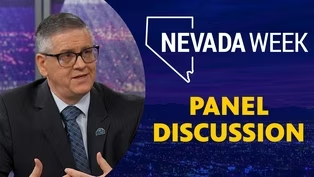
Clip: S5 Ep17 | 20m 14s | Experts working with veterans discuss the issues many veterans are facing today. (20m 14s)
Video has Closed Captions
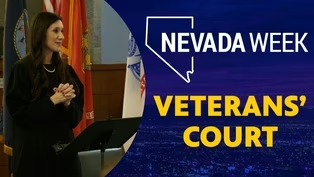
Clip: S5 Ep17 | 4m 35s | A specialty court allows veterans in trouble with the law to get help. (4m 35s)
Providing Support for PBS.org
Learn Moreabout PBS online sponsorship
- News and Public Affairs

Top journalists deliver compelling original analysis of the hour's headlines.

- News and Public Affairs

FRONTLINE is investigative journalism that questions, explains and changes our world.







Support for PBS provided by:
Nevada Week is a local public television program presented by Vegas PBS