
Nevada Lawmakers and the 118th U.S. Congress
Season 5 Episode 26 | 26m 46sVideo has Closed Captions
Two re-elected Nevada lawmakers talk about their plans for the 118th U.S. Congress.
The 118th U.S. Congress is underway in Washington, D.C. We talk to two Nevada lawmakers about what they hope to focus on during the new session.
Problems playing video? | Closed Captioning Feedback
Problems playing video? | Closed Captioning Feedback
Nevada Week is a local public television program presented by Vegas PBS
Nevada Lawmakers and the 118th U.S. Congress
Season 5 Episode 26 | 26m 46sVideo has Closed Captions
The 118th U.S. Congress is underway in Washington, D.C. We talk to two Nevada lawmakers about what they hope to focus on during the new session.
Problems playing video? | Closed Captioning Feedback
How to Watch Nevada Week
Nevada Week is available to stream on pbs.org and the free PBS App, available on iPhone, Apple TV, Android TV, Android smartphones, Amazon Fire TV, Amazon Fire Tablet, Roku, Samsung Smart TV, and Vizio.
Providing Support for PBS.org
Learn Moreabout PBS online sponsorshipThe 118th U.S. Congress is now underway, Nevada lawmakers lay out their plans for the session, this week on Nevada Week .
♪♪♪ Support for Nevada Week is provided by Senator William H. Hernstadt.
-Welcome to Nevada Week .
I'm Amber Renee Dixon.
Her close win over Republican challenger Adam Laxalt ensured Democrats would retain control of the U.S. Senate.
Nevada Week recently spoke with Senator Catherine Cortez Masto about her reelection and vision for her second term in Congress's upper chamber.
Well, Senator, we had wanted to have you on as part of a debate with your former challenger Adam Laxalt.
You agreed.
We never heard back from him.
But overall, there was a lack of debates across the country ahead of November, and I'm wondering, what do you think about whether congressional candidates should be required to debate?
(Sen. Catherine Cortez Masto) Well, I think it-- I support it in Nevada, absolutely.
I do support that we have debates and that they are broad enough that there is no partisanship on either side, that we are actually coming into it to debate policy that all Nevadans get to hear on so many venues--from TV, to print, to radio--that covers all of that, including a Spanish language.
I think it is important, and that's why I agreed to do it.
-In talking about your narrow victory over Adam Laxalt, you have attributed part of it to simply getting out and talking to voters, learning about them, finding out about their needs.
You reportedly went out to the state's rural areas and even solicited support from Republican officials.
I'm wondering what you told those rural Nevadans and those Republicans that they're now counting on you to fight for in the 118th U.S. Congress.
-Listen, I'm a candidate that was running.
I'm now an elected Senator for the last six years, honored to be reelected again.
It's incumbent upon me to get out and talk to people in Nevada.
How am I going to represent them if I don't hear the issues that, that matter to them.
And for the last six years, I've been able to do that for so many Nevadans, including in our rural areas.
That's why I've been able to fight for resources that were important for some of our rural communities, including bringing broadband into our communities that opened the door to telemedicine and telehealth and e-learning, including fighting for resources for affordable housing throughout the state, including in our rural communities, along with the important infrastructure we need in our rural community.
So that's something for me that was important that I learned just showing up and talking with them and then following up and fighting for them.
And I will continue to do so.
And listen, I said this when I won this reelection: Whether you voted for me or not, I'm going to fight for Nevadans because it's good for all of us.
When-- You know, it is true when people say that "rising tide lifts all boats."
That's what this is about.
When everybody succeeds, it's good for the state.
And that's going to be really my focus going into the next six years.
-What are those Republican officials looking for from you this session?
-Well, I think in general, Nevadans-- Listen, I was honored to have the support of not just Republicans and Democrats, but nonpartisans.
Remember, there's a lot of nonpartisans in our state.
And the focus for many Nevadans that I talked to was they just wanted people that were solving problems, that were working to address the issues they were dealing with and working across the aisle.
And to me that was just as important, and I will continue to operate in that way.
-I want to talk to you about the high cost of housing, particularly the Clark County Lands Bill which you sponsored, and was touted as a way of making more land available for development, and some of that land would be available for building affordable housing.
That bill did stall.
Do you plan on reintroducing it?
-Yes, we are going to continue.
We are still continuing to work on that bill.
It is important for so many reasons, including to address drought and other issues in our, in our community in Southern Nevada.
But housing was an important part of it.
But that's one piece of the housing puzzle.
Right now I'm getting ready to go talk to some housing advocates here in Washington that I've worked with in Nevada to really talk about what we need to continue to do to support the building of affordable housing in our state.
It's just-- It's not only the land, it's the financing, how you put it together.
It is making sure that here at a federal level, we're supporting not only the financing that incentivizes that affordable housing, but we're also supporting programs like the HOME program or other programs that will bring funding into our state to support affordable housing.
We've already seen it.
You know, the work that I have done in the past that, that right now our state legislation, the current governor, Governor Sisolak, took $500 million of the federal funds that I fought for to put it towards affordable housing in Nevada.
So that kind of cooperation and coordination won't.
No matter where you live in Nevada, I'm going to continue to address to ensure that we're bringing those resources for affordable housing.
-Clark County had reportedly pulled its support for that bill, but would not comment on why.
According to your office, it was because you had to enter into negotiations to get some bipartisan support for it, which resulted in 24,000 acres being made available for development instead of 30,000.
What kind of adjustments, if any, will you be making to get Clark County support back?
-Well, we're already talking with Clark County.
They're already on board with us.
There are, as you well know, in that bill, many stakeholders.
And the goal for me was to hear from everyone to make sure we're accommodating everybody's needs and, at the same time, getting it through a political process here in the Senate.
And I will say, I am pleased by all the stakeholders, including Clark County.
Everybody's still talking.
Everybody's still working towards that common goal.
And for me, as well as the rest of the delegation, the fight really is to make sure we finalize that and still move Clark County Lands Bill.
-Anything in particular that Clark County says you have to have in there?
-Well, there are a number of things.
It's a large bill.
But I will tell you, everybody-- And let me just say thank you to every stakeholder out there who had worked and has worked on the Clark County Lands Bill.
It's been important for so many people, and it really is about how we manage our growth.
At the same time, allow for economic development, for housing, for to address the drought, and so many other areas where we really can focus together and still allow for that outdoor recreation that we know is an economic driver in our state.
So it was a number of stakeholders coming together.
And I'm just pleased we all continue to work in the same direction.
-The volatility of gas prices, how do you ensure at a federal level that you can have affordable gas for your constituents?
This isn't an issue just for Democrats or Republicans, this is everybody coming together to lower these costs, including, by the way, big oil.
You know, if big oil we're really focused on helping us lower these costs and actually doing the drilling on the 9,000 permits they're sitting on that would put more of that supply in instead of taking those profits, these record profits that they have and giving it to their stakeholders, we would be in a better position.
This-- And that's why I have a price gouging bill that I have introduced to address this.
We have to continue to work together to lower costs for families, just like we did when we negotiated and actually passed legislation to allow for prescription drug negotiation that's going to lower healthcare costs for families.
The Inflation Reduction Act that's going to lower energy costs for our families in Nevada, that was work that was important for us to continue to focus on these high prices.
And it's something I'm committed to doing.
Another priority you've mentioned is immigration reform.
Because Republicans will be controlling the House and the 118th U.S. Congress, U.S.
Senator Alex Padilla of California recently said that, quote, It's going to be extremely difficult to get through common sense humane immigration reform, including protections for DACA participants, end quote.
What realistically do you think you can accomplish in terms of immigration reform?
-Well, let me just say this: I think, unfortunately for many of us, including some of my Republican colleagues, there is still this focus on passing DREAM, a dream act, and helping Dreamers and DACA recipients.
To me, not only is that a priority, TPS recipients, farm workers, essential workers, we should be focused on that.
And we can do that and still really make sure we're providing resources to secure and support border security in this country.
We can do both.
They're not mutually exclusive.
Unfortunately, some of my colleagues want to play politics with it on the very backs of Dreamers.
I will say this: This is a fight for me that I'm going to continue.
We are right now looking at trying to negotiate something that really focuses on Dreamers and border security at the same time.
And we're having those conversations between Republicans and Democrats.
To me, this is an important first step, and we need to continue to talk to try to move them and not give up.
And then in the next Congress, figure out what we can continue to do working together or utilizing the vehicles we have to pass this.
But it is important we get it done.
Why do I say that?
Because you and I both know.
You know Dreamers in our community.
We know them.
They're there.
They're on the front lines of this pandemic.
They have grown up in our communities and want to be a central part of it.
And they-- They really are entitled to live there and be there and be a part of it.
They want to pay taxes.
They want to be a part of our economy.
They're entrepreneurs in our communities.
That is separate from border security issues that we can also address.
So to me, this is really an issue that we need to prioritize and continue to focus on.
-If you can do both, protect the immigrants that are already living here and secure the U.S. border, what do you do about immigrants who are currently trying to get into the country illegally or plan on it?
-Well, that's the border security.
That's the conversation we're having is you can do both.
You can still have a-- fix a broken immigration system and reform it and treat people with, with respect or dignity and secure our borders at the same time, to give resources to the border patrol, to so many along the border that need to secure those borders.
Listen, it's something I know well, because as Attorney General, these are issues I worked on, on the border.
There's a lot of drug trafficking, human trafficking, weapons trafficking that comes across that southern border.
I know it because I worked with the AGs from Mexico to address those issues.
I was the only Attorney General in the state of Nevada that entered into agreements with those AGs from Mexico to address those issues.
So that's when I went, when I got to the Senate.
This is an issue I was going to continue to fight for.
First thing I did when I got here was call the head of Border Patrol, say what do you need?
What do you need in your budget to help us ensure that you have the resources and tools you need to continue to secure our border?
And I will continue to fight for that.
We can do that and, at the same time, absolutely address an issue for our Dreamers, our DACA recipients, TPS recipients, and farm workers in this country.
We can do both.
-With that Republican majority in the House, the slight Democratic majority in the Senate, what are you looking to pursue in terms of federal protections for abortion or even access to contraception like the morning-after pill?
-Well, I'll tell you, just the fact that I won is ensuring that the Republicans in the Senate can try to pass a federal abortion ban.
And to me, now we need to continue to open that door to ensure that women in this country have every right to choose their reproductive freedoms and make those decisions about their health care, without some elected representative in the room with them or dictating to them what should be done.
And that includes, to me, continuing to pass legislation like I've introduced to allow women to freely travel to states like Nevada to seek health care in the state of Nevada, from doctors who are going to be protected and not criminalized for providing that care.
And I also do believe that is important, we pass federal legislation that really gives women the right and the freedom to make these decisions without being criminalized.
-And finally, Senator, Democratic National Committee members voted to make Nevada the second presidential primary in the country, after South Carolina.
You advocated for Nevada to go first.
Why is this a big deal that Nevada does not get to go first?
-Well, I think Nevada should be first because at the end of the day-- and this is, this is really what we put in our application.
And we satisfied all the criteria that were set by the Rules and Bylaws Committee of the DNC, which is that we are a very diverse state.
The state of Nevada is a microcosm of the rest of the country.
We are prolabor.
We have hardworking families there, blue collar families that are working there, along with a beautiful diversity we have in not only the people that live there, but the geography and the type of work that is there.
So to me, if you're a presidential candidate and you come to Nevada and you can have a message that resonates with Nevadans and win Nevada support, you're going to be much better off going and competing in some of these other states because of the diversity that we have.
-U.S.
Senator Catherine Cortez Masto, thank you for your time.
-Thank you.
It was great to talk with you.
- Nevada Week also sat down with Congresswoman Dina Titus who Nevadans reelected to a seventh term, her sixth term representing Nevada's 1st Congressional District.
Well, Congresswoman, unlike the 117th U.S. Congress, the 118th Congress is going to have a House with a Republican majority.
What impact does that have on what bills you decide to support?
(Rep. Dina Titus) Well, most of my political career has been spent in the minority, and that counts the state legislature and the Congress.
So I understand what it means to have to work hard to get things done when you don't have the votes on the floor.
I think you just have to pick your battles more carefully.
You look for issues that aren't so ideological, so you can find people that you can compromise with.
I'm on the Infrastructure Committee, for example.
Roads and bridges don't know party lines.
Everybody should support that for their own district.
So there's some potential there.
And I've partnered with some Republicans on some of the animal issues, animal testing by the VA, for example.
Brian Mast is a partner there.
So I'll continue to work on those issues.
Some of the things that we were able to push in a democratic House, though, we're now playing defense.
And that would be like the abortion issues, some of the climate issues, even protecting Social Security.
-Infrastructure and animals.
Do you have particular legislation planed?
-Well, yes.
In the animal area, we have a Wild Horse and Burro Protection Act.
And that's to be sure that we have a safe healthy way to manage horses on the range.
You know, Nevada has the most wild horses.
Right now they round them up with helicopters.
And you have seen those horrendous pictures of how they just run a colt to death or something.
So I'm working with Interior and our own committees, Grijalva chairs that now from Arizona, to get that done.
But another thing is animal testing.
The VA has stopped testing on dogs, but a number of the agencies test on dogs, puppies and kittens.
And as I said, Brian Mast is my main partner there.
But people just don't want to see that because animal testing really doesn't translate to humans anymore.
-As of this recording, we are still in the 117th Congress.
And you recently introduced, along with three other members of Congress, the Impact Human Trafficking Act.
What will that do if it does become law?
-Well, we hope that it'll maybe get in the final appropriations bill.
But we've seen human trafficking just growing internationally, not just in this country.
And Las Vegas is a place where it occurs, and it occurs both for sex trafficking but also for labor trafficking, and from other parts of the world.
And we want to be sure that state, local, and federal governments can work together on this issue, that there are resources for identifying the problem, and then helping the victims.
Sometimes when an underaged person is caught for prostitution, the person is a victim because they've been trafficked, but then they become the criminal because they're the ones doing the prostitution.
We'd like to see that cleared up and address the issue here locally as well as nationally.
-About the Impact Human Trafficking Act, it was introduced at the end of November.
To me that seems awful late.
But there's got to be some sort of thinking behind it, some practicality?
-Well, a lot of getting legislation through is in the timing.
Sometimes you start something this session of Congress because you want to see it continue into the next session.
That's the way with the wild horses.
We've been working on that for a long time.
Sometimes you do it at the last minute in hopes not that the bill will pass, but that it'll be turned into an amendment to get on a bill that has to pass before the end of the session, which would be like funding the government.
-Okay.
So then it is possible that if you introduce something now, it may not get passed this session, but because it's put together already, you can reintroduce?
-Exactly.
That's right.
You've got the information, you got the bill drafted, you got the supporters lined up.
So you're ready to go.
-Okay.
Anything you introduce this session, you plan to reintroduce?
-Well, I'll continue to work on the wild horse issue if we don't get that passed.
Some of the environmental issues are very important to me here in Nevada, certainly.
Avi Kwa Ame is something that they've been working on for 20 years, and now I've just picked it up.
We think that's going to be done by the President through the Antiquities Act, but we'll continue to watch that in the next session, too.
-You brought up, and you pronounced it "Avi Kwa Ame."
-Avi Kwa Ame.
-It's interesting, though, because you talk about the environmental issues, and there's two sides of that because you are protecting some land and species on that land.
But then there are solar and wind projects that could potentially happen there to reduce greenhouse gas emissions.
They won't be able to be built there because now it's a federal monument.
How do you rationalize those?
-Well, I've been a strong supporter of renewable energy since I was in the legislature.
I had the bill that did net metering where you can generate your own solar power, sell it to the power company back and get some reduction on your own bills.
And also the Portfolio Standard, which forces the power company to buy so much solar as a percentage of their portfolio.
The projects that keep coming up on the Avi Kwa Ame monument territory are kind of wannabe projects.
They have not even been approved by the BLM.
It's just a potential thing that maybe could happen sometime in the future.
Look how much land is here in Nevada.
You can find a lot of places to put wind and solar that just don't happen to be on sacred land with lots of things that need protecting, from the cave drawings to the bighorn sheep.
-For those who don't understand the importance of protecting land like that, what would you say?
-Well, I'd say go out there and see it, for one thing.
It's not very far away, and it just has majestic vistas.
We don't need to develop every place, and people would rather have some wild area around as the other side of Nevada from our urban core.
So I say visit it and then think of protecting public land for future generations, not just today.
-And what about the need for developable land in Nevada?
How do you justify that while protecting this land?
-Well, I think again, there are a lot of places you can build that don't have to be on sacred land.
There was a lands bill this time in the Congress, it didn't get out of the Senate, but that will probably come back too because you have to provide some land for development where the community can grow.
And I certainly support that.
But you have to be selective.
You have to have sustainable growth.
You have to have the water to feed that growth.
You have to put in transportation.
So it's a much bigger, more complex issue than just throwing up a few houses on a piece of land.
-And I think you're talking about the Clark County Lands Bill.
-That's right.
-Any insight into what negotiations may have happened to regain Clark County support if it has come back?
-I think it will come back probably in a compromised, more reduced manner where the environmentalists, the County, the State, the developers are all at the table and follow it through to the end.
It kind of went awry because some interests didn't feel like they were being protected.
-Well, was it because the amount of land was reduced that would become available for development?
-Well, it went both ways: There was land that was set aside for conservation to offset the land set aside for development, and in the development part, there were provisions for affordable housing, which is very important here in Southern Nevada.
But all the different parties have little pieces of it that they weren't too happy with.
So I'm sure you'll see it come back again.
-On the topic of affordable housing, when we had you here in October, you talked about the need to create incentives for the construction of affordable housing.
Is it just not all that attractive for companies?
-Well, you have to be sure that the company can make some money on it; you don't take away all the profit margin.
But we have to build it in places where it's needed, you have to build it quickly.
You know, we put-- I think $500 million came out of the, one of the recovery bills to the state, and then the governor created the Home Means Nevada.
And it had those kinds of incentives in it and help for people to pay mortgages and get into some of these lower income projects.
-Okay.
And from what we understand, though, that 500 million will be just a drop in the bucket in terms of how many units are needed, something like 85,000 affordable housing units are needed.
So what else can be done outside of, you know, the Low Income Housing Tax Credit, which is a huge federal program.
-That is.
And that's very important if you can get that tax credit.
Also in the recovery bills, there was help for people to get mortgages and also to pay the rent.
So that's been a little helpful, too.
But the lack of affordable housing is not new in Nevada.
This has always been the case.
And it ties to the homeless population.
People can't pay the rent, they move from house to house, sleep in their car, then they become on the streets homeless.
So again, it's a complex issue that ties with other things going on.
-And that tax credit, is it at risk?
-Well, you always have to protect tax credits.
That's another one of those bills you were mentioning that comes up at the end of every session is to move those tax credits forward where, whether it's the Child Tax Protection Act or the Housing Protection or protection for investments in renewable energy.
That's a tax credit as well.
-How tired are you of talking about gas prices?
-Well, gas prices are going down.
So that makes me a little happier.
I saw $4.15, and that's still too high, but it's a lot better than $5.50.
-And that's-- It's December right now.
So this may air in January.
And who knows the volatility of gas prices?
How much really can you do at the federal level to help?
-Well, the President has opened up the reserves.
That has helped.
And certainly there's more drilling going on now with the licenses that already existed.
There's several bills that I cosponsored to go after the gasoline companies for gouging, taking advantage of the situation just to raise prices.
If you look at the profits those companies made and the salaries those CEOs have, you can see that there's obviously gouging going on.
However, the war in Ukraine continues, and that's a factor.
And then all of European inflation and dependency on oil from--was Russia and now the Saudi Arabia-- that's something we have less control over.
-Do you anticipate more bills about price gouging and potential penalties on big oil companies?
-I'm sure those will be reintroduced, and I will continue to cosponsor them.
It'll be harder, though, with the Republicans in the majority in the House.
-Congresswoman Dina Titus, thank you for your time.
-Thank you.
-The Impact Human Trafficking Act did not make it out of the House, and neither did the Wild Free-Roaming Horses and Burros Protection Act.
However, through the final bill that funds the federal government through fiscal year 2023, Titus did secure funding to help address both issues.
Nevada Week has reached out to other Nevada lawmakers, including new Nevada Governor Joe Lombardo, and we hope to bring you those conversations soon.
In the meantime, a happy New Year to you from all of us here at Vegas PBS.
♪♪♪
Video has Closed Captions
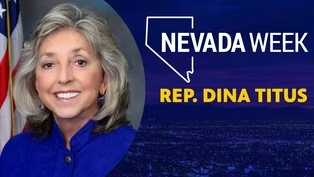
Clip: S5 Ep26 | 11m 30s | We talk with Rep. Dina Titus about the upcoming congressional session. (11m 30s)
Video has Closed Captions
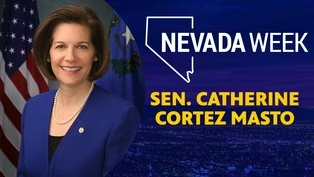
Clip: S5 Ep26 | 13m 39s | We talk with Senator Catherine Cortez Masto about the upcoming congressional session. (13m 39s)
Providing Support for PBS.org
Learn Moreabout PBS online sponsorship
- News and Public Affairs

Top journalists deliver compelling original analysis of the hour's headlines.

- News and Public Affairs

FRONTLINE is investigative journalism that questions, explains and changes our world.



Support for PBS provided by:
Nevada Week is a local public television program presented by Vegas PBS