
Native Voters Alliance NV on Special Legislative Session
Clip: Season 8 Episode 20 | 9m 28sVideo has Closed Captions
Native Voters Alliance NV Executive Director Barbara Hartzell shares the concerns and priorities.
Native Voters Alliance NV Executive Director Barbara Hartzell shares the concerns and priorities of our state’s Indigenous communities during the special Legislative Session
Problems playing video? | Closed Captioning Feedback
Problems playing video? | Closed Captioning Feedback
Nevada Week is a local public television program presented by Vegas PBS
Native Voters Alliance NV on Special Legislative Session
Clip: Season 8 Episode 20 | 9m 28sVideo has Closed Captions
Native Voters Alliance NV Executive Director Barbara Hartzell shares the concerns and priorities of our state’s Indigenous communities during the special Legislative Session
Problems playing video? | Closed Captioning Feedback
How to Watch Nevada Week
Nevada Week is available to stream on pbs.org and the free PBS App, available on iPhone, Apple TV, Android TV, Android smartphones, Amazon Fire TV, Amazon Fire Tablet, Roku, Samsung Smart TV, and Vizio.
Providing Support for PBS.org
Learn Moreabout PBS online sponsorshipAnd our special session coverage continues now with a look at how the state conducted it in a regular session, the public can comment on proposed legislation either in person, in writing or by telephone.
But in this special session, the Assembly decided not to allow public input by phone, citing time constraints.
This is one example of what Native Voters Alliance Nevada is describing as not public input, but manufactured exclusion.
And here, to elaborate is Barbara Hartzell, executive director of the nonprofit Native Voters Alliance.
Nevada, welcome to Nevada Week.
Welcome.
Thank you.
So not allowing public input by phone, how did this impact your organization and the people that you represent?
With our organization, we do a lot of work within the native, indigenous communities here in Nevada.
And so when they limited telephonic, accessibility, we're talking about tribes who live within the rural.
There is tribes that would have to travel 12 plus hours to be able to testify in person.
If, if they would even be able to be called on at that time as well.
So it's not even a guarantee that you make it to the location, testify, and that you're even going to be heard on it.
It's a reminder, a stark reminder of just how many times us as the native community, have been excluded from the process of government.
We're continuously told to show up, voice our opinions.
Yet when we work to make sure that we can include our communities, that that doesn't happen, that it's limited, it feels like our voices are not respected, are welcomed.
They're a burden.
Instead of a right.
And so really, just taking in how hard we've worked to be included in the process, how much work that goes in into the state tribes themselves.
We have our urban native population.
So and then takes all of that and we work very hard to make sure that our voices are uplifted and heard and that in these processes they're respected and that we have the input to, be able to oppose or support or even have neutral testimony when it comes to, the legislative, legislative, session.
Yeah.
From your perspective as the executive director going into this special session, how well aware were you of what was going to be proposed?
So I can't say specifically exactly like what, what was going to be within, the specific bills that were being presented.
But we work very hard to have relationships with our legislative, with our, government so that we do have some understanding.
We participate in legislative sessions.
So from the prior legislative session, we've had, we kind of had an idea of what possibly could be coming out to the special session.
So while a lot of the language, maybe amendments and stuff could be a surprise.
We do work very hard.
I want to give a shout out to our public affairs director, Matilda Guerrero Miller.
She does an excellent job of, making sure that our organization, our communities, are well informed about what's going on within our government.
How much of a contrast is that from what your organization gets to learn as being a lobbying firm of sorts, versus what the average person gets to know, the average Nevadan?
I could speak for myself.
I grew up on the Las Vegas Indian Colony here.
I had no idea how government ran.
I had no idea that local laws that, affected me every day were passing here in the state.
I thought of, like, there's not this untouchable body or entity.
And so really, that's where a lot of the work comes from, is to keep the community informed.
What is the process?
How do we move legislation?
What is this actually mean?
How can this actually impact our communities?
And so as and when we really take that into the work that we're doing.
And so that is a huge part of it.
If like especially like we call a special session in like two days and here we are having to rush to try to educate, the communities around us, our community, to inform them what this means, what this impacts, while also asking them to be included and to participate only to tell them that that participation is limited and they can't participate in that process even if they wanted to.
And when was that determined that nobody would be able to call in testimony?
I believe it the day of the day of the start of the session, and then the Assembly did not allow it, but it was happening in the Senate.
There is some context to this, to, the a special session in 2023.
Was there telephonic testimony allowed then?
I believe it was limited.
Okay.
All right.
In an open letter that you wrote about what was going on, the title is when government closes its doors in Indian Country, knows exactly what comes next.
For those who do not know what does come next for Indian Country, well, we could really look at the pattern of intent that one voices are not included when we as Indian country are, excluded out of this process.
Nothing good has ever came out of that process.
Our voices are not heard.
Laws and legislation are passed that impact us in some of the most harmful ways, that we have to then live with.
And we have to figure out how to maneuver around that and how to even figure out can it be changed, can we move forward and maybe push back on some, some of this policy?
So historically, from the time, you know, from times of like even when tribes were actually recognized, you know, there's treaty tribes, there's federally recognized tribes, even in that process, we're not included.
We weren't included on what that determined.
How was that determined?
Residential schools.
We didn't get a say.
So in that policy.
Our children were just sent off to it.
So, like, every day, we have to live with the constant erasure and the exclusion of.
But then we have to deal with the impacts of what that actually means to us and how that actually impacts us.
And so really, it was a very jarring moment to hear like that.
Again, we're asked to show up.
We're asked to be present.
We're asked to participate.
And yet you're asking our tribes like the shoe tribe, duck water tribes, to travel over 12 hours to get to a location to participate.
And then they can't, or they may not even get called on.
So, historically, we have constantly been erased even in this process.
I know we've heard that.
Oh, I didn't even think of it from your point of view.
That's the point.
That's the whole point of speaking and uplifting our voices is to make sure that we are thought of, that we are our voices are respected.
Our community is brought into the process of the time that you did have to learn about the proposed legislation in this special session.
Was there anything that you supported or opposed?
Yes, we supported, the Windsor Park bill as well as the corporate, limiting corporate corporations from buying up housing.
So we supported those two.
And then we, I believe we did not support the other the film tax, the film tax credit.
Yes.
Which was presented as creating a lot of new jobs that Nevadans would otherwise not have access to locally.
But your response was that this is an economic burden that Nevadans cannot bear.
Why?
Why is that one on one side saying, well, it's going to provide jobs, but you're saying it's going to hurt Nevadans economically?
Yeah.
It's like we could just think about like we just came from a government shut down folks access to food and housing and health care has been limited.
We see with the economy gets more and more expensive for us, to just be able to have the basic necessities.
We experienced here in Nevada, our EitC program, possibly losing their funding.
And then we're able to, fortunately be able to retain some of that.
But then us as a community stepping in to make sure, like, those programs are still being able to support our communities.
And so when we look at things like that, and then you come in and say, oh, we're going to give this almost $2 billion tax credit to a corporation that already has the resources, already has the finances, that we just came from a burden and still living within that burden to be able to afford it.
And so even with, the messaging that came from that, that's really like looking into the perspective of like just how much our communities are, are not having access to the things they need and the financial burden as it is to be able to have those things here in the state.
And so we really push back on on that with that in mind of like what we just experienced, what we've been going through.
Barbara Hartzell, Native Voters Alliance, Nevada, thank you so much for joining Nevada.
Thank you.
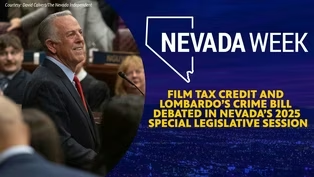
Film tax credit and Lombardo’s crime bill debated in Nevada’s 2025 Special Legislative Session
Video has Closed Captions
Clip: S8 Ep20 | 7m 54s | NV lawmakers reconvene in Carson City for the “unfinished business” of Nevada’s Legislative Session. (7m 54s)
Philanthropists offering more support to Southern Nevada’s Nonprofits
Video has Closed Captions
Clip: S8 Ep20 | 7m 59s | With less federal funding and more economic uncertainty, many nonprofits are in need of extra help. (7m 59s)
Providing Support for PBS.org
Learn Moreabout PBS online sponsorship
- News and Public Affairs

Top journalists deliver compelling original analysis of the hour's headlines.

- News and Public Affairs

FRONTLINE is investigative journalism that questions, explains and changes our world.











Support for PBS provided by:
Nevada Week is a local public television program presented by Vegas PBS