
Las Vegas Paiute Tribe on Economic Growth
Clip: Season 8 Episode 22 | 12m 40sVideo has Closed Captions
Las Vegas Paiute Tribe Chairman Benny Tso shares details on the tribe’s economic developments.
Las Vegas Paiute Tribe Chairman Benny Tso shares details on the tribe’s economic developments, the Lands Bill, and what they’re looking forward to in the future.
Problems playing video? | Closed Captioning Feedback
Problems playing video? | Closed Captioning Feedback
Nevada Week is a local public television program presented by Vegas PBS
Las Vegas Paiute Tribe on Economic Growth
Clip: Season 8 Episode 22 | 12m 40sVideo has Closed Captions
Las Vegas Paiute Tribe Chairman Benny Tso shares details on the tribe’s economic developments, the Lands Bill, and what they’re looking forward to in the future.
Problems playing video? | Closed Captioning Feedback
How to Watch Nevada Week
Nevada Week is available to stream on pbs.org and the free PBS App, available on iPhone, Apple TV, Android TV, Android smartphones, Amazon Fire TV, Amazon Fire Tablet, Roku, Samsung Smart TV, and Vizio.
Providing Support for PBS.org
Learn Moreabout PBS online sponsorshipPoised for potential land expansion, the Tribe is playing a growing role in the Southern Nevada economy, while advancing new wellness programs for its members and thousands of urban Indians.
Here to expand on those topics and more is Benny Tso, Las Vegas Paiute Tribe Chairman.
Chairman, thank you for joining Nevada Week.
-Thank you for having us.
-So the land expansion that I mentioned, that is part of the lands bill in Congress, formally known as the Southern Nevada Economic Development and Conservation Act.
We've talked about it on this program.
It's meant to open up federal land to build houses on.
There's also a conservation aspect.
And what would it mean for your Tribe?
(Benny Tso) We'd be able to put a bigger footprint for our Tribe, you know, having that much acreage added to the existing 4,000, under 4,000 acres.
It would improve our economic development, improve our traditional homelands.
We once had about 2.5 million acres, you know, spanning from Southern Utah, Southern Nevada, tip of Northern Arizona, all the way down through Southern California.
So to get that little bit back, I think, would help boost our, you know, economic development, some Tribal homes, and some-- Obviously, it would help out, you know, the surrounding areas with the growth in Nevada.
-And this would be near Snow Mountain where you already have a reservation.
And this would add on to it, and you would plan to develop it?
What would you do with that land?
Do you know?
-Right now, you know, we're still in the planning stages.
We have some ideas, potentially, for some of that land use.
Some of it we would be trying to help out, you know, the local installment of Creech Air Force Base, potentially, you know, expanding for airman housing there to help them out with some things.
And we know that the energy corridor is running through that way, so partnering up with that type of utility and being able to provide possibly some Tribal homes for our Tribe, Tribal members.
-Wow.
Are there efforts to mine in that area right now?
-Right now we're in a co-stewardship with BLM right now.
So all of those things are a no-go for potential mining.
We definitely don't want anything like that around there.
We're close to the Tule Springs monument, you know, which is part of our cultural significance of the Tribe.
That's part of our creation story.
So, yeah, I don't think there's going to be any mining up in that area.
-Okay.
And the area that we're talking about is also where the Las Vegas Paiute Golf Resort is, three courses first opened back in 1995.
How has that impacted the Tribe that you now help oversee?
-It's a huge impact.
That's one of our economic drivers for the Tribe, you know, along with our smoke shop and our NuWu Cannabis marketplace.
But I think that's taken the forefront right now.
So the focus is a little bit more on the Golf Resort, you know, new ideas, trying to bring it current.
But plans for possibly a hotel, conference center, things of those natures.
But, again, we're still preliminary.
We're still taking a look at how that would affect the land, affect the resources, and, you know, things like that.
-And then you talked about new ideas.
One of those recently came to development with the Vlasic Classic.
Tell me about that.
-I think it's the first of its kind.
It's the first full-consumption golf tournament.
And I don't know how people feel about that, you know, mixing-- -Marijuana consumption?
-Yes, marijuana consumption.
No alcohol.
They have to stay completely separated, you know, per the State and per the Tribe's, you know, regulations.
But it's a full-consumption cannabis, you know, golfer, golf tournament.
-Golf tournament.
Was that early November that that happened?
-Yes.
It was the 8th of November.
-And how did it go?
-I think it went well, well-served for the cause that, you know, that helped out-- -The Last Prisoner Project.
And will you tell us about that.
-Yeah.
So people that have been incarcerated for cannabis, you know, cannabis use, and small amounts that they are not considered, you know, prohibited now.
So what that does is that creates revenue for those inmates to be helped out with their fighting their cases, you know, getting some of those cases overturned, especially their nonviolent, you know, convictions.
So I think it's a good cause.
-People who are still serving time for a substance that is now legal in many places.
-Yes.
-The cannabis industry in Nevada, you had a big role in getting your Tribe involved in that.
You opened one of the largest dispensaries in the country at the time.
That was back in 2017.
That is the NuWu Cannabis-- -Marketplace.
- --marketplace located...?
-We have two locations.
So we have one downtown on our downtown reservation.
It's on Main Street in between Owens and Washington.
And then we have a sister store out at Snow Mountain.
-Okay.
-So that's-- We call that NuWu North.
-Okay.
And for our viewers who are unaware of the colony that you have in north, north of downtown, will you tell the story of how that came to be.
-So back in the day, Helen J. Stewart, a lot of our relatives and a lot of our aunties, uncles, grandparents, great-grandparents, they did work for Helen J. Stewart on her ranches and also worked on the Union Pacific Railroad, which passes right behind us.
So she saw the need and identified a little area of her land.
So she deeded the 10 acres to us to have, and it gave us a place to call home and it gave us a place to be able to rest, you know, as we worked on her ranches and worked on the Pacific Railroad.
And going a little bit fast forward, we did some, a little bit of work, leg work, and got a few more acres put into trust for us, and now we expanded that 10 acres to about 31 acres now.
-Okay.
So it's where you have your dispensary, also the consumption lounge.
And for how many years?
That was the only consumption lounge in town, right?
-Yeah.
It started off as a, as a tasting room so you can get what they called back then "micro doses," just to kind of get a feel for the project.
I guess the best way to explain it is like if you went to a winery and you got flights of wine, right?
And then it just grew from there to being a full-on consumption lounge.
-And with the introduction of other consumption lounges in Las Vegas, has it impacted the business there?
-No, not at all.
I think we're a standalone, you know, and I think what it does is gives us the opportunity to showcase what Tribes can do, put their mindset to it, and, you know, kind of do the things the right way and follow the regulations.
We've created our own policies and procedures.
Our regulations are along with the State's, if not more restricted than theirs.
But it doesn't; I don't think it impacts anything.
-The UNLV Cannabis Policy Institute, we had them on earlier this year.
They had a report talking about the falling prices of retail cannabis across the board.
Does that impact you?
Are you concerned by that?
-Right now, at this point in time, we do see the decline in the cannabis retail side of it.
And we're just like everybody else, too, so we're realizing a little bit of that.
But I think the way we've structured our program and the way we've adopted, you know, from 2017 up until now, I think we're prepared for it.
I think we've taken a look at some of the things, kind of forecasted some of the events and some of the happenings that are going on, and we're able to, I guess, kind of survive some of that.
One of the things that we're most proud of with our Tribe is we don't look at things for today.
We kind of forecast, you know, generations out.
So we have to do that to prolong our existence and for us to make sure, not only us as enrolled Tribal members now, but for the future generations to come.
-Do you see any correlation to the smoke shops?
I believe you had mentioned in an interview with the City of Las Vegas that you saw a downturn in the smoke shops, and you started looking elsewhere for other development.
-Yeah.
That was one of the main reasons, you know, to diversify their revenue, to not kind of put our eggs all in one basket, to be able to create and, you know, generate new revenue sources for our Tribe, just like our ancestors did before us, our old relatives did before us.
When they created the smoke shop and they did all of that stuff, you know, they gave us the opportunity to kind of look outside the box.
And they gave us a foundation to grow on.
So, you know, being, you know, on the Tribal Council now, and as the Chairperson leading the Tribal Council, I think that that falls on our shoulders as well now.
It's now it's time for us to kind of diversify, spread our wings, so to speak, and to be able to generate revenue and economic development for our Tribe.
-You also have an indoor grow facility?
-I wouldn't necessarily call it indoor, but it is, it's an outside grow.
So we have about-- There's a 110,000 square foot grow facility that we have out at the Snow Mountain Reservation.
So we've figured it out, and we kind of had that ball rolling.
So we're in between harvest right now, so the first harvest-- -The climate is suitable for that, then?
-Yeah.
Again, being able to figure things out and being able to kind of go with the flow and see what works and not works, you know, being able to grow grass out there is not too much of a difference.
-Okay.
Because that was another point the Cannabis Policy Institute had was that indoor growing is so expensive; and if interstate trade is ever allowed, it's cheaper to grow in California, it'll be cheaper to buy here, and perhaps local growers are going to be out of luck.
But sounds like you have that kind of planned out.
Okay.
A couple more topics.
We were fortunate to go to the grand opening of the gym and wellness center at the colony earlier this year.
How was that made possible?
Why was that important?
-I think-- What made it possible is, you know, the partnerships that we have and some of the federal funding that we received through the Special Diabetes Program for Indians, some HUD grants, and things like that.
The Tribe put a little bit into it.
I think what's special about that and what benefits the Tribe and the Tribal community in Las Vegas is that we're able to educate.
We're able to provide a place for nutrition, health and wellness, you know, and some traditional holistic healing, as far as that goes.
And it brings our community back together.
We're starting to lose some of our culture.
We're starting to lose some of those things, but I think having the wellness center, being able to provide nutrition classes, cooking classes, you know, craft fairs, things like that, basketball tournaments, being able to have that and the accessibleness of having that in downtown, why not?
And it's a true benefit for all of our Tribal youth.
A lot of our members are up in age, you know, trying to get there.
So getting them back on that health track and getting them back, you know, with their wellness and health, I think it's beneficial.
-And so you brought up the federal funding that made that possible.
Have any of the federal funding cuts recently impacted your Tribe?
-No, not necessarily.
Again, you know, we're a Tribe that's kind of forecasted; we kind of think ahead, a little bit ahead.
I think what helps us out is our Tribe is pretty much, you know, self-sufficient, and we try to do as much as we can for both our businesses and our Tribal members.
-Las Vegas Paiute Tribal Chairman Benny Tso, thank you so much for joining Nevada Week.
-Thank you.
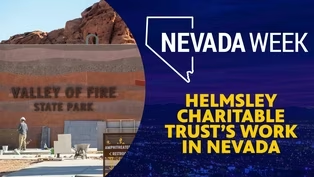
Helmsley Charitable Trust’s work in Nevada
Video has Closed Captions
Clip: S8 Ep22 | 12m 47s | From addressing rural health concerns to building a new Valley of Fire State Park visitor Center. (12m 47s)
Providing Support for PBS.org
Learn Moreabout PBS online sponsorship
- News and Public Affairs

Top journalists deliver compelling original analysis of the hour's headlines.

- News and Public Affairs

FRONTLINE is investigative journalism that questions, explains and changes our world.











Support for PBS provided by:
Nevada Week is a local public television program presented by Vegas PBS