
Moniz breaks down challenges of nuclear talks with Iran
Clip: 6/23/2026 | 8m 29sVideo has Closed Captions
Ex-Energy Secretary Moniz breaks down challenges of nuclear negotiations with Iran
To discuss the U.S. nuclear negotiations with Iran, Amna Nawaz spoke with Ernest Moniz. Trained as a nuclear physicist, he was the Energy Secretary during the Obama administration and was a chief architect and the lead technical negotiator of the 2015 Iran nuclear agreement. He’s now chief executive officer of the EFI Foundation, which focuses on energy policy.
Problems playing video? | Closed Captioning Feedback
Problems playing video? | Closed Captioning Feedback
Major corporate funding for the PBS News Hour is provided by BDO, BNSF, Consumer Cellular, American Cruise Lines, and Raymond James. Funding for the PBS NewsHour Weekend is provided by...
Moniz breaks down challenges of nuclear talks with Iran
Clip: 6/23/2026 | 8m 29sVideo has Closed Captions
To discuss the U.S. nuclear negotiations with Iran, Amna Nawaz spoke with Ernest Moniz. Trained as a nuclear physicist, he was the Energy Secretary during the Obama administration and was a chief architect and the lead technical negotiator of the 2015 Iran nuclear agreement. He’s now chief executive officer of the EFI Foundation, which focuses on energy policy.
Problems playing video? | Closed Captioning Feedback
Where to Watch PBS News Hour
PBS News Hour is available to stream on pbs.org and the PBS app.
Providing Support for PBS.org
Learn Moreabout PBS online sponsorshipAMNA NAWAZ: For more on the# U.S.
negotiations with Iran,## we turn now to Ernest Moniz.
Trained as# a nuclear physicist, he was secretary of## energy during the Obama administration and# was a chief architect and the lead technical## negotiator of the 2015 Iran nuclear agreement# known as the Joint Comprehensive Plan of Action,## or JCPOA.
He's now chief executive officer of# EFI Foundation, which focuses on energy policy.
Secretary Moniz, welcome back to the# "News Hour."
Thanks for joining us.
ERNEST MONIZ, Former U.S.
Energy Secretary:# Good to be back.
Thank you, Amna.
AMNA NAWAZ: So I want to start with your# reaction to this back-and-forth on the## issue of nuclear inspectors.
Yesterday, Vice# President Vance said Iran had agreed to allow## access to the IAEA to nuclear sites.# Today, Iranian officials are saying## that is just not true.
What do you make of# Vance's statement and the Iranian response?
ERNEST MONIZ: Well, first of all, the# issue could not be more important, frankly.
Frankly, since 2015 to this day, we have# always said that the most important part## of the nuclear dimensions of the JCPOA were in# fact the extraordinary verification measures,## and those hinge entirely upon# access by the IAEA inspectors.
So, when the vice president says that# the inspectors can come back into Iran,## that's not so special, nor is it special that# they have access to the Iranian declared nuclear## sites.
That's important.
But even more# important, which the JCPOA did have in it,## is that the inspectors could go to places# that Iran had not declared as nuclear sites,## but that the inspectors had reason to# believe may have had nuclear activity.
So it's the covert -- the# covert sites.
And, furthermore,## it's -- we're a long way from that# stage, obviously, given the exchange## that you referred to.
But, furthermore,# I believe that this negotiation has to at## least replicate what came out in 2015, namely,# that Iran agrees to the additional protocol.
That means that the inspectors can go to# sites that have not been declared by Iran,## but, furthermore, that there is# a finite time window for granting## that the access.
It was 24 days in 2015.# No other country has such a restriction.
It is absolutely critical that the inspectors# have access to potential covert sites and to have## access to them quickly enough to prevent major# cleanups of those sites before they inspect.
AMNA NAWAZ: So, to match the verification that# was in place for the previous nuclear deal,## they would have to guarantee access to even those## non-declared covert nuclear# sites, is what you're saying.
Also, on the issue of the highly enriched# uranium, the essential ingredient for a## nuclear weapon here, there was specific language# in the memorandum of understanding that was signed## that said the two nations had agreed to resolve# the disposition of stockpiled enriched material.
How can that be done?
What# would you expect to see when## the technical negotiations continue on this issue?
ERNEST MONIZ: There's two distinct issues here.
One is that, first of all, Iran, in# contrast to the situation in 2015,## had over the last few years enriched# uranium to a very high level, the 60## percent.
To give you a scale, 90 percent# enrichment is considered weapons-grade.
But I caution that you don't need weapons-grade# uranium to make a bomb; 60 percent uranium -- 60## percent enriched uranium is in fact quite adequate# to make a bomb.
You need a bit more material## than you would with 90 percent.
That's why the 60# percent enriched uranium is so sensitive, it's so## critical, because that material actually was the# last piece that Iran historically did not have in## its possession in order to make a bomb if it chose# to do so, which I don't believe they have, OK?
But resolving that issue is the absolute, in# my view, first order of business with regard## to enriched uranium.
Where is it?
What condition# is it in?
What is the risk.
Get rid of the risk,## probably by having the IAEA inspectors oversee# dilution of that material back to a very,## very low enrichment, which# would not present a danger.
AMNA NAWAZ: As you well know, these talks# are now being led by Vice President Vance,## Special Envoy Steve Witkoff, Jared# Kushner.
There are, of course,## technical teams involved in the# details of these negotiations.
But you have sat across the table from the# Iranians.
You know what it is to negotiate in## the nitty-gritty.
Are you confident that the right# people are negotiating for the American side to## see through these verification measures that you# say are necessary to at least match the JCPOA?
ERNEST MONIZ: Well, I think the# question, of course, is how they use## the technical people, who they will# need to answer various questions.
I mean, those people exist,## for example, in the Department of Energy National# Laboratories.
In 2015, when I was negotiating,## we used the National Laboratory scientists# very, very heavily.
To be perfectly honest,## we used the time difference between Switzerland# and California very effectively in order to be## able to have those scientists carry# out all the analyses that we wanted.
Now, the place -- so that's a question of the## negotiators being skillful not# only in negotiating with Iran,## but skillful in using the technical assets that# are available to the United States government.
Now, the advantage I did have, being,## of course, trained as a physicist, was that# I knew which questions to ask.
And that was## a much more efficient way of carrying forward# the negotiation, perhaps a more effective way.
AMNA NAWAZ: There is this 60-day timeline they# have set, with the possible extension if needed.
But how confident are you that a detailed# agreement can be reached within those 60 days?
ERNEST MONIZ: Well, I have to be very skeptical# that a detailed agreement can be reached in## that time.
And, of course, one can ask, how# important is it to have a detailed agreement?
My answer to that would be, it's very# important, specifically because ambiguity## is something that can be manipulated, skirted by# the Iranians in particular.
And that's why the## agreement in 2015 was over 150 pages' long.# Sure, we had the same assurances up front## that the MOU has, namely that Iran committed to# never acquiring or developing a nuclear weapon.
But our mantra was, OK, fine, but we don't trust,# and verify.
So that's why the verification was## so important.
And that's why the don't# trust was reflected in the fact that we## followed every rabbit hole, basically, to block# ambiguities that could lead to the development## of a weapon or at least to approach# the threshold of having a weapon.
And I believe that that is an essential# element, and I do not see how that could## be done in 60 days unless a lot of groundwork# has already been done, which I'm not aware of.
AMNA NAWAZ: That is former U.S.
Secretary# of Energy Ernest Moniz joining us tonight.
Secretary Moniz, thank you so much# for your time.
Really appreciate it.
ERNEST MONIZ: Thank you, Amna.

Book documents war experience for Ukraine’s LGBTQ+ community
Video has Closed Captions
'The Queer Face of War' chronicles hardships for Ukraine’s LGBTQ+ community during war (4m 42s)
A decade after Brexit, UK voters reflect on break from EU
Video has Closed Captions
A decade after Brexit, UK voters reflect on decision to break from European Union (8m 32s)
Farmers struggle as shifting weather patterns disrupt crops
Video has Closed Captions
Farmers struggle with crops as climate change makes weather less predictable (7m 45s)

How the federal student loan changes could impact borrowers
Video has Closed Captions
How the federal student loan changes could impact borrowers (6m 52s)
News Wrap: SCOTUS sides with Trump in deportation case
Video has Closed Captions
News Wrap: Supreme Court sides with Trump administration in deportations case (4m 26s)
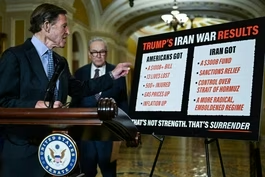
Senate votes to limit Trump’s war powers in Iran
Video has Closed Captions
In rare rebuke, Senate votes to limit Trump’s war powers in Iran (6m 27s)
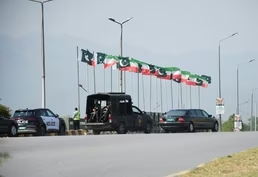
U.S. and Iran at odds over nuclear inspections
Video has Closed Captions
U.S. and Iran at odds over nuclear inspections, Strait of Hormuz fees (4m 7s)
Providing Support for PBS.org
Learn Moreabout PBS online sponsorship
- News and Public Affairs

FRONTLINE is investigative journalism that questions, explains and changes our world.

- News and Public Affairs

Today's top journalists discuss Washington's current political events and public affairs.
 New Episode

 New Episode




 New Episode
Support for PBS provided by:
Major corporate funding for the PBS News Hour is provided by BDO, BNSF, Consumer Cellular, American Cruise Lines, and Raymond James. Funding for the PBS NewsHour Weekend is provided by...