
In a challenging year, Three Square continues to serve the hungry in Southern Nevada
Clip: Season 8 Episode 21 | 9m 13sVideo has Closed Captions
Three Square Food Bank President and CEO Beth Martino sits down to discuss challenges.
Three Square Food Bank President and CEO Beth Martino sits down with Amber Renee Dixon to discuss the challenges Three Square has faced with federal funding cuts and inflation. She also shares how the organization continues to help the growing number of Nevadans looking for food assistance.
Problems playing video? | Closed Captioning Feedback
Problems playing video? | Closed Captioning Feedback
Nevada Week is a local public television program presented by Vegas PBS
In a challenging year, Three Square continues to serve the hungry in Southern Nevada
Clip: Season 8 Episode 21 | 9m 13sVideo has Closed Captions
Three Square Food Bank President and CEO Beth Martino sits down with Amber Renee Dixon to discuss the challenges Three Square has faced with federal funding cuts and inflation. She also shares how the organization continues to help the growing number of Nevadans looking for food assistance.
Problems playing video? | Closed Captioning Feedback
How to Watch Nevada Week
Nevada Week is available to stream on pbs.org and the free PBS App, available on iPhone, Apple TV, Android TV, Android smartphones, Amazon Fire TV, Amazon Fire Tablet, Roku, Samsung Smart TV, and Vizio.
Providing Support for PBS.org
Learn Moreabout PBS online sponsorship-More Southern Nevadans are struggling with food insecurity, and some for the first time.
According to Three Square Food Bank, one in six people in our area are food insecure.
That's up nearly 40% since 2023.
And with federal funding cuts, inflation, and tariffs impacting Three Square and other nonprofits, the organization is calling on the community to help.
Beth Martino, President and CEO of Three Square Food Bank, is here to share more.
Beth, welcome back to Nevada Week.
-Hi.
Nice to be here.
-We first had you on when you first got this position back in mid-2023, and, wow, what a couple of years it's been for you, even just this year alone.
I want to start.
Let's go back to March, and that is when the US Department of Agriculture announced it would be cutting about a billion dollars in funding for two specific programs that provided food to schools and to food banks from farmers and ranchers.
Southern Nevada, in Southern Nevada you are the largest hunger relief organization.
So what did those cuts look like for you?
(Beth Martino) Well, at Three Square it meant that there was food we were expecting to receive at this time of year through the summer as well that we won't be receiving.
So we looked for ways to try to fill that gap, because we were expecting to have that food on our shelves, which meant that that would have been going out to food pantries and food programs all across Southern Nevada.
So we had to find ways to supplement that.
And for us, that meant calling for more donations and food drives and also buying more food from our own financial resources.
But it also meant for us that the farms that we had been working with and local farmers, growers, food manufacturers, may also be feeling that impact.
And so we wanted to look for ways that we could try to mitigate that, and we were really fortunate that the Nevada legislature took some steps to fund a program called Home Feeds Nevada, which buys food from local Nevada farmers.
So felt really good that we were able to put that together in time and make it through the session with that package and hopefully do a little to support the food banks, but also do a little bit to support local farmers and growers.
-When you talk about those federal cuts, how much food are we talking about that impacted you?
-Well, it was about 5 million pounds of food that we would have expected to receive over the course of a year that we were unsure how much we would receive.
And I think if there's one word that seems to characterize this entire calendar year, it's been "uncertainty."
And so that might have been the first piece of uncertainty that came to us at the food bank.
But then throughout the year, we've seen more waves of things that have just created uncertainty, both for the nonprofit community and the people that we serve.
-Are you referring to the government shutdown?
-Yeah.
So the government shutdown's not entirely unexpected in that we knew through the summer that there were some challenges in getting a federal budget passed, but I'm sure that none of us thought it would last as long as it did.
Certainly didn't expect that SNAP benefits would be disrupted in the way that they were.
And that affects the entire nonprofit community, but, more importantly, it affects our neighbors, the people that we serve every day.
It affects businesses and really the whole state economy.
-So and that brings more demand on to you when those SNAP payments are temporarily stopped, as they were.
And so then the governor's response to that was to give state money directly to food banks, yours and to another's in Northern Nevada.
He also deployed the National Guard to help with packaging and distribution, teaming up with you for that.
What were your takeaways from that experience?
-Well, the State was an incredible partner for the food banks trying to find ways to meet the need while also operating within the constraints that the federal government had set out.
So I think we were fortunate to have the State come to us and say, How can we support your emergency response at the two food banks?
And to be trusted to do that meant a lot to us, because we are out here working in collaboration with so many organizations every day, but to know that the State recognized that and that we had partners there that would help facilitate that work.
So both food banks were able to be out on November 1 serving neighbors that were impacted by those SNAP disruptions.
And earlier in October, we were able to meet the need of the federal workers whose pay had been delayed, and that's all really important, because those folks are counting on their pay, they're counting on their SNAP benefits.
And to be able to meet that need in the way that we have is, I think, a testament to our state and what we do in difficult times.
-When you're talking about the State operating under federal guidelines, are you referencing that they could not pay SNAP recipients directly, the federal government had said, if you do that, you risk not getting, I believe, further funding?
-That was our understanding.
And we were in close communication with the agency that pays SNAP benefits.
And I think they were being advised that paying benefits directly might have some repercussions for the state, so they were trying to operate out of an abundance of caution.
But ultimately at Three Square, what's most important to us is making sure that people have food on their tables.
So we were just always seeking a solution and what might that be.
-The 5 million pounds of food, have you been able to recuperate that?
-So one of the outcomes of the government shutdown is the funding we received from the state allowed us to purchase additional food, and that did put more food in the community at the time that we needed it during the shutdown.
So we are actually looking, in terms of the total amount of food that we would have available, looking a bit better than we thought we might.
But we've also seen the need rising.
Just over the summer alone, our data showed a 16% rise in the number of people coming into food pantries across Southern Nevada.
And most interestingly, 75% of that increase were first-time visitors.
So we're seeing people who had not experienced need before coming out looking for food assistance.
-The USDA, when asked why you are making these cuts to the two programs, said that they were short-term programs with no plan for longevity and that these moves were a return to long-term, fiscally responsible initiatives.
How would you respond to that?
-Well, it's true that some of the cuts that have been implemented were covid-era programs.
The challenge, however, is, we believe, many people believe that we recovered from some of the economic impacts of the pandemic, when, in fact, as you mentioned at the start of this segment, we've seen a 40% rise in food insecurity over the last couple of years.
So what that tells us is we actually aren't seeing things return to prepandemic levels, whether it's food insecurity, housing assistance.
Many other needs in our community have just continued to rise since the pandemic.
So to pull those programs back at a time when people need them is really challenging, and it's not just for Three Square but for many of the organizations that we work with as well and certainly for the people that we serve.
-Supply chain issues, inflation, those have been present since covid.
Add in tariffs, how big of an impact are tariffs making on you?
-Well, rising prices are affecting the people we serve at the grocery store.
So if you're going in to buy groceries and your dollar doesn't go as far, then that means you're looking to food assistance to try to fill that gap.
And whether that's a program like SNAP at the federal, state or federal level or whether that is a food pantry, you have to find a way to put food on the table.
And your dollar is just not going as far.
And tariffs have an impact on that as well.
But at Three Square, inflation and tariffs also means that we're paying more for food.
So at some point, our dollar might not go as far.
And so it really, when we see rising costs, it really affects all of us in different ways, and I think we have to be mindful of that.
-What about the quality of food you're able to provide amid these cuts?
We were talking about fresh produce.
Is that still available?
-We've actually been remarkably successful over the past few months in sourcing fresh produce.
There are certainly times when we are sourcing things that may not be the quality that we want, especially when we're trying to meet a need that has tripled overnight.
But generally what we have found is that we've been able to kind of circumvent a lot of supply chain issues.
We have a great team at Three Square that works really hard to make sure we're bringing in those kinds of things.
And last year, of the food that we distributed, which was about 48 million pounds of food, almost half of that was produce, meat, and dairy.
So more than half of what we're distributing kind of falls into what most people would traditionally classify as healthy foods.
-What do you want people watching to know?
-It's a time right now, heading into the holidays and the end of the year, when we see a lot of need in the community and for folks to take care of their neighbors.
And you can do that by checking on someone in your neighborhood, or you can do that by reaching out to organizations like Three Square.
If you're in a position to help, there are ways you can donate your time.
You can donate food or funding.
But on the flip side of that, if you're someone who needs help, I want folks to know they're not in this by themselves.
They're not in this alone.
You can turn to Three Square.
You could check our website and find where to go to get assistance.
And there are many other organizations that can help you through whatever the difficult time is you're having.
-All right.
Beth Martino with Three Square Food Bank, thank you so much for joining Nevada Week.
-Thanks for having me.
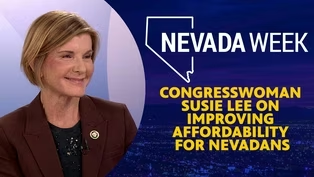
Congresswoman Susie Lee on improving affordability for Nevadans
Video has Closed Captions
Clip: S8 Ep21 | 15m 56s | NV Congresswoman Susie Lee discusses the work she’s doing on a wide array of subjects. (15m 56s)
Providing Support for PBS.org
Learn Moreabout PBS online sponsorship
- News and Public Affairs

Top journalists deliver compelling original analysis of the hour's headlines.

- News and Public Affairs

FRONTLINE is investigative journalism that questions, explains and changes our world.











Support for PBS provided by:
Nevada Week is a local public television program presented by Vegas PBS