
Helmsley Charitable Trust’s work in Nevada
Clip: Season 8 Episode 22 | 12m 47sVideo has Closed Captions
From addressing rural health concerns to building a new Valley of Fire State Park visitor Center.
From addressing rural health concerns to building a new Valley of Fire State Park visitor Center, we look at the work the Helmsley Charitable Trust is doing in Nevada
Problems playing video? | Closed Captioning Feedback
Problems playing video? | Closed Captioning Feedback
Nevada Week is a local public television program presented by Vegas PBS
Helmsley Charitable Trust’s work in Nevada
Clip: Season 8 Episode 22 | 12m 47sVideo has Closed Captions
From addressing rural health concerns to building a new Valley of Fire State Park visitor Center, we look at the work the Helmsley Charitable Trust is doing in Nevada
Problems playing video? | Closed Captioning Feedback
How to Watch Nevada Week
Nevada Week is available to stream on pbs.org and the free PBS App, available on iPhone, Apple TV, Android TV, Android smartphones, Amazon Fire TV, Amazon Fire Tablet, Roku, Samsung Smart TV, and Vizio.
Providing Support for PBS.org
Learn Moreabout PBS online sponsorship-We move now to Valley of Fire State Park and its new visitor center.
The Moapa Band of Paiutes provided Tribal consultation for it, given that its location lies within the Tribe's ancestral lands.
Designed to educate and inspire, the center has several notable features, like a 200-seat outdoor amphitheater and an indoor facility where you can watch an orientation video narrated by William Shatner.
A $7 million grant from the Helmsley Charitable Trust, along with a matching $8 million investment from the Conserve Nevada program, made it possible.
A hotel and real estate mogul in the 1980s who the media nicknamed the "Queen of Mean," Leona Helmsley and her husband created the Helmsley Charitable Trust and made their grandson, Walter Panzirer, one of its trustees.
He joins us now.
Okay.
So mental health, telehealth, and rural healthcare are your priorities.
How does the donation to the Valley of Fire Visitor Center, $7 million, fit into that?
(Walter Panzirer) Well, that's a good question.
It totally fits into it.
I'm a firm believer that everybody needs to have access to open spaces, access to the outside, access to recreate and get exercise and just mental health breaks out in the open.
So with the opening of the Valley of Fire new Visitor Center, it allows people to better access their parks, to get out there, to know what opportunities are available at Valley of Fire.
That visitor center, old visitor center, was wonderful, but it served its purpose.
It was built in the 1950s back when Las Vegas and the valley was, had far less population, and it's so outgrown.
And so this new visitor center will serve Nevada for now and probably for many, many decades to come.
-Let's talk about private philanthropy's role in rural healthcare.
Your passion for rural healthcare stems from your time as a first responder in South Dakota.
You saw firsthand how different access to healthcare is depending on where you live.
-Absolutely.
I am so passionate about rural healthcare.
I started my career in Oakland, California, so I saw a system where people had access points.
And when I moved to South Dakota, I saw there wasn't a lot of access points.
There were a lot of competent individuals--doctors, physicians, nurses, other first responders--but the technology was lacking, and that spurred my passion when I came to the Helmsley Charitable Trust.
I saw the haves and have nots, and I saw that people's zip codes determined healthcare outcomes.
And that's not right.
Everybody deserves healthcare equity.
And that's what we do at the Helmsley Charitable Trust is level that playing field in a variety of ways--by bringing technologies, by taking those risks out in rural communities to make equity across the healthcare divide.
-What are you most proud of here in Nevada?
-There is so much I'm so proud of.
We've been in Nevada almost five years.
And in that short time, we've invested over $62 million across the entire state.
We have helped every critical access hospital.
We have helped every county.
Two of the projects that stand out on my mind that I'm most excited about and it has made a huge amount of difference across Nevada is, one, our ECMO program.
We expanded beds across, ECMO beds, which is reserved for the sickest cardiac and pulmonary patients across Nevada.
-That acronym, will you pronounce it?
I don't know how to.
-ECMO.
-But Extracorporeal Membrane Oxygenation, what in the world does that even do?
-What it does-- I'll bring it down to the layman's level.
-Yes, please.
-What ECMO does is basically works as your heart and works as your lungs.
-I mean, rural hospitals ability to afford something like this is... -Yeah.
It doesn't exist.
-It wouldn't have happened.
-It would not happen.
And even having ECMO centers, it didn't even happen in Nevada.
It was very much not used across the state.
So when we came in and made this investment, we expanded services in Southern Nevada over at UMC for child and adult ECMO and also ECMO services at Dignity Health - St.
Rose.
And then up in Northern Nevada at Renown Health, we brought a brand new service line of ECMO.
So now the state's pretty much covered.
So wherever you go for tertiary services, you can access this type of service if it's needed on it.
But that, when I think-- When you say, What has been the most impact, biggest impact?
Hearing those ECMO stories.
We had a 45-year-old gentleman saved, able to return home to his family, who had a massive heart attack and was placed on ECMO to live up in Northern Nevada at Renowns.
In Southern Nevada, a 17-year-old had a cardiac arrest, a witness cardiac arrest.
He was placed on ECMO.
He's alive today.
And seeing those faces and hearing those stories is what makes it so meaningful.
The second point that is really impactful that we've done as a grant was across all of our service states' areas, we placed AEDs in first responder vehicles.
And that's very important.
When you talk about an AED, an automatic external defibrillator, in first responder cars, what we've learned and what we've seen, we have saved over 700 documented saves of people surviving sudden cardiac arrest.
When you think about that, 700, that's like a small town.
-Now, one, I guess, critique of private philanthropy in healthcare is that, sure, you may buy these wonderful machines, but then are you there paying for the maintenance?
And what if a hospital closes down and there's no one to even operate the machine?
-Well, we're very concerned about hospital closures.
That's something that can be a reality, but that doesn't keep us from funding these small critical access hospitals.
We like to say we don't write checks, that we're long-term partners.
So, for example, when you say "machines and training," we also have a point-of-care ultrasound initiative that we've done across Nevada.
Very important to have point-of-care ultrasound for diagnostic tools in rural clinics.
We've even done it in urban clinics.
-What does that mean, point-of-care, for those who don't know?
-For those that don't know what point-of-care is, it's a small, little ultrasound machine that the physician can just use bedside.
They don't have to send you somewhere for a lab or anything.
They can do the scan.
It's not just for OB.
It can be used for cardiac.
It can be used for different types of ailments as well.
So it's pretty much standard of care.
All across Southern Nevada, all across Reno, you see these machines in your primary care offices, not so much in the rural areas and not so much in more of your impoverished areas.
So the trust, several years ago, made a grant to provide point-of-care ultrasound in lower income clinics, urban clinics, rural clinics, rural hospitals.
And we've also partnered with Great Basin College, where-- to provide the training, because it's so important to make sure you have the trained sonographers.
And so we expanded the training program at Great Basin to provide that training for the new machines that are going all across Nevada.
-There was a program that we had you on when you were here last when your trust, this trust had just entered Nevada, and it was providing law enforcement in rural areas with iPads that can connect to a mental health professional, because you have faced it yourself.
You're going out to a call, and really what needs to happen is a mental health intervention.
How has that worked?
-Well, that has been going-- It's still ongoing.
We're in nine counties.
And I got to say, across where it's been working--we're also in South Dakota as well, and we've expanded into Wyoming.
So it's across all of South Dakota and now expanding in Wyoming.
And where we've seen successes is when it's utilized.
So in these nine counties that are the high utilizers, we have seen it in Nevada, keeping Nevadans at home 80% of the time.
That's huge.
Where before, if they would, they would be conservative.
Because if someone's threatening suicide, threatening self-harm, they take them to a higher level of care.
Or they could end up in a jail.
And so when we're able to keep 80% of the people at home in their community, that's a huge cost savings for the county, because you got to remember, some of these rural counties are coming all the way down to Las Vegas for beds or all the way over to Reno for beds, and now-- That takes deputies and EMS workers out of their county.
So it's keeping the county workers there, saving the county money, and also keeping the patients where they need to be, because not every patient needs that highest level of care.
If they can be served in the community, that's what's best for the patient.
-What is keeping counties from utilizing this to its full potential?
-I think it's something where it's new.
This is, this is a brand new technology.
This is something that's a new tool kit.
So it sort of takes some time to develop change.
And I'm very confident.
I look at how South Dakota, when our first state, where we launched that, has embraced our virtual crisis care.
-Internet access can also be an issue out in rural areas.
Is that something you're confronting?
-Yeah.
In some states it is.
It can be a challenge, especially as we work with telehealth.
I got to say, Nevada, from all the past governors, has really utilized broadband and really utilized the federal broadband funding.
So Nevada is in a much better place than some of our other states that we work with.
But it still can be a challenge.
-Okay.
Last topic.
Private philanthropy, how much can it help in a system-- So many rural hospitals have populations that utilize Medicare and Medicaid, and that funding is always at threat of running out.
Can private philanthropy fill that role?
-Private philanthropy cannot totally fill that role.
It's never a substitute for reimbursements or payment structures and those type of things that is necessary for the smaller hospitals to operate in the black and operate in a profit and reduce their risk of closing.
-So payment structures like-- -Payment structures-- - --like employee salary-- -Yeah.
Employee salaries or anything like-- It's not a substitute for the fee-for-service for what they're getting back on the insurance.
-Okay.
-Where philanthropy can come in and be so impactful is taking those risks, bringing new service lines that should be sustainable.
That's the key.
When the Helmsley Charitable Trust brings a service line, we look to make sure that the hospital can afford it after the grant's out and afford to keep on running it.
It's key, because we never want to come in and introduce a new service line--whether it's a cardiac cath lab, a cancer center, fill in the blank on it--and have that disappear after the grant, because that does more harm to the community.
Because the community gets used to the service, the community wants that service, but if the hospital can't afford to maintain it, we failed as a funder.
But it's the funder or the philanthropy's role to come in and really push the envelope of risk.
It's pushing those envelopes.
-Walter Panzirer, thank you so much for joining Nevada Week.
-Thank you for having me.
I greatly appreciate it.
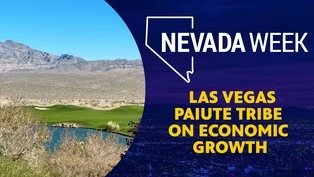
Las Vegas Paiute Tribe on Economic Growth
Video has Closed Captions
Clip: S8 Ep22 | 12m 40s | Las Vegas Paiute Tribe Chairman Benny Tso shares details on the tribe’s economic developments. (12m 40s)
Providing Support for PBS.org
Learn Moreabout PBS online sponsorship
- News and Public Affairs

Top journalists deliver compelling original analysis of the hour's headlines.

- News and Public Affairs

FRONTLINE is investigative journalism that questions, explains and changes our world.











Support for PBS provided by:
Nevada Week is a local public television program presented by Vegas PBS