
Finding Solutions for Nevada’s Housing Crunch
Clip: Season 8 Episode 38 | 16m 6sVideo has Closed Captions
Nevada’s housing administrator explains a new 2025 legislative bill to boost attainable housing.
Addressing Nevada’s affordable housing crunch takes a lot of different efforts. One launched by a bill passed in the 2025 Legislature aims to increase attainable housing. The administrator of the state housing division explains what it means.
Problems playing video? | Closed Captioning Feedback
Problems playing video? | Closed Captioning Feedback
Nevada Week is a local public television program presented by Vegas PBS
Finding Solutions for Nevada’s Housing Crunch
Clip: Season 8 Episode 38 | 16m 6sVideo has Closed Captions
Addressing Nevada’s affordable housing crunch takes a lot of different efforts. One launched by a bill passed in the 2025 Legislature aims to increase attainable housing. The administrator of the state housing division explains what it means.
Problems playing video? | Closed Captioning Feedback
How to Watch Nevada Week
Nevada Week is available to stream on pbs.org and the free PBS App, available on iPhone, Apple TV, Android TV, Android smartphones, Amazon Fire TV, Amazon Fire Tablet, Roku, Samsung Smart TV, and Vizio.
Providing Support for PBS.org
Learn Moreabout PBS online sponsorshipFinancing plays a pivotal role in the development of housing, and it's why the state is getting into the lending business.
Assembly Bill 540, one of Governor Joe Lombardo's bills last legislative session, established the Nevada Attainable Housing Account with the goal of functioning like a revolving fund so that money paid back on loans can be used to finance more housing in the future.
It's a move more states are taking to tackle the country's housing shortage.
And here to explain is Steve Aichroth, Administrator of the Nevada Division of Housing.
Steve, welcome to Nevada Week.
(Steve Aichroth) Thank you, Amber.
Thank you for having me.
-And AB540 certainly does a whole lot more in the affordable housing space in addition to this lending aspect, and we're going to cover all of it ahead.
But let's first take a step back.
And there are people who are moving to Nevada who say, Wait, the housing here is much more affordable than where I'm coming from.
How do you explain this issue to them?
-Well, ever since the pandemic really occurred, and post-pandemic, we've seen a great influx of folks from neighboring states, from all over the country, really, who see the opportunities in Nevada.
But it's causing a crunch, because we do have greater demand and not enough supply.
Now, that's happening even from places they're leaving, that there is a supply issue throughout the country.
And really that was the crux of AB540 was to increase supply for attainable funds, attainable housing for Nevadans.
-So it's a supply issue, and so the state, partly, is going to help developers build housing by giving them some financing.
And what kind of homes are we talking about here?
-So it really runs the gamut.
When we were looking at developing AB540, it was envisioned as being sort of holistic to cover everything from literally zero income folks up to 150% of AMI folks.
So that's-- -"AMI" being Area Median Income.
-Yes, sorry.
I'll try not to speak in housing vernacular.
-How would you simplify that, though?
That is the median of what people are making in-- -In a particular county in Nevada.
-And for Clark County, I believe that's about $94,000?
-Sound right, yeah.
-Typical family of four?
-Yes.
-Okay.
-Yeah, two earners.
So effectively, when it was developed, it was gone through what was the Governor's Housing Task Force.
And this was a group, and there was probably 20 to 30 of us forming this legislation before it was introduced to the state legislature.
And one of the things that we really focused on was creating home ownership opportunities for middle-income earners.
So part of it was peeled off.
It was originally 175 million.
So that's why we get to this wonky number of 133.
It was 175 million.
21 million was peeled off for rental assistance throughout the state of Nevada, and another 21 million was peeled off for supportive housing services, which the division is also administering.
So that left 133 million that you now see in the bill as it was passed.
-Okay.
And so that is for housing for lower-income folks that's going to be built as well as, would you say, middle income?
Oh, 100%, yes.
-And that's the 150% AMI, which means that a family making about $150,000 can use this.
-Potentially, yes.
Really, the, the way it was designed, we're going to support multifamily developments, so apartment development for those below market rate.
So you know, most of the programs we run at the division will be for 60% AMI and lower.
That is pretty typical.
We can go up to 80% area median income-- sorry --in some cases, but once you get above 80% of area median income, there are really no resources available to assist folks in their housing.
And as you and everybody else knows, it's been well documented, virtually everybody at an average income has potentially a housing issue.
-Yeah, it's tough, because you're so right about that.
But then there are so many low-income people in need of housing.
And according to the National Housing Coalition, there's about a 78,000-unit shortage.
How do you justify money going toward middle-income earners?
-Because we need it all across the spectrum.
There is a component to the AB540 bill that actually addresses, like low-income housing tax credit development, which is our traditional financing.
And in the initial awards, we've provided funding to two particular projects here in Southern Nevada.
And so we are addressing that through this fund.
But really, the idea is to create home ownership opportunities.
That was really what the focus of the task group was.
And the idea being, yes, Nevada has lots and lots of renters; but if we can create homeowners from those renters-- In other words, they're already paying 1,500, potentially 2,000 and up in rent.
That'll cover a mortgage in many, many cases.
So if we can provide them the ability to actually get into home ownership, that does two things: Number one, it builds generational wealth, creates a better sense of community, all those things that come along with home ownership.
But it will also free up an apartment for somebody else to come into.
So it kind of works its way up the ladder, if you will.
-So the developers who are building these homes using the state funds, they do have to repay this money.
And that's part of this revolving fund.
When did the state become aware of that idea?
It seems kind of new across the country.
-Yeah.
It is new across the country.
And so the Nevada Housing Division, effectively, is the state housing finance agency.
There's 54 of them across the country.
50 states, each state has one, DC, New York City has their own, Virgin Islands, and Puerto Rico.
So we all typically are tax credit allocators to develop that traditional affordable housing that I first mentioned, the Low Income Housing Tax Credit projects.
-Which is a national level.
-Right.
That is federal monies and authority that come in from the federal government.
And that's been our traditional role.
Well, again, post-pandemic, from the standpoint of a housing finance agency and every housing finance agency are feeling pressures to do things differently.
And a lot of it was emergency rental assistance and making sure people were housed stably during the pandemic.
You know, there's homelessness issues.
There's the whole ecosystem of housing issues that typical housing finance agencies deal with.
As we come further out from the pandemic, we are all seeing the same struggles for middle-income earners.
So there's probably a handful of states that are doing exactly what Nevada is doing.
And I'm not going to say we're late to the game.
We were able to model some of our programs or at least see the successes and some of the challenges that other states were having as we developed this.
-We talked on the phone ahead of this about the Home Means Nevada initiative.
You were in this role when that was rolled out.
Those were ARPA funds from the pandemic.
That was Governor Steve Sisolak.
I think $500 million for affordable housing in the state.
That sounds like a giant number.
And I believe you told me, you know, We thought it would be easy to give that money away, and we learned it's not so easy.
It's more nuanced than that.
Is that part of this discussion?
What did you learn from that?
-So thank you for the question and bringing it up, because that was a huge investment.
So those are federal funds.
That was the largest amount of monies, if you will, that was ever provided to the State of Nevada for housing.
The attainable fund complements and builds on that, because that's the single largest investment of state funds.
And there is a difference between federal dollars and state dollars and the flexibilities that you can do those things.
So to go back to the ARPA funds, we were restricted at basically 80% of area median income.
-And those were one-time use funds.
-One-time use funds.
-Whereas, this Attainable Housing Account-- Please continue.
I don't want to cut you off.
-No.
That's fine.
However, as you mentioned, it's hard to give this money away.
A lot of that money at the ARPA, SLFRF funds, actually went out as loans to some of these multifamily developments.
So that money will return.
It will be a long time.
It'll probably be about 20 or 30 years before that comes back.
So somebody in my seat, you know, in 20--, I don't know, 2040, 2060, is going to see this money come back to the state, and it's going to be like, Where'd this come from?
-Oh, wow.
Okay.
So that was the 500 million?
-That was the 500 million.
-I didn't realize there was any return on that.
-Yeah.
Long time, but-- -Okay.
And compare that to what you're doing now, that's a shorter amount of time?
-Right.
What the Division is trying to do is parlay that 133 million, if you will, a number of times in a shorter period of time.
So when we were looking at the funding projects that we were going to award, we really honed in on a couple things--certainly the financial capability of the developer to do the project, but, really, how fast could those monies return and the project readiness.
-I'm glad you brought up the project readiness and the ability to repay the loan, because you just came from a project.
And please tell us about that.
-Sure.
That was the Paradise Trails project.
It's literally around the corner from your studios here.
It's 29 homes, so it's a small project.
It's an infill project.
They received, or will be receiving, up to about 800,000.
To use 800,000 to create home ownership opportunities for 29 families to make that affordable and attainable is a pretty good return on investment.
So in that particular instance, that's actually going to be married with some things that the builder is doing, and then we will be providing on those particular homes, if you qualify, down payment assistance.
And they will-- The developer is doing an interest rate buydown and reducing some of the cost of homes.
So what a great way to do this.
Now, that money, because it's down payment assistance, won't return in two to four years unless somebody moves, because it is the Housing Division will actually have a second on the home.
So it's not forgivable; you will have to pay it back.
But it will allow somebody to literally get into those homes for probably starting at about $2,000 a month.
-There is an aspect of affordable housing development that deals with financing, where these are built and then, after a certain amount of time, they can become market rate housing.
Whoever owns them can say, I'm going to now charge what a regular apartment complex would charge, for example.
How are you preventing that from happening with the units that you are financing?
-So there's a couple ways that we do that.
And what you're really referring to is our traditional low-income housing tax credit properties.
The first thing is if they sign with the Division, if the Division is providing them debt financing, they have to be affordable for 30 years.
Depending on the program they go through, potentially up to 50 years.
So there's a 30- to 50-year secure, it's going to be affordable.
They can get out, per federal law, at 15 years if they choose to.
The Division has, when we issued the tax credits at the very beginning, at the outset, requires that developer to waive the right to do that.
So the only way that a developer is not going to meet that 30-year criteria is if they foreclose--the property gets foreclosed upon, and they get into some financial troubles, things of that nature.
Very rarely happens.
These are really, really safe investments, and they are investments for the investors, the developers in the state.
So and then we'll come through, typically at about 15 to 20 years, working with the development community to preserve those.
And so sometimes it's what we call preservation and rehabilitation, where we'll come through, we'll provide additional tax credits, which will incentivize them to go for another 30 years.
So we have a couple of tools in our tool belt.
They're limited because of the federal funding that is provided.
And then we also have gap funding.
And you know, we've historically used things like state tax credits, which we'll be out of.
So we're going to go to the next legislative session saying, Hi, can we have some additional state tax credits?
We were allocated 40 million in 2019.
We didn't even effectuate those because of the pandemic, because they're a hit against the general fund.
But in the past, this upcoming year, and the previous three years, we'll have expended all of those tax credits.
-And I nearly forgot one of the most obvious questions.
What about tariffs?
How are they impacting these developments?
-So we've seen it.
Not just tariffs, interest rates, land costs, virtually everything that comes down the pike is kind of going against the tide, if you will.
That's the world we live in.
So, yes, we try to be as judicious as we can when we underwrite a project and make sure it works.
Developers are savvy.
And the developers who typically play in with the state and the federal government, particularly in the tax credit program, they're incredibly smart, because it's a different kind of development than what a traditional market rate developer will do.
And thank God we have them, because it is a little bit burdensome.
But the mission is right.
So that's not to put shade on those developing any kind of housing, but the-- in the affordable space, you kind of have to have a passion for it.
-It's complicated.
-It's extraordinarily complicated.
So we see those, whether it's tariffs, whether it's interest rates, we're trying to work through that all the time.
And, yeah, it's just, it's the game we have to play.
-All right.
Steve Aichroth with the Nevada Division of Housing, thank you for joining Nevada Week.
We hope to have you back on.
-Thank you, Amber.
 New
NewHow a New Family of Drugs Can Work for Alzheimer’s Patients
Video has Closed Captions
Clip: S8 Ep38 | 4m 6s | A new class of drugs targets brain proteins to fight the effects of Alzheimer’s Disease. (4m 6s)
 New
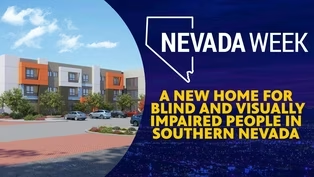
NewA New Home for Blind and Visually Impaired People in Southern Nevada
Video has Closed Captions
Clip: S8 Ep38 | 5m 28s | The Blind Center of Nevada opens new low-income housing for the blind and visually impaired. (5m 28s)
Providing Support for PBS.org
Learn Moreabout PBS online sponsorship
- News and Public Affairs

Top journalists deliver compelling original analysis of the hour's headlines.

- News and Public Affairs

FRONTLINE is investigative journalism that questions, explains and changes our world.












Support for PBS provided by:
Nevada Week is a local public television program presented by Vegas PBS