
Film tax credit and Lombardo’s crime bill debated in Nevada’s 2025 Special Legislative Session
Clip: Season 8 Episode 20 | 7m 54sVideo has Closed Captions
NV lawmakers reconvene in Carson City for the “unfinished business” of Nevada’s Legislative Session.
Nevada lawmakers reconvene in Carson City for the “unfinished business” of Nevada’s Legislative Session.
Problems playing video? | Closed Captioning Feedback
Problems playing video? | Closed Captioning Feedback
Nevada Week is a local public television program presented by Vegas PBS
Film tax credit and Lombardo’s crime bill debated in Nevada’s 2025 Special Legislative Session
Clip: Season 8 Episode 20 | 7m 54sVideo has Closed Captions
Nevada lawmakers reconvene in Carson City for the “unfinished business” of Nevada’s Legislative Session.
Problems playing video? | Closed Captioning Feedback
How to Watch Nevada Week
Nevada Week is available to stream on pbs.org and the free PBS App, available on iPhone, Apple TV, Android TV, Android smartphones, Amazon Fire TV, Amazon Fire Tablet, Roku, Samsung Smart TV, and Vizio.
Providing Support for PBS.org
Learn Moreabout PBS online sponsorshipwe begin with the close of the state special legislative session.
It lasted seven days, stirring concerns over transparency and accessibility, and has now left Republican Governor Joe Lombardo with a tough decision.
He called the special session and set its agenda to include his own crime bill.
But the version of that bill that the Assembly and Senate passed now has language in it, similar to a measure he vetoed in the regular session.
What that language is and why legislation to bring major film studios to Las Vegas did not pass.
For that, we bring in Tabatha mueller, Capitol bureau chief and government accountability reporter for the Nevada Independent.
Tabatha, thank you for joining us.
Are you still in Carson City, or have you made your way back home?
I've made my way back home, but we're still not too far because we still have a few more things to do.
So.
Right.
Well, let's start with that film, bill.
It narrowly passed out of the Assembly.
What do you know about why it did not get out of the Senate?
I mean, when we spoke to lawmakers after the vote, there were at least three who were very much sort of making that last minute decision, and all of them said, look, we really considered and weighed the pros and the cons, right?
We talked about this legislation as a way to generate thousands of jobs for Southern Nevada during a time where there's a lot of economic uncertainty.
And so I think lawmakers were considering that and the fact that this would have put sort of the state in a fiscally, you know, sort of precarious position.
Right?
We're talking about $120 million in transferable film tax credits that companies, film companies could receive them.
And then sell to other companies to offset their tax burden.
And, you know, we either would have had to find a way to raise revenue in the future or to kind of take a little bit of a fiscal hit to the state budget.
And ultimately, what those lawmakers said was, look, we just it doesn't pencil out for us, okay?
The governor's crime bill, according to the former sheriff, it will put teeth back into Nevada's penal code.
It did pass out of both chambers.
It'll increase penalties for a slew of crimes.
It'll also reestablish that corridor court for people who commit crimes in tourist areas like the strip corridor.
But now there is language in it that may prevent the governor from actually signing his own bi So there was an amendment that was adopted that sort of would prohibit school districts and public schools from allowing law enforcement officials, certain law enforcement officials from accessing school grounds without a lawful order, except in exceptional circumstances.
And what those officials are is in kind of immigration officials.
Right.
So and there was a bill that was brought in the 2025 session that was vetoed by Governor Joe Lombardo.
And so that's sort of the question mark that we're all watching.
Is will Governor Lombardo sign this legislation?
I think another interesting note about this amendment is that it would also require detention facilities, such as immigration facilities, to maintain a running list of the people that they hold.
And there have been reports of people not being able to find out if their family member is in an immigration detention center.
So this will require a list of those people to be kept.
And then, as you mentioned, will not allow Ice to go on to school grounds, a measure that the governor specifically vetoed last session.
What is your insight into whether he will sign this bill?
I think that for me, what was interesting is we saw that as this was sort of brought forward, there was a separate measure that did not move forward that would have established that corridor court that we just discussed.
And watching that die made me think that this bill might actually have the potential to get the governor's signature, because that other one didn't pass for that corridor.
It was something that both Democrats and Republicans had sort of reached, I think, an agreement on.
So it'll be interesting to see what happens next.
Now, maybe I could be wrong.
I don't have a crystal ball.
If I did, I'd be having a nice vacation in the Bahamas right there.
As we speak, it is Thursday, November 20th.
The special session wrapped up on Wednesday night.
How many days does the governor have to decide whether to veto or sign the legislation?
That has passed?
So the governor has ten days, excluding Sundays, after the end of a legislative session, to either sign a bill into law or veto it if he doesn't sign the bill, and if he doesn't veto it, it'll automatically pass into law.
But as we've seen under Governor Joe Lombardo's administration, he has yet to do that.
He has always said that he will either sign a bill or he will be to it.
Okay.
And of the legislation that has reached his desk, there is a measure about school zone safety.
We have been talking about that on this show recently.
In light of so many deaths within close proximity to schools, what will that bill do and do you expect the governor to sign it?
I expect the governor to sign that piece of legislation.
And I think that what's kind of critical about that measure is it's designed to sort of make sure that people are following traffic laws, right?
They're increased penalties when you're in school zone.
There's some additional changes that are designed to say, hey, like maybe be more careful.
You know, there's some there's some specifics around U-turns and some other things.
But I think the biggest piece of that that I want people to take home is that there are going to be harsher penalties in those school zone areas.
Okay.
And hopefully there is the enforcement that follows along with that.
Finally, there is another measure that does not need the governor's support, and it deals with mail in voting.
What happened with that?
So kind of in the final few, I mean, in the final moments of the legislative session, lobbyists and the press corps were very surprised when this measure, a resolution was brought forward and a constitutional amendment and lawmakers brought this for Democrats did, and they passed it out of both chambers.
It didn't need the governor's approval because it's not a bill.
And it's essentially saying, look, we're going to enshrine mail in ballot and some expanded access to drop off mail ballots in the Constitution, but before it can be enshrined in the Constitution, it'll need to come back in another regular session and it'll need to go before the voters.
Okay.
And I believe Democrats think that that will help their numbers.
Does that counter voter I.D.
measures in any way?
What's the connection?
So we saw that voter ID passed with an overwhelming majority via, a constitutional amendment that was brought by a petition.
And what I think that folks are maybe worried about, at least from the Democrat side, is saying, look, if we're bringing this, does that mean that, you know, voters have find a more difficult time to vote?
Is that harder?
And if we have expand those mail drop off ballot boxes, will that give voters more access to the process?
And so I think that there's a balance there.
I think there's also some political messaging around this.
I mean, Democrats basically took this and said, we are going to bring something that is important to us, to Governor Joe Lombardo's special session that he called.
And I think that really makes a statement for the public and for others watching this, that the legislature is its own branch of government.
It's something that Senate Majority Leader Nicole Cannavaro talked about after we adjourn signage, I and she said, look, this is this is our job as lawmakers is to make these kinds of decisions, okay?
So the Democrats are flexing their muscle despite the traditionally special sessions that have been led by, the governor, Tabitha mueller of the Nevada Independent.
Thank you so much for joining Nevada Week.
Thanks so much for having me.
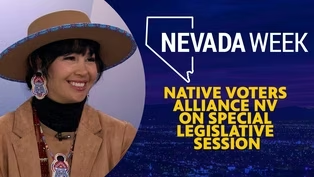
Native Voters Alliance NV on Special Legislative Session
Video has Closed Captions
Clip: S8 Ep20 | 9m 28s | Native Voters Alliance NV Executive Director Barbara Hartzell shares the concerns and priorities. (9m 28s)
Philanthropists offering more support to Southern Nevada’s Nonprofits
Video has Closed Captions
Clip: S8 Ep20 | 7m 59s | With less federal funding and more economic uncertainty, many nonprofits are in need of extra help. (7m 59s)
Providing Support for PBS.org
Learn Moreabout PBS online sponsorship
- News and Public Affairs

Top journalists deliver compelling original analysis of the hour's headlines.

- News and Public Affairs

FRONTLINE is investigative journalism that questions, explains and changes our world.











Support for PBS provided by:
Nevada Week is a local public television program presented by Vegas PBS