
Election Observers, Election Fraud Study, CCSD Budget
Season 9 Episode 17 | 26m 46sVideo has Closed Captions
Volunteers observe election. Study looks at election fraud. CCSD’s budget shortfall.
Nonpartisan election observers will be at the polls this midterm election. A recent study looked at election fraud in the Mountain West. The Clark County School District could face another budget shortfall next year. What is it doing to avoid the problem?
Problems playing video? | Closed Captioning Feedback
Problems playing video? | Closed Captioning Feedback
Nevada Week is a local public television program presented by Vegas PBS
Election Observers, Election Fraud Study, CCSD Budget
Season 9 Episode 17 | 26m 46sVideo has Closed Captions
Nonpartisan election observers will be at the polls this midterm election. A recent study looked at election fraud in the Mountain West. The Clark County School District could face another budget shortfall next year. What is it doing to avoid the problem?
Problems playing video? | Closed Captioning Feedback
Where to Watch Nevada Week
Nevada Week is available to stream on pbs.org and the PBS app.
Providing Support for PBS.org
Learn Moreabout PBS online sponsorship-The Carter Center has trained citizens observing elections in five U.S.
states, and Nevada is one of them, plus... how the Clark County School District is budgeting for less state money as enrollment drops.
That's this week on Nevada Week.
♪♪ Support for Nevada Week is provided by Senator William H. Hernstadt and other supporters.
-Welcome to Nevada Week.
I'm Amber Renee Dixon.
Ahead, a new report examines documented cases of election fraud in the Mountain West, going back nearly 30 years.
But we begin with the Nevada Election Observation Network, or NEON.
The Carter Center, founded by the late President Jimmy Carter and the late First Lady Rosalynn Carter, funds this network and help train its observers.
Since 1989, the Carter Center has observed more than 120 elections around the world but began observing U.S.
elections in 2020 as trust in American elections declined.
This year, it's supporting observer networks in five U.S.
states, including Nevada.
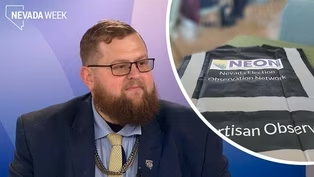
And here to explain why Nevada was chosen is Logan Gifford, NEON's Deputy State Manager.
Logan, welcome to Nevada Week.
-It's great to be here, Amber.
How are you?
-I'm doing well.
And tell me, why Nevada?
What do you know about that?
(Logan Gifford) You know, I think "why Nevada" is a wonderful question, and what I have learned in our process here is the fact that voters have a hunger or a thirst to understand election laws and regulations.
We've been successful in training and deploying 219 poll observers throughout the state, and there was clearly a thirst to learn more about the electoral process.
-Tell me about what an observer at a polling site is doing.
What are they looking for?
What are they writing down?
How are they responding?
-That's a great question, and I want to emphasize that our poll observers went through an extensive amount of training before we deployed them.
Actually, we had two different trainings down here in Southern Nevada, an online training for our rural counties, as well as an accessibility audit that we have initiated with 10 additional observers to look for accessibility voting patterns and things like that.
So it's really a unique opportunity.
And what they're going through is our standardized checklist, and they're monitoring and observing post- and pre-logic inaccuracy, testing things like that.
And we're going to be releasing that data after the election, and that's going to go out to the folks as well as public officials.
-I believe that you are also observing the election technology, correct?
-Correct.
-What are you looking for?
How do people know what to look for?
-So our team is really composed of a lot of really well-trained officials, and our board of directors have really come down extensively on the education component.
And as you stated in your intro, the Carter Center has been observing elections for a long time and initiated this project in 2020.
And this is our pilot year, and we're really learning through the pilot process.
And I think it's going to be interesting to see what comes of it.
-Yeah, that checklist that you're talking about.
So these observers are at the polling sites.
Where are they located, and what are some of those questions on the checklist?
-They're going to be throughout the entire state.
So, like I said, we have observers in Lander County, Pershing County, everywhere, Clark County.
We have 90 shifts that we had filled in Clark County down here.
So, like I said, we're everywhere.
-Wow!
And what I mean is when someone does go to vote, where will the election observer be?
-Oh, that's a great question.
So that's actually designated through each individual county.
As some of you guys may know, the County Clerks report to the Secretary of State, and it's actually one of the unique things about election administration here in the Silver State.
So in Clark County, there's a designated area for them to sit and observe.
It's usually taped off out of the way to not obstruct the voting process.
-And that checklist, what are some of the questions?
-Some of the questions are going to be about how many machines we're operating; how many staff were there at those locations; again, whether or not there was accessible voting machines; or if there were barriers.
One thing that I learned personally from the accessibility audit that you would see quite commonly is a trash can being propped open to hold a door.
And that's not necessarily fair for some folks.
So to document that, right?
-That's a separate part of what the Carter Center is doing here is taking this information down about people with disabilities and how they have access to the polls.
So that's its own kind of separate report you're coming up with?
-Correct, absolutely.
And, again, we have 10 observers that are working on that throughout the state.
And Dora has been an incredible asset to the team, and I'm really proud to have helped spearhead that with her.
It's personal for me because I have a brother that was born with cognitive disabilities, so I think he's getting ready to participate in the next election.
So it was great to be a part of that pilot program to honor him.
-How has it gone so far?
Have you been made aware of any issues?
-No major critical incidents.
And so far, we're feeling confident that our report is going to have some really interesting information for folks to want to consume.
We'll be releasing a press release on election day, and we'll have some media accessibility.
So we're ready to talk to folks and let them know what we find.
-If there is an issue, is that documented or is there simply a checklist?
-Of course, it's documented.
And with our existential stakeholders and participants, we, you know, feel confident.
And when we established this, when NEON was first established, we had notified the Secretary of State that we were going to be here.
So we have relationships with those officials.
-What about mail ballots?
Are you involved in that?
-Absolutely.
We are monitoring that process and have observed again pre-logic and post-logic accuracy testing and gone through mail ballot processing training in some counties.
-Wonderful.
Logan Gifford with the Nevada Election Observation Network in its very first year here in Nevada, thank you for joining Nevada Week.
-Thank you.
-As the U.S.
Department of Justice steps up prosecutions of alleged non-citizen voting ahead of the midterms, there's a new look at documented cases of election fraud in our region.
A report from the Lincy Institute and Brookings Mountain West at UNLV counts cases from 1998 through 2025.
It covers five Mountain West states--Nevada, Arizona, Colorado, New Mexico, and Utah--and relies on data from the conservative Heritage Foundation's Election Fraud Map.
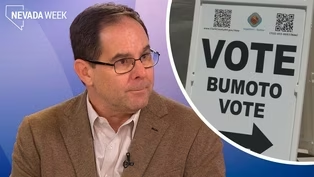
To learn more about the report's findings, we sat down with David Damore, Executive Director of the Lincy Institute and Brookings Mountain West.
David Damore, welcome back to Nevada Week.
-Thanks for having me.
-Let's start with the presence of non-citizen voting within this new report.
(David Damore) Very rare.
So you look at that, and the, the Heritage, where these data come from, they use a pretty broad definition of election fraud.
But in this category, what they call ineligible voters, those are deceased voters--we had one of those in Nevada--a felon voter and minor voters, and then non-resident voters and non-citizen voters.
So in the time period we look at in the, across the Mountain West, you have two cases of that, one in Nevada in 2014 in Washoe County and then a case in Colorado in 2005.
-Two cases in 30 years in the five mountain west states?
-Yeah.
And if you look at all those, it's about 55 million votes were cast during all the elections in the time period we look at.
-As you brought to my attention ahead of this interview, the U.S.
District Attorney is saying that there are two Nevadans who are lawful residents but have illegally voted in the 2024 election.
-And that just came in today, yes.
Yeah.
-How do you stack that number up compared to-- -And we don't know.
Those are just indictments.
We don't know if they're going to be found guilty, right?
And it's unclear also if you think about the back and forth with the Trump administration and the Secretary of State's office where they had started with something like 16,000 non-citizen residents on the rolls.
Then it was reduced to 185.
It's unclear if these were cases that came from that, that 185.
We don't know.
This is just sort of breaking news on that.
But, obviously, very vigilant.
I think there was 20 cases in California that came out of this as well.
-Okay.
And this is the Department of Justice asking states for voter roll information and claiming that they have non-citizen voters on their rolls.
Why did you use data from the Heritage Foundation?
-For a couple of reasons.
First, you know, most everybody knows this doesn't happen very often, so there isn't a lot of data collected on this.
You see sort of like the Brennan Center does a little bit of work on this, but the sort of schadenfreude for the liberals is here you have one of the most conservative think tanks that sort of created the Project 2025 of the Trump administration.
If you go back to the first Trump administration, it was these data that provided the basis of the fraud commission that then, that President Trump put together.
And that, of course, disbanded without any making any recommendations or any findings because the data just don't support this sort of widespread notion on that.
So that was the the reason why for using the Heritage.
-Right.
But I would argue with you, there is contingent out there who does not believe that election fraud is rare.
-There are.
You're absolutely right.
And it's really hard to reach those people.
-Even with this kind of data?
-With this kind of work, exactly.
You know, we just know, particularly in the era of fragmented media, right, people are getting-- they're in their echo chambers.
They're getting this information coming over and over again.
And particularly when it comes from the President if you're a Republican, that's a pretty strong cue for you as well there.
There's also been some interesting work here on looking at sort of how people, in the face of this sort of when evidence doesn't support your beliefs, they tend to sort of use rationalizations.
They tend to sort of rethink this, how this went.
"Well, that's just the tip of the iceberg.
That's all that they're reporting" kind of stuff there.
There's also, if you go back to 2020, the Presidential election there, there was a sort of that red mirage, right?
Everybody knew who followed the election that on election night Trump was going to be ahead just because of the partisan differences in how votes are cast, right?
So in-person votes get cast first and then mail votes take a while.
Obviously, states have gotten better at processing mail, Nevada, in particular, for doing that.
So you saw this early evidence of Trump's up.
Go to bed that night, and then you wake up next morning, he's behind.
That fuels that suspicion, and that's just this sort of artifact of how the votes get counted here.
But if you're already in that mindset and not thinking about that, that's going to foster that.
I think when you watch some of the reporting on TV when they're sort of trying to be up to date, I think they do a pretty good job of saying, Okay, we're going to get a big dump from a Democratic voting candidate --excuse me, county-- to sort of prime people a little bit on this that these are coming from different spaces and these different spaces have different patterns of voting.
But, you know, if you want to buy into it, you're going to buy into it.
-What do you make of early voting numbers so far in Nevada?
-About what you'd expect.
Democrats have a lot of enthusiasm.
Obviously, I think the morning report today, they're up about six points.
You also see what we've seen last couple of midterms, and that is the nonpartisans are making up a smaller share relative to registration, so the electorate is going to be more partisan as opposed to during the Presidential election where you saw really high nonpartisan voting, essentially almost at the same rate as the Democrats in that race there.
So you're going to end up with a more partisan electorate.
What surprised me is after 2024, where the Republicans had really sort of pushed early voting, mail voting, get your voting in early.
And they did a really good job.
I mean, that was the first election in my memory when they were ahead coming out of the early vote.
This time, it doesn't seem that they're going to sort of be putting it on maybe this weekend or Election Day vote.
And that's, you know, a risky one here.
But, obviously, there's a, there's a lot of, I think, Republicans who are still kind of mulling their choices, "Do I want to vote?"
But the Democrats, they're, they very much want to, want to be-- have their vote cast, get it out of the way.
-And what's unique about Nevada and I think some of the rural counties is that they rely on the mail-in ballots, and that tended to be more Conservative areas, right?
-Mm-hmm.
-Are you taking anything from that number of how many mail-in ballots have come in?
-They're, you know, they're going to be about 2 to 1 out there.
So, you know, that's where the Republicans need a big turnout there.
But the problem is, is there's just not enough voters, right?
If Clark continues to vote at its pace, right--and it's a Democratic-leaning county, more than--and Democrats have done a nice job in the months leading up to it to bolstering their registration number, something they hadn't done the prior two cycles there.
So there's a bigger pot of Democratic voters than there was maybe a few years ago to do that, so I think that that's the challenge for the Republicans, they can sort of run up the score in the rurals.
The other problem for the Republicans is Washoe County keeps trending more Democratic for them.
Where that used to be a Republican-leaner, then it was kind of 50-50, and then now you see it.
Even though the Democrats don't have strong registration numbers, they're winning that county.
-What do you think of Republican Governor Joe Lombardo's chances of keeping his seat now versus a month ago?
-If you'd asked me this five, six weeks ago, I would have said, you know, it's going to tighten there.
And now, I think you look at these early voting numbers; he's got to be quite concerned on this.
And I think as Lombardo goes, so goes the Republican ticket, right?
If he loses, I think the Democrats are going to sweep the constitutional offices.
I think they end up with potentially super majorities on that.
Now, if he wins, holds on and narrow win, what does that mean for those sort of, for the Secretary of State race?
That's probably going to be Democratic, but the Attorney General's race, Lieutenant Governor's race, right?
So that I think is the key there.
I don't think-- I think the Republicans are going to struggle in the, the three Democratic House seats.
You think about two years ago, five-point swing towards the Republicans.
That gerrymander held up, and now you have the win in the back for the Democrats.
Even though the Republicans are putting a lot of money in those races, I don't think they're going to come in for them.
-What else stands out to you about this election fraud in the Mountain West report?
-The big question is just how rare it is, right, is that, you know, all the rhetoric around it.
And you have a concerted effort for the last 10 years to really focus on this issue, and they just don't support it.
It just doesn't support it.
And so this gives, you know, we're obviously going to have-- I think voter ID will pass again.
I don't think that that's, really there isn't much of a counter campaign to that at all.
You've seen that across the country.
So that's the sort of response to that, and we're going to have that implemented for the next election in Nevada unless something dramatically is relative to the vote two years ago.
-Right, okay.
So from the report from 1998 to 2025, the Heritage Foundation reported 85 cases of election fraud across those five-- -And, again, that's a broad definition because you're looking at voter intimidation in there.
You're looking at falsifying signatures on ballot petitions and not just ineligible people voting.
So that was all of those put together, and so that's about, again, about 55 million votes cast in those elections in those states.
-And the majority of the cases were duplicate voting, which means what?
-Yeah.
It means people voted multiple times.
The other thing-- -Purposely?
-They forgot they did, or they didn't want to double check, right?
"Oh, I wasn't sure about the mail, so I voted this way."
The other one that's common, less so in Nevada but you see it quite often in the database, is felons voting.
So that's a fairly common ineligible voter voting because the states vary quite a bit on ex-felons' eligibility on that.
So the point is that it's rare.
The people who do it, they get caught on this.
But this has just been a sort of persistent part of the election narrative, really even before Trump.
But he's really sort of amplifying it through his megaphone.
-All right.
David Damore, thank you for returning to Nevada Week.
-Sure.
Thank you.
-The midterms will help decide who represents Nevadans in the 2027 legislative session, and that is where lawmakers are expected to consider reworking how the state funds schools.
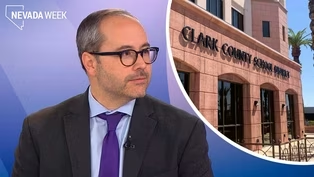
The Clark County School District is calling for changes after enrollment fell by more than 10,000 students this fall, a drop the District says cost it more than $100 million in state funding.
Governor Joe Lombardo approved emergency funding to provide temporary relief, but it expires early next year.
Nevada Week spoke with Justin Dayhoff, Chief Financial Officer of the Clark County School District, to find out what CCSD plans to ask the legislature for.
(Justin Dayhoff) So one of the challenges we have right now with the way that the state funds schools through, it's called the Pupil-Centered Funding Plan, or the PCFP, is that it uses four different quarters of enrollment to fund the school system.
And that means that during the middle of the year we're constantly getting changes to our revenue because enrollment changes throughout the course of the year.
Where that presents a challenge is in a situation like we're facing right now, where we have declining enrollment.
And when, even with our best projections, if we're off by 1 or 2%, that could be thousands of students in a school district our size.
And that's what we saw this fall.
It's a really close projection, but not quite close enough.
And so what that means for us as a district is that, in realtime in the fall, we have to make some really challenging decisions to make adjustments.
And that means disrupting classrooms in the middle of the school year, rather than allowing us the opportunity to plan ahead.
So what we're asking the legislature is to adjust the way that the state funds schools so that way it's adjusting to the previous year enrollment, which means instead of having four quarters and having to update that first quarter, snapping it to the previous year October count, which would allow us to release our budgets in January and start planning, knowing what we're going to be funded at for that entire next school year.
So that way we can make decisions that we have to make.
We're not trying to kick the can down the road.
We still have to make tough calls, especially with declining enrollment in the spring.
But it means we wouldn't have to do that in the middle of the school year in October.
We would be able to use the previous year's counts.
-And so I imagine the purpose of having the counts during the school year, the quarterly counts, is so that you are accountable to the state for how much funding you should get.
So if this were to happen, you may get funding from the state for students that don't end up existing.
And I wonder, is this fiscally responsible?
-It's a great question.
But, you know, it's not a deviation from current law.
So, in fact, there are two different funding mechanisms that we have in the Pupil-Centered Funding Plan when we think broadly speaking.
One is our adjusted base, which is what comes quarterly, but then we also get funded for weighted student counts.
So those are counts of students who have additional special needs and who require additional resources in order to educate.
And under existing law, that's actually already the previous year, October 1.
So what we're asking the state to do is just to conform that to make sure that the way that they fund the adjusted base is the same way that they already fund those other students.
And I mean the other thing is, you know, any time you take a snapshot of enrollment, two minutes later it's already wrong.
You know enrollment is always moving, so best it's always a proxy or an estimate for what we have.
It's never going to be truly live enrollment.
And so we're sticking to that and conforming to existing state practice.
-What are the reasons behind the declining enrollment?
-So birth rates are the biggest driver, you know, and it's not unique to Las Vegas and Southern Nevada.
This is something that we see nationwide right now across the country.
In fact, and even statewide.
So not even within Southern Nevada.
You know, statewide this year they had more than 12,000 fewer students statewide.
And some of that is choice, but the majority that we see right now are really birth rates.
This past year we graduated more than 24,000 students, but we only have just over 16,000 kindergartners coming in.
And so you can see what that means for the cohort, and it's families just not having kids at the same rate as they used to.
-Within the school choice sphere, there are public charter schools.
And according to the State Charter Authority, I believe those schools actually had growth compared to what they projected last fiscal year.
And so, then, if you apply this funding formula that you are proposing, would those schools lose out on money?
-That's a great question.
And, no.
So one of the things we put in our bill draft request, which is the legislative ask, essentially, for action, is a mechanism that allows for situations where districts are increasing in enrollment or the state public charter schools increasing in enrollment.
Because, ideally, someday these trends will reverse, right?
And you don't want to just address the now; you want to try and be as future-proofed as you can.
So one of the things we do is it's actually "greater of" calculation.
So it's a greater of your prior year October 1 or your three-year, your prior year plus three years of your average increase.
So if a charter school is increasing in enrollment or a district is increasing in enrollment, that will be addressed in the formula as well.
-Okay.
Mark Mathers is CFO of the Washoe County School District.
He sits on the Commission for School Funding alongside you, right?
-Yes.
-There was a meeting in February where he expressed concerns about funding based on historical averages, partly because he thinks it might delay districts from adjusting their staff to what it should be.
I mean, potential layoffs--preventing layoffs.
He didn't say that exactly, but that's what could happen.
What do you think about that point?
-Well, so it's actually our last commission meeting.
Just last week, we voted to align our recommendation to CCSD's bill draft request.
So the commission has changed its position to actually recommend that October 1 date as well.
One of the reasons for that is, considering that, yes, it does allow us to provide some sort of soft landing to school districts, but it's not getting districts off the hook in any way.
At the end of the day, we're still going to be held to account for the students that we enroll.
It's just the timing.
It's really about the sequence.
So that way, again, you know, we're still-- The onus is on us as a district in January to do the hard work to make projections for that next school year so that way we're not in a position where we're overfunding or overallocating resources to schools or making class sizes in an unsustainable way.
Those decisions still have to exist.
It's just the sequence of it makes it less disruptive to the classroom and to instruction.
-So the emergency measure that the Governor signed, that lasts, that funding lasts until, I believe, right when the legislative session starts in 2027.
-That's correct.
-So how soon do you need the legislature to come up with something?
-Well, we're hoping that they'll continue to take action right as soon as the legislature starts, and the Governor of the legislature suggested that this will be first up for them when session begins to continue to address this.
And when you think about it, the emergency action is actually akin to what we're proposing in our legislation.
The emergency action held the district to legislatively estimated enrollments.
And so they are really providing in an emergency action that same soft landing that we're suggesting that they take through permanent action through the bill.
So I suppose it's a two, two answers to that question: one that they move quickly to continue to sustain the funding for the rest of this school year and then also move with action on the bill to make sure that they can address this in perpetuity.
-Well, I imagine that would require another emergency measure of funding so that they can have the time to go through that bill and decide whether to make that change.
-That's correct.
-Okay.
So you are anticipating that or will perhaps be asking for that?
-We are certainly optimistic, and we'll be asking for that.
-Okay.
There is another ask from you, and that is in regards to special education funding.
What are you going to be asking the state for in 2027?
-Thank you for that question.
You know, we want the state to evaluate the way that it funds special education for school districts and considers that in its funding allocation.
One of the things that we, as a district, have to do is we have to fund students with special needs, right?
An individualized education plan, which is what constitutes a student with special needs, it's really a contract.
There's no question of if we provide those services.
We have to provide those services, and those come at a cost.
And so one of the things that we've noticed as a district is that the cost to provide those services well exceeds what the state gives us by more than $170 million a year.
So what we do is we have to take that out of our general fund and then move that into our special education fund to supplement what the state gives us.
And so it's a little bit of robbing Peter to pay Paul in order to do that.
And so we're asking the state to take a look at that to see if there's a way that they can offset that transfer because that has an impact both on our special education students, our students who oftentimes need the most support and who critically need that, but also on our general fund students.
-Justin Dayhoff with the Clark County School District, thank you for joining Nevada Week.
-Thank you.
-And thank you for watching.
To learn more about the Clark County School District's proposed bill to prevent mid-year budget cuts, go to vegaspbs.org/nevadaweek.
Remember, Election Day is Tuesday, November 3.
And then we hope you'll join us on Thursday, November 5, at 7:30 p.m.
when our panel of journalists breaks down the latest election results.
♪♪♪
 New
Clark County School District Budget
Video has Closed Captions
Clip: S9 Ep17 | 9m 25s | Following a major budget shortfall, how will Clark County School District avoid future deficits? (9m 25s)
 New
Video has Closed Captions
Clip: S9 Ep17 | 10m 12s | A new study looks at how election fraud plays out in Mountain West states. (10m 12s)
 New
Video has Closed Captions
Clip: S9 Ep17 | 5m 49s | A group of nonpartisan volunteers will be out observing Nevada’s elections this election cycle. (5m 49s)
Providing Support for PBS.org
Learn Moreabout PBS online sponsorship New Episode
- News and Public Affairs

Top journalists deliver compelling original analysis of the hour's headlines.

- News and Public Affairs

FRONTLINE is investigative journalism that questions, explains and changes our world.



 New Episode


 New Episode




Support for PBS provided by:
Nevada Week is a local public television program presented by Vegas PBS