
Election Integrity
Season 9 Episode 15 | 26m 46sVideo has Closed Captions
No non-citizens found on Nevada voter rolls. Remembering Indian Boarding Schools.
The Department of Homeland Security said Nevada had thousands of non-citizens on its voter rolls, but the state says there are zero. How the accusations went from thousands to none in a matter of months. And what does it show about election integrity? Plus, remembering the survivors of the U.S. Indian Boarding School era.
Problems playing video? | Closed Captioning Feedback
Problems playing video? | Closed Captioning Feedback
Nevada Week is a local public television program presented by Vegas PBS
Election Integrity
Season 9 Episode 15 | 26m 46sVideo has Closed Captions
The Department of Homeland Security said Nevada had thousands of non-citizens on its voter rolls, but the state says there are zero. How the accusations went from thousands to none in a matter of months. And what does it show about election integrity? Plus, remembering the survivors of the U.S. Indian Boarding School era.
Problems playing video? | Closed Captioning Feedback
Where to Watch Nevada Week
Nevada Week is available to stream on pbs.org and the PBS app.
Providing Support for PBS.org
Learn Moreabout PBS online sponsorshipThe bipartisan pushback against federal claims that Nevada has thousands of noncitizens on its voter rolls, plus... -I wish people would understand that this was like a century-long traumatic event.
-For more than 100 years, the U.S.
Government took Indigenous children from their homes and forced them into boarding schools.
How local Indigenous leaders are honoring them, that's this week on Nevada Week.
♪♪ Support for Nevada Week is provided by Senator William H. Hernstadt and other supporters.
-Welcome to Nevada Week.
I'm Amber Renee Dixon.
In July, the Trump administration said Nevada could have nearly 16,000 non-U.S.
citizens on its voter rolls.
A month later, the Department of Homeland Security told the state it had confirmed 185 noncitizens.
After investigating, state officials say their records show every one of those 185 people is a U.S.
citizen, but Homeland Security disputes that.
So what happened, and what does it mean for voters as early voting gets underway?
Joining us from the bipartisan Democracy Defense Foundation, Nevada are former Republican Governor Brian Sandoval and former Democratic Assembly Speaker Richard Perkins.
Thank you both for coming back onto Nevada Week.
-Thanks for having us.
-Mr.
Sandoval, the Department of Homeland Security maintains that there are thousands of people on Nevada's voter rolls who could be noncitizens.
How much of a concern should this be for Nevada voters?
-Well, I think even in your introduction, that allegation has been made before.
The Nevada State Attorney General's office investigated every single one of those and found out of 16,000 it was zero, zero.
And if there's allegations that there's more, then certainly there's the system will work again; and the Attorney General's office, the Nevada Secretary of State's office will conduct an investigation.
What concerns me is how that could seed some doubt, you know, in terms of our elections.
And I think time after time, our Nevada Secretary of State has shown that our system is actually one of the best in the country.
-Mr.
Perkins, that 185, that's what the Secretary of State has investigated, correct?
Not the entire 16,000 that's been put out there by DHS.
And why not investigate the rest?
-I actually don't know how many of the 16,000 that the Secretary of State's office investigated.
I do know specifically that, in conjunction with the Attorney General's office, the 185 were all run to ground and all found to be citizens.
So that's, you know, was narrowed down to the 185, and that 185 became zero.
I'm sure they'll do the same with this next allegation.
-And if I could jump in.
DHS course corrected itself.
So certainly throughout this 16,000 number and then suddenly it became 185 and then, you know, our state, the Nevada Secretary of State's office and our Attorney General's office stepped in and demonstrated that it was zero.
-And that next allegation that you mentioned, I had mentioned it off camera before we started.
Nevada Week reached out to the Department of Homeland Security about this issue, and they said that since that 185, they have now manually confirmed about 2,000 more aliens from the same list.
That's according to their statement.
Nevada, the Secretary of State, has also said that it's unable to investigate these claims thoroughly because the Department of Homeland Security has not provided enough identifying information.
What do you understand about that?
-Well, it's fascinating that they make these allegations without providing the backup material for us to actually run it to ground.
It's exactly why the Democracy Defense Foundation exists, to give the facts to the people so they understand how secure our elections are.
Throwing these wild allegations out into the public space without any evidence whatsoever is really inappropriate.
And but I'm still sure that we will put the efforts together to look at the new 2,000 people that they've, you know, given as noncitizens with the information that we actually have available to us and try to run that to ground.
-And I'll just throw in, you know, the timing for this is not-- is bad.
I mean, early voting starts on Saturday.
And I think that there's been a great lead-up both here in Clark County and Washoe County and statewide.
All the local registrars are ready to go.
And again, there's just kind of this naked assertion that, you know, that folks are not citizens.
And I guess all you can-- The only way that you can judge this is what has happened previously.
And, you know, again, if there are folks that are registered to vote that are noncitizens, then we should, we should do that.
But the state should have the opportunity to investigate and determine it itself instead of just throwing out information.
-And I can tell you that it's kind of appalling to both of us.
We've had these conversations.
I spent a career in law enforcement.
You know, Governor Sandoval spent a great deal of time on the federal bench as a judge.
We deal with facts.
And just to throw this stuff into the public view without any supporting facts is really inappropriate.
-Last thing, if it's okay.
And you also notice there was no challenge after the state made its determination that all of these individuals were indeed U.S.
citizens.
So I think that speaks for itself.
-Yes.
And that was not a question that DHS answered when I asked them whether they still believe those 185 people are noncitizens.
They did add on, though, in a statement.
"Nevada's claim that it lacked enough information to act is false.
FDNS..." (which is the Fraud Detection and National Security Directorate) "...already handed over the unique state voter ID numbers assigned by the Nevada Secretary of State.
The Attorney General and the Secretary of State can find every file and verify every identity.
They have the data; they refuse to use it."
Any comments?
-You know, I, I've never heard of that entity that you've talked about, and obviously it's a legit federal entity.
But I, you know-- at least my understanding, my experience, my observation is that our Secretary of State, our Attorney General, all of our voter systems stand ready, willing, and able to take that information because it's in our best interest to look into that.
And if they're saying that they don't have enough information to run this to ground, I believe them.
-Well, and even recently the courts have taken up this case that the Federal Government is trying to involve themselves in local elections and found that there is no federal database that is specific enough to actually identify who citizens are.
We have a number of databases, social security databases and other things, but nothing that the federal government can show that they can actually identify at their level who's a citizen and who's not a citizen.
-Well, and Governor Lombardo, a fellow Republican, Mr.
Sandoval, he says he wants the voter rolls in Nevada to be run against a federal database known as the SAVE Database.
Do you think that should happen?
-You know, I will trust the process that we have in place right now.
And again, I have 100% confidence in our Secretary of State; in our voter registrars, you know, local county registrars; and our Attorney General's office.
I'm a former attorney general, too.
And so it is in their best interest and our state's best interest that they do whatever they can, again, to run these things to ground.
You know, I don't have a full understanding of what that process would be, but if they think it's-- "they" being the Secretary of State and the Attorney General's office thinks it's appropriate, then let's do it.
-And that's the database that you were referring to, right, the federal database?
And what have you found as far as how legitimate it is?
-Well, it's a legitimate database.
It's just not all encompassing; it isn't all inclusive.
So there are so many gaps in the federal database in terms of determining who our citizens are and who they're not that, when they provide this information--the local governments, the state governments, the Secretaries of State, the registrars--can go through that, and they've been wrong.
The federal government has been wrong every single time.
-Another question about Governor Lombardo.
In March, he sat down with Jon Ralston of The Nevada Independent, who asked him about election security.
Let's listen to that.
(Jon Ralston) Will you say here tonight that there's no evidence that our elections are insecure?
(Governor Lombardo) There's no evidence that our-- -Elections are insecure, the integrity of our elections?
-No, I can't say that.
I can't say that.
-Why not?
-Because we just said there's been some prosecutions.
You know, it's just like criminal activity.
Just because we arrested somebody doesn't, you know, for one item, doesn't mean he didn't do 20 items, right?
And you have-- you have to take that into consideration.
And why not put mechanisms in place to secure that confidence-- -That confidence has been shaken.
- --that we've done everything we can?
-The confidence has been shaken by Donald Trump and his enablers.
Nobody else has shaken the confidence.
And isn't it-- -Don't say "nobody else," Jon.
That's not accurate.
You can't say nobody else.
I just heard somebody cheer on election-- said it wasn't-- here in your audience.
So there's people that--whether it's right, wrong, or indifferent, or perceived or not--they're frustrated, and they want-- Why not give them the ability to feel better about the system?
-Mr.
Sandoval, Republican to a Republican, have you talked to Governor Lombardo about his stance?
-I have not.
I've not had a conversation with the Governor about this, you know, specific detail.
But I would-- If I did, I would say we all want the same thing: safe, secure, and accessible elections.
I think everybody can agree on that.
And, you know, listening to this little excerpt from the Ralston interview, I don't think anybody will dispute there were a couple situations where an individual, I believe, if I remember right, voted twice.
And so those cases should be prosecuted.
They should be investigated.
But I don't think it casts any doubt on the rest of our election system.
-You don't interpret that as saying, I'm not confident in Nevada's elections?
-Oh, absolutely not.
I am fully confident of our elections.
-Okay.
Now, noncitizen registration does happen.
In New Jersey the governor recently said there that 6,600 noncitizens were accidentally registered to vote.
That was a software error at the motor vehicles department.
That can happen there.
Can it happen here in Nevada?
-Well, our systems are run by folks from the human race, right?
I mean, we're not infallible, but everything that we've looked at and all of the cases that have come up have been dealt with.
And whenever there's been a situation where somebody voted twice or something that might cast some doubt on our election process, it's been so minimal that it is as a fraction of a fraction, to use somebody else's term.
So it just doesn't cast a doubt on the integrity of the election.
By the way, I think that Jon Ralston and Governor Lombardo are both right.
He brings his experience from a former law enforcement officer as well.
There are, there are situations where this happens, but I think that we have put things in place through the Secretary of State's office, particularly Secretary Aguilar has done an amazing job with his office.
The registrars at the local level, all of our volunteer elections workers just do an extraordinary job of making sure that our elections are safe and that we have integrity in them.
We can trust in them.
-Why do you think this is happening, this effort to sow distrust in the elections?
-I can't answer this question, but I-- That's why the Democracy Defense Foundation exists.
We are trying.
We, you know, our effort is to make sure that misinformation isn't undermining the integrity of our elections and bringing out the facts.
You know, we talked about facts.
John Adams said facts are stubborn things.
We have toured the Washoe County Voter Registrar's office.
We've toured the Clark County Voter Registrar's office.
They have walked us through all the security that they have.
The people of the state of Nevada should be really proud that we, actually, I think it was MIT rated us as the No.
2 state in the nation in terms of voter security, election security.
-What do you think about the federal government's involvement in Nevada's elections this year; for example, suing the state, the Department of Justice suing Nevada for not providing certain information about voters.
-Well, and certainly the federal government can opine however they want, but they have no role in elections, none.
Elections, by Constitution, are left to the states.
There's clearly this effort to get into the states to, you know-- and they're sowing, trying to sow doubt.
I mean, I'll answer your previous question a little more directly, I believe, because I do think that when you suppress voter turnout, it services-- serves one group over another.
And we have better, a better democracy and a better election when we have more people turn out to vote.
So it's still, elections are left to the states, not to the federal government.
-And about that voter information that the federal government wanted.
The U.S.
Attorney General's office says that states need to give them that information so we can do our duty to protect American citizens from vote dilution.
Meaning that if a noncitizen votes, that vote cancels out the vote of a U.S.
citizen.
If it is-- It is the duty of states to run their elections.
So then, what is Nevada specifically doing to make sure that votes are not diluted?
-Well, I think the Secretary of State's doing an extraordinary job.
We have-- We've created an entirely new system, where instead of all of the counties doing their elections and then funneling all that information to the Secretary of State for aggregate, it's now from a top-down system.
The Secretary of State has all the voter registration information.
It has all the elections information and communicates with each of the 17 counties to do that.
So those systems have been put in place and modernized over the last few years.
Technology has been amazing.
It has allowed us to dig a little deeper and figure out these things before there's a problem.
-Okay.
Mr.
Sandoval, as governor, you commanded the Nevada National Guard.
Right now the military says it has no plans to send troops to polling places, yet President Trump has not ruled that possibility out.
What do you think we will see at Nevada's polling sites this year?
-I think we will see what we have seen before, a very orderly election.
Certainly, I mean, there is a Nevada law that prohibits-- It's actually a felony to intimidate people, you know, who are trying to access or cast, you know, cast their vote or exercise their right to vote.
So, you know, I'm confident in our system, as I've said before.
I think we do an excellent job.
Our people of Nevada should feel really good about it as they start.
You know, right now, early voting, as I said, is going to be starting in the very near future.
And so I don't think we're going to see anything different than what we haven't seen already.
-Mr.
Perkins, the Democracy Defense Foundation formed when the distrust in elections was concentrated among Republicans.
Nationally, Pew finds that Democrats' confidence in the midterms has fallen from 77% to 58% in two years.
What is your message to fellow Democrats?
-Believe in our process.
And, look, this is not a partisan issue, to be honest.
I mean, the polling that the Democracy Defense Foundation has done has shown, you know, when Republicans win, Democrats don't believe in the election sometimes to some degree.
When Democrats win, Republicans feel like it's-- there's not as much integrity as there should be.
So there's a roller coaster here.
But I would tell my fellow Democrats that, having done the investigation that Governor Sandoval and I have done throughout our process, Nevada is doing an extraordinary job, and they can believe in that.
By the way, Amber, when we did our checks, you know, a couple of years ago, people were concerned about hacking voting machines, the security of ballots, the security of drop boxes, and the like.
And-- Or even the ability to actually view the vote counting process.
Nevada does it extraordinarily.
All the, all the voting machines are airgapped.
There's no way to hack into them.
People can go and watch the process of the voting count.
All the ballots are under lock and key.
You know, Governor Sandoval and I did those tours and actually saw those processes.
-Okay.
There was a poll commissioned by the Democracy Defense Foundation, Nevada.
It was conducted in June and found that confidence in the accuracy of Nevada's 2024 vote count rose to 37% very confident, up from 31% a year earlier.
When those results were released in July, Mr.
Sandoval, you said in a press release that some Nevadans still have real concerns.
Of those concerns, what stands out to you, and how legitimate are those concerns?
-No, and there's a more recent polling that we can talk about in a minute.
-Okay.
-But to answer your question, again, it's never going to be 100%, and I understand that.
And that's, again, part of our responsibility is two, you know, bipartisan former Speaker, former Governor, coming together to, again, stop the misinformation and put out the facts.
And but there's still going to be a group of people.
And that's, you know, hopefully they'll be watching this, your program today--I'm sure you have amazing viewership--and learn more about our system and how trustworthy it actually is.
-Is there a concern, though, that stands out to you that you hear a lot from the people who are not confident or who are only a little confident?
-Well, I think where the lack of confidence-- The most confidence comes from in-person voting or early voting.
The lesser confidence-- I won't say lack of confidence.
Lesser confidence comes in the mail-in balloting, and that is mostly focused with Republicans.
Republicans are less than the Democrats.
But again, when you look at it overall, it's very strong.
And there's a bit of an irony because the Republicans have less confidence in mail-in balloting; but two of the highest counties in Nevada, Douglas County and Nye County, the Republicans vote in by mail over 70%.
-Right, yeah.
Last question, because we are running out of time.
Question 7 is again on the ballot in Nevada.
It has to pass twice in front of Nevada voters.
It already passed in 2024 with 73%.
It would require photo ID in order to vote in person, and then either a driver's license or a social security number for mail ballots.
Where do you each stand on Question 7?
Do you support it, Mr.
Perkins?
You first.
-I support what the people support.
73% supported it in the last election.
I suspect it'll be a similar number this time.
Are there downsides to Question 7?
I think there are.
It'll-- There are folks who are challenged in getting IDs and that sort of thing or those who have a lack of trust in our government system, whether they're legal immigrants or others.
There's a challenge there.
But at the end of the day, the voters will speak and that'll be the law of the land.
-Mr.
Sandoval?
-I'm not going to advocate either way, but I'm confident it's going to pass, you know, similar to what the speaker said.
North of 70% are going to support this.
What I think is going to be important is to watch what happens in the legislature.
So when this ballot question passes, how it is implemented is going to be determined by the Nevada legislature.
And I think one of the subjects they need to focus on is to make sure that it's implemented in a way that it doesn't disenfranchise anyone.
-All right.
We will be following that if Question 7 does pass again.
Early voting runs October 17 through October 30, and November 3 is Election Day.
Mr.
Sandoval and Mr.
Perkins, thank you so much for joining Nevada Week.
-Thank you, Amber.
-September 30 marked the National Day of Remembrance for U.S.
Indian boarding schools.
In the 1800s, the federal government and churches began operating those boarding schools as a way to assimilate Indigenous children into white culture.
As a result, Indigenous children were taken from their families and placed in boarding schools hundreds or even thousands of miles away.
You're looking at photos from the Stewart Indian School in Carson City, Nevada.
At these schools, several children died from disease and abuse.
A federal investigation has confirmed at least 973 deaths.
On the National Day of Remembrance, local tribal organizations held a ceremony, which a Nevada Week team attended.
We heard from one of the organizers and then a firsthand account from a woman taken to a boarding school as a child.
(Little Cat) I wish people would understand that this was like a century-long traumatic event; that it's like everlasting; that it affects our future generations, myself included; how it affected our great-grandparents, our grandparents, and parents and how they raised us and how our culture assimilated and how it affects us today in the sense of I don't speak my language.
I remember my mom's friend was telling me how, when my mom shared the news of having us, my siblings and I, and she was saying that she never wants to teach us Navajo because she was bullied and punished for speaking the language.
So to this day, I don't.
I only know certain words.
(Yvonne Hawk Verjan) I just remember my grandmother would go to work, my aunt Jenelle would go to work.
I was taken care of by one of my aunts.
I don't know what happened by that time.
I just know this lady came and got me, took me somewhere.
I end up in New Mexico at a boarding school.
I didn't, I didn't-- At that time, I wasn't thinking about anything because I'm a young kid, you know?
I just remember my hair getting cut.
I had this funny looking dress on, and I see all these people, these ladies, you know, dressed in different kind of uniforms and all that.
I just, all I remember bits and pieces.
I just remember she's taking me down the stairs into the basement.
I see all these beds laying all around.
It was a real cold, cold, eerie feeling I had.
I didn't want to go.
I had no choice.
And then that night we slept, I slept on the floor.
I could hear all the kids crying.
I just remember us lining up the next morning against a wall.
We all had to stand there like, you know, like that.
And then we end up having chores to do.
And some of them didn't do it right.
They get taken to a room, get punished.
Next thing I know my grandmother came and got me out of there.
Bits and pieces I remembered, but it's not a good feeling.
It was like scary.
-In Nevada, the Interior Department has identified three federal Indian boarding schools.
The only one located off a reservation was the Stewart Indian School in Carson City.
By 1919, it housed more than 400 students.
It closed in 1980 and now serves as a cultural center and museum dedicated to telling the stories of the students who lived there.
Since 2017, the Army has worked to return the remains of children buried at the Carlisle Indian Industrial School in Pennsylvania.
That was the nation's first off-reservation boarding school.
Last month, according to the Las Vegas Review Journal, the remains of Della Tuscarora Atkins, a Shoshone girl from Nevada who died at Carlisle at 17, were brought home to the Duck Valley Indian Reservation in Northern Nevada, more than 2,000 miles away and 126 years after her death.
We want to thank you for joining us here on Nevada Week.
Another reminder that early voting runs October 17 through October 30, and Election Day is Tuesday, November 3.
To watch a series of videos to help you prepare for the election, go to vegaspbs.org.
And we'll see you next week on Nevada Week.
♪♪♪
 New
NewVideo has Closed Captions
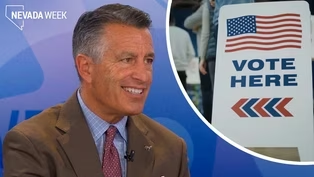
Clip: S9 Ep15 | 20m 21s | How claims of thousands of non-citizen voters in Nevada went to zero in a matter of months. (20m 21s)
 New
NewRemembering Indian Boarding Schools
Video has Closed Captions
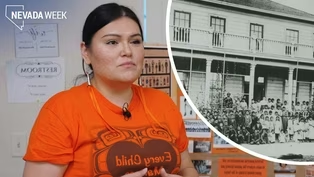
Clip: S9 Ep15 | 4m 34s | Local Native Americans gather on Boarding School Remembrance Day to honor the legacy. (4m 34s)
Providing Support for PBS.org
Learn Moreabout PBS online sponsorship New Episode
- News and Public Affairs

Top journalists deliver compelling original analysis of the hour's headlines.
 New Episode
- News and Public Affairs

FRONTLINE is investigative journalism that questions, explains and changes our world.



 New Episode

 New Episode



Support for PBS provided by:
Nevada Week is a local public television program presented by Vegas PBS