
Cuts to Nevada’s Share of the Colorado River
Season 9 Episode 7 | 26m 46sVideo has Closed Captions
Next steps for the Colorado River. Getting help for Test Site workers. Elvis fashion.
The federal government is now getting involved in the on going dispute over how to divide up the dwindling Colorado River. Members of the military who worked at the Nevada Test and Training Range were exposed to many toxic substances but some of those workers are not getting treatment through the VA. A new book from a Las Vegas author explores the iconic fashion of Elvis.
Problems playing video? | Closed Captioning Feedback
Problems playing video? | Closed Captioning Feedback
Nevada Week is a local public television program presented by Vegas PBS
Cuts to Nevada’s Share of the Colorado River
Season 9 Episode 7 | 26m 46sVideo has Closed Captions
The federal government is now getting involved in the on going dispute over how to divide up the dwindling Colorado River. Members of the military who worked at the Nevada Test and Training Range were exposed to many toxic substances but some of those workers are not getting treatment through the VA. A new book from a Las Vegas author explores the iconic fashion of Elvis.
Problems playing video? | Closed Captioning Feedback
Where to Watch Nevada Week
Nevada Week is available to stream on pbs.org and the PBS app.
Providing Support for PBS.org
Learn Moreabout PBS online sponsorshipWorrisome water levels.
Lake Mead and Lake Powell hit record lows in back to back weeks.
What the federal government is proposing to protect water supplies and hydropower, plus.
And in our case, the military, they say we were never there, therefore we were never exposed.
And so the government basically says it's not our problem, when in fact it is.
Veterans exposed to radiation at the Nevada Test and Training Range are taking their fight for recognition to Congress and.
Another quirk that Elvis had, which like looking back at it now, everyone says, well, what was that all about?
That Elvis was really uncomfortable with the length of his neck.
A new book explores the motivations behind some of Elvis Presley's most iconic looks.
That's this week on Nevada Week.
Support for Nevada Week is provided by Senator William H. Hearn, STAT and other supporters.
Welcome to Nevada week.
I'm Amber Renee Dixon.
Water levels at the country's two largest reservoirs, Lake Mead and Lake Powell, hit record lows this month.
And according to the U.S.
Bureau of Reclamation, those reservoirs are moving closer to levels that would sharply reduce hydropower generation.
Both Lake Mead and Lake Powell are part of the Colorado River system, and the seven states that depend on that river have yet to agree on how to share its shrinking supply amid a decades long drought.
Last month, in its final environmental impact statement, the Trump administration analyzed several possible approaches for managing Lake Mead and Lake Powell, referred to as alternatives.
The administration also identified its preferred approach, which is a ten year framework that would generally set operating rules two years at a time.
Preliminary rules for 2027 and 2028 would reduce Nevada's share of the Colorado River by 50,000 acre feet a year.
That's about one sixth of the state's legal allotment.
The Department of the interior is expected to issue its final decision, and the first set of operating guidelines before October 1st.
And here to explain what could complicate that final decision is Allen Jalali, water and environment reporter for the Las Vegas Review-Journal.
Allen.
Welcome back.
Thank you for having me.
And the reason that the federal government is stepping in is because the states have yet to agree on a plan, right.
Is there hope they still could.
I don't think anybody is expecting the seven negotiators in the room to come to a consensus.
I think what we're seeing right now is, like you said, this ten year framework, that there are still objections to from two of the states, including Nevada.
So, I think, you know what we're probably going to see in the next month or so is that the federal government is going to hand down an operating plan.
And that could lead to a fight at the Supreme Court between the states as to, how these shortages or shortages are getting allocated.
What is Nevada's stance on what is being proposed, that ten year framework?
Every two years?
New rules?
From what I understand, Nevada is okay with the initial 50,000 acre foot a year, reduction, which, as you said, is about a sixth.
And it's something that we've been well prepared for in our modeling.
However, what this plan does posit is past those two years, it could be up to 3.6 million acre feet between the lower basin states of California, Arizona, Nevada and also Mexico.
And that could mean some pretty steep cuts up to almost 200,000 acre feet, which is two thirds of Nevada's allocation.
just to reiterate, the 50,000 acre feet a year cuts, from 2027 and 2028 that are being proposed, that would not significantly impact southern Nevadans.
It's just not something they should be worried about, right?
Well, to put it in perspective, our use for the Colorado River in southern Nevada came in at about 198,000 acre feet last year.
So, you know, that would still put us well within what we are using to this day.
And one of the things that's really helped us is, as you know, the water recycling that we do here is very extensive, and we're able to cash in credits for water that we return back to Lake Mead.
you know, as much as we're growing, we are continuing to reduce our water use through, conservation.
the Colorado River Indian tribes, they are some of the most senior water rights holders on the Colorado River.
What has their response been to the final environmental impact statement?
what's really interesting, I think about the tribal aspect of this is, you know, the seven states have somebody in the room that's hashing these things out.
Folks like the Colorado River Indian tribes and the other 29 federally recognized tribes within the basin don't have a seat at the table.
And they're like, the public have to rely on the, you know, environmental laws that allow them to submit some public comment.
So I think, you know, in their letter that they submitted to the Bureau of Reclamation, they expressed some hesitance.
I think what they're saying right now is they feel they have not been included sufficiently in this final, iteration of what we're seeing and how do the water cuts stand to impact these tribes?
Well, from what I understand, they do have irrigation.
An irrigation project that's managed by the Bureau of Indian Affairs, which they say in their letter, they have not been able to, you know, use the for their full allocation of the water rights because of, a lack of upkeep and maintenance to that, that project.
So, I think we could see that there unused allocation that they feel they have the right to you, could go elsewhere.
You wrote an article about Lake Mead barreling toward a system crash, right?
What would that look like in Southern Nevada?
What would it mean?
Well, what the those academics were saying in those paper, in that paper was that, you know, below a certain, point that we are nearing moratoriums every month?
It would be right over the river is what they call it.
And what that means is, water managers wouldn't be able to control how much water is moved from Lake Powell to Lake Mead.
It's just what the natural flow of the river would be anyway.
And so it begs the question, you know, we've spent, you know, billions of taxpayer dollars on, network of dams and infrastructure.
You know, it could render it effectively useless.
I think concerning that, you know, we would have less control Last thing you brought up billions of dollars.
Nevada lawmakers are now asking for some money in relation to water.
How what are they want to do?
Well, I think a large part of the frustration with what is being talked about right now is that we're focusing on, the little water that's available rather than finding ways to put water back into the system.
Right.
I think what we've heard from experts is that we're in an era where we're out of cheap water.
It's time to invest the billions of dollars in desalination plants in California and Mexico.
It's time to, see if groundwater pipelines are potentially, a way to bring more water into our desert cities.
And what this funding request is asking for is to, really match what we saw.
Under the Biden administration, about $4 billion was allocated towards drought.
And, you know, while the, the lawmakers, bipartisan, are not quite ready to say which projects they're focused on or what states they would benefit, it is just, a larger question of how are we going to fund these projects and what what is the federal government's role in ensuring that we can keep our taps flowing in these cities?
So that would be a funding request from Congress?
Yes.
Okay.
Allen Hilali, Las Vegas Review-Journal.
Thank you so much.
Thank you.
Nevada week, we move now to a bipartisan bill before Congress.
Right now, the Sergeant Dave Crete Forgotten Veterans Act would require the Department of Defense to recognize the Nevada Test and Training Range as a location where contamination occurred.
Located in the desert northwest of Las Vegas, the federal government conducted hundreds of nuclear weapons tests at the entry from the 1950s through the 1990s.
In 2000, federal law established compensation for eligible civilians who work there under the Department of Energy and were diagnosed with certain illnesses as a result of their exposure to radiation and toxins.
But military veterans who served there have not received the same presumption of exposure.
U.S.
Senator Jacky Rosen of Nevada named this updated legislation after local Air Force veteran Dave Crete, founder of the nonprofit The Invisible Enemy.
He joined me in studio to explain how the bill came to bear his name, and what it could mean for veterans and their families.
We had legislation introduced in the end of 24.
Then the new Congress came in.
We introduced another bill.
Senator Rosen being the sponsor in the Senate and we got part of that passed in the National Defense Authorization Act.
So the old bill was kind of out of date because some of the language was already law.
And so then this year, Senator Rosen reworked the bill, added some things to it, and informed me that that was the name of the bill, found out it was a secret amongst some, including my wife and everybody else on the board knew I was.
I think I was the only one that didn't.
What do you think?
Honestly, the first thing I thought was usually, if you get something named after you like that, you're dead.
I was just.
I was blown away.
I don't know what to say.
And it's even awkward still to tell somebody.
What's the name of your bill?
It's me.
You know, it's awkward, but it's a great honor.
What is the ultimate purpose of this bill that you have had to talk so much about?
Is talking something that you like to do?
Yeah.
I have no problem talking.
Okay.
The important thing is, when we all went up range, when we worked at these classified bases, we were never told and we didn't know what we were being exposed to.
And now, you know, 30 years later, it takes a long time for a lot of these diseases and cancers and things to manifest themselves.
And now it's become illnesses for our family members.
And, you know, we've established a memorial list to try to track and honor those that we know that worked up there, that died.
And as we sit here today, this week, we'll probably hit 600 names on that list.
And you're specifically talking about the Nevada Test and training, right?
Correct.
You were there for about four years in the 80s, right?
Correct.
What was happening there that you are able to talk about?
We know there was nuclear testing, so there was nuclear testing.
And my location, there was the stealth fighter.
That's where it was developed.
And the biggest surprise for us, you know, as young guys going up is there was a squadron of Russian fighter jets So our fighter pilots would get first hand experience on what it's like to fly against the enemy's aircraft.
Your particular role was as a security officer, correct.
You were guarding against any potential outside?
Correct?
we were the base cops in the security for up there.
And it was a very, very different environment.
The federal government has acknowledged that people who worked up there during a specific time frame were exposed to toxic chemicals and radioactive material.
Right?
Correct.
But they don't extend that acknowledgment to veterans.
Is that correct?
It's correct.
There's two things.
There's the atomic veterans, which are the folks that they talk about that were there when the testing was taking place back in the 50s.
And 60s, they've recognized them as being there.
The Department of Energy is the contractor on the range that builds everything.
They do the nuclear testing.
But they they built our hangars and our Joe Hall and our roads and everything else through Department of Energy contracts.
And they have been recognized.
The government says, yes, you were there, you were exposed.
And if you have illnesses, we're going to take care of you.
And in our case, the military, they say we were never there, therefore we were never exposed.
And so the government basically says it's not our problem, when in fact it is.
And denying our existence is is really shameful.
And when guys go in and try to get care, they're often denied.
And the benefits that are there for veterans that's promised when we sign up is denied.
And the worst is, like I said, we have a memorial list that means there's a whole bunch of widows.
And since we can't connect ourselves as being there in our illnesses and most common thing, guys die from us cancer, the average age of 63, those family members, widows that are left behind are denied benefits as well.
So the government cuts them off.
But if those were spouses of civilians that worked there, they would they would get benefits and those benefits were established.
Or that acknowledgment was back in 2000.
Correct.
Under President Clinton, it has been a long time.
When did you become aware of this connection between your work there and and your own health?
I started researching in about 2015.
My unit, the Copper Unit, had a reunion, and we started having conversations and discovering at that point that many of us have tumors.
There was miscarriages with our wives, some birth defects with our kids.
And then the conversations went to that, like Dan Traxler, who was my own OJT supervisor and trainer when I went up range, he died at 33.
And those conversations started.
And you knew that doesn't make sense.
The numbers don't add up.
You know, 75% of our guys and the cops that were at this reunion all have tumors.
That's not normal.
And so you I have about 20 I had currently.
I had one on my back that had to get removed because it was about the size of a grapefruit like all of us even, like, on my forehead.
I have a little one that sits up here and, and they're all over, and we all have them.
It's in your arms, your legs, your torso.
I have one of my lungs.
What's remarkable is that this extends to your children, to family members.
How so?
So when we were at that reunion, that was at my house, one of the guys there was.
We were having a conversation.
The first conversation, there was eight of us that were sitting there and one of the guys says, well, I don't have any, but my son was born with a tumor.
And, and I, I brought up, I said, my son was born with something called neurofibromatosis.
My first born, he has a brain tumor.
And it's a lifelong life altering problem that he's been faced with.
And it's a tumor problem where tumor X can grow on the end of your nerves.
It messes with your your nervous system.
His gave him some challenges in school, and he's done remarkably well.
But he had to take the hard path in life and still does.
And it's now genetic.
So, you know, he has the concerns about his daughter's that they would be born with this.
And so far everything looks okay, which is great.
But, we've since learned that all four of our kids were born with problems.
And we find out it's the same problems and the same story I hear over and over and over from the guys that worked up there.
Because the government has admitted that exposure to radiation alters our genes, it alters our DNA.
And some of these alterations that it does are permanent.
So we pass these genes that have been damaged to our kids.
So it's, it sucks.
Yet you told me ahead of this that you have a grandson in the military, and you encouraged him to enter the military.
I think it's great.
I'm proud of what I did.
All of us are really proud of what we did.
We don't like what's happened since we're patriots.
You know, if you talk to all the guys that worked up brains, all the men and women that worked up brains, you would have troubles finding people that regret it.
We don't, you know, so that's really not the issue.
I'm super proud of them.
The legislation that is in front of Congress right now, it's bipartisan.
It is considered a common sense legislation.
How do you rationalize that it has not yet passed or advanced so veterans benefits right now in Congress are being debated?
And it has to do with money.
At the end of the day, there's going to be money spent.
Our bill was the CBO scored it, which in English means the Congressional Budget Office says it's going to cost money and it was $115 million over ten years, which in DC is nothing for the rest of us.
That's that's a lot of money.
But when you look at a trillion and a half dollar DoD budget as an example, it's nothing.
Representative Susie Lee has brought this issue to the attention of the Secretary of Defense.
She has?
Yes.
Pete Hegseth, and, you know, he's a busy guy right now.
He has a war that he's fighting with Iran.
What would you say to him about the necessity of of confronting this now?
He could sign a piece of paper and the problem is fixed.
We don't have to have a law to fix this.
It can be solved administratively.
His staff could write something up.
It's easy.
It really is a pretty easy fix.
And is there?
It's exposed.
And here's the list of guys that served there.
And the Air Force has the list.
What has been accomplished?
You talked about what Rosen did.
Senator Rosen did get through what has gone so on the NDAA and National Defense Authorization Act, that passed last December, November, December, there was we had two amendments in that bill.
One was to recognize Entr as being an area of contamination that didn't pass, because that's what the CBO says.
Well, that's going to cost money.
The other was something called a Isler individual longitudinal exposure record.
And this is going to help my grandson, because what this does is in in my day in the military, they didn't track what we were exposed to.
They keep a list of it.
They didn't tell the VA about it when we got out.
They didn't even tell us.
There's no record that we can access about it.
This individual record that now is law is the military has to compile a record of exposures.
They have to give it to the VA when the current military member gets out.
It has to be available to the VA doctors.
It has to be available to the veteran.
And it can be shared with their civilian doctors.
So when you go to the doctor and say, I have this problem, you can show them what you've been exposed to so the doctor can see a true history and maybe make some better diagnosis or some easier ones, and they won't allow that to happen with us.
I can't even have my medical records.
You created a nonprofit, The Invisible Enemy, to help address this issue.
That was in 2023, correct?
You also came out with a small documentary that's very powerful.
It's on YouTube, but now is there talk about a Netflix documentary.
So yeah, our goal is to get it on Netflix.
And if you put something on Netflix, you get paid.
The way you increase the value is to go win a film festival.
So our goal is let's maximize our return.
Because making a movies is is not only a lot of work.
A learning experience costs a lot of money.
And we've been very blessed with our crew.
But, we would like to get a return on that investment and maybe provide true future funding for the charity to continue its work to help veterans, Last question.
President Trump last year said that he wants nuclear testing to resume in the United States because other countries are doing it like China and Russia.
That has not yet happened to our knowledge.
But when you hear that, what do you think?
They've done nearly 950 tests.
What could they possibly learn?
And there are simulators that exist now that the government uses to simulate testing, to see how certain components work without actually detonating a nuclear device.
We've done more than all other countries combined.
I understand the purpose of a nuclear weapon.
You can't be held hostage by a company, by a country that does.
But I don't.
I cannot imagine what game we would get out of showing where the big kids on the block, that there would be some technological advantage to doing more nuclear testing.
We have a link to the mini documentary mentioned in that interview on our website, Vegas.
PBS.org.
And finally, Graceland just wrapped up its annual Elvis Week in Memphis.
But the King's legacy lives on here in Las Vegas.
Local author and fashion historian Karen Feder has a new book offering an up close look at the clothing that helped define Elvis Presley's image.
Titled Elvis Dress to Rock, the book focuses largely on the stage costumes of his Las Vegas years and federal hopes.
Her research will offer even the most devoted Elvis fans something new.
Visit Graceland and you'll see three stories worth of Elvis Presley's costumes.
Costume, costume, costume Karen Vedder's job was to tell the story behind each one.
Graceland wanted sort of a catalog that would explain the exhibit.
The result?
This book, Elvis Dressed Rock, takes an in-depth look at more than 150 pieces of Elvis's stage, where I love the cover and.
Not only does it have texture, but there's not a picture of Elvis.
Write this, and it sort of sets the stage for the fact that this is all about Elvis's costumes, what he wore, why he wore, and the people that helped him wear, Sedar says.
Atop that list of people is Bill blue.
His first project with Elvis, the legendary 1968 comeback special broadcast on NBC.
Turns out that blue is also a southern boy, and I think that really set the foundation for a level of trust.
They both have this foundational background of, you know, growing up in small towns in the South.
And I think also due to the success of that 68 special, Elvis, just, you know, sort of said to himself, well, obviously there's something that's working here and I'm not I'm not going to screw this up.
Let's just keep going with this.
Among the fashion featured in that comeback special was a Napoleon collar, an old favorite of Elvis.
Since that, Elvis was really uncomfortable with the length of his neck.
And so when you see Elvis in that in the 50s, when he just breaks out on the stage, he's always, always got a collar flipped up because that made him feel more comfortable about camouflaging the length of his neck.
This is one of the concepts behind why the Napoleon collar maybe happened in that six days special.
The other.
The other reason is also because it was a fashionable statement in London on the Carnaby Street movement, the mod scene.
The Napoleon collar was very popular in fashion at the moment.
Also popular was the space age movement.
Better says she thinks that's what motivated blue to design Elvis's tunic suits.
The jumpsuits came after in Elvis's very first 69 show here in Vegas.
He wasn't yet wearing jumpsuits.
He was wearing what is called a tunic suit for whatever reason, the law is that that was inspired by Elvis's karate guy, the uniform he wore when he practiced karate.
In fact, it's inspired by the Space Age movement.
So that was blue dressing Elvis and something that was very fashion forward coming directly off the runways in Paris and London.
After the 69 tour, blue realized that there were some problems with how his costumes were performing on stage for Elvis, and blue suggested the jumpsuit and they tried it out.
Elvis loved the jumpsuit idea, the audience loved the jumpsuit and it just sort of took on a life of its own, and that life continues, says Fetter, whose research led her to B and K enterprises a company using Blue's original patterns to create custom Elvis costumes fit for any king.
They're able to take a design that was built for an Elvis body, and to scale it in such a way that it works for all of their custom clients.
But there's this marketplace that still is out there that is still recreating Bill Blue's work after decades and decades, and Till the End of Time will be making these jumpsuits, I imagine.
Right?
Sater is also the author of the book The Folly Their Year in Las Vegas.
To learn more about her and her work, and to find more information about Sergeant Dave Creech, nonprofit The Invisible Enemy, visit the Nevada Week section of our website at Vegas pbs.org.
And we'll see you next week on Nevada Week.

Cuts to Nevada’s Share of the Colorado River
Video has Closed Captions
Clip: S9 Ep7 | 7m 1s | The federal government intervenes in the Colorado River dispute. What about Nevada’s share? (7m 1s)

Video has Closed Captions
Clip: S9 Ep7 | 4m 21s | A Las Vegas author has a new book that explores the iconic fashion of Elvis. (4m 21s)
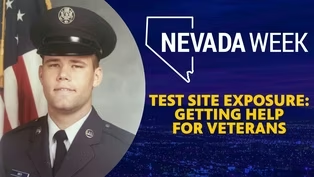
Test Site Exposure: Getting Help for Veterans
Video has Closed Captions
Clip: S9 Ep7 | 13m 55s | A new bill aims to help veterans exposed to radiation at the Nevada Test and Training Range. (13m 55s)
Providing Support for PBS.org
Learn Moreabout PBS online sponsorship New Episode
- News and Public Affairs

Top journalists deliver compelling original analysis of the hour's headlines.
 New Episode
- News and Public Affairs

Today's top journalists discuss Washington's current political events and public affairs.

 New Episode

 New Episode


 New Episode
 New Episode

Support for PBS provided by:
Nevada Week is a local public television program presented by Vegas PBS