
Childhood Cancer Awareness Month
Clip: Season 9 Episode 8 | 10m 8sVideo has Closed Captions
For Childhood Cancer Awareness Month, a nonprofit raises concern over changes to Medicaid.
September is Childhood Cancer Awareness Month and a nonprofit that helps families with that diagnosis is concerned about changes to Medicaid.
Problems playing video? | Closed Captioning Feedback
Problems playing video? | Closed Captioning Feedback
Nevada Week is a local public television program presented by Vegas PBS
Childhood Cancer Awareness Month
Clip: Season 9 Episode 8 | 10m 8sVideo has Closed Captions
September is Childhood Cancer Awareness Month and a nonprofit that helps families with that diagnosis is concerned about changes to Medicaid.
Problems playing video? | Closed Captioning Feedback
Where to Watch Nevada Week
Nevada Week is available to stream on pbs.org and the PBS app.
Providing Support for PBS.org
Learn Moreabout PBS online sponsorshipSeptember will mark childhood cancer awareness month.
The local nonprofit cure for the Kids Foundation treats children with cancer and rare diseases and, thanks to its affiliation with a national research network, is able to connect those children with more than 100 clinical trials.
I spoke with cure for the kids founder and that Logan Parker, about why access to research is personal to her, and how changes to Medicaid could affect her organization and the families it serves.
Cure for the Kids Foundation is a financial supporter of Vegas PBS, And during that process, you.
That was 25 years ago in Las Vegas.
There is very little here for children who fell into that category.
So when our medical journey was all said and done, which he's alive and well and healthy and, you know, very, active and, a Clark County firefighter as a matter of fact, father of three.
So our result was positive.
Our experience was tragic, if that makes sense.
And so I really wanted to create something where children would have access to the things that would ultimately save their life.
And that's research.
And access to research could be a variety of different things, whether it be pharmaceuticals, which is what most people consider.
But there's also research being done in medical equipment and combined therapies.
And different things like that.
So to me, access means being able to receive the care, research focused care that you need locally and care for the kids serves children who are fighting cancer, but children who are also battling rare diseases.
And when I think of that, I imagine it must be pretty expensive to pay for that treatment.
How are the patients and the families that you're serving paying for everything?
it's a mosaic of options when it comes to that.
You know, 50% of our patient population is a medicaid beneficiary.
So the other 50% has generally commercial insurance.
There might be a few that are completely uninsured.
They fall between the income levels of who would qualify for Medicaid, but they don't make enough to buy insurance.
And so under the one big beautiful bill, there will be significant cuts to Medicaid, which Republicans say is eliminating waste and fraud.
How are those cuts impacting the families and patients you serve?
Well, it's a little early to tell exactly what that impact will be.
I can tell you that there's some additional food insecurities now that the snap, requirements have changed.
So we've seen an increase in requests of food cards or grocery vouchers and things like that.
You know, the biggest issue for us is 50% of our population is a medicaid beneficiary.
A huge percentage of that.
The patients are already receiving drugs that we provide that are reimbursed less than acquisition cost.
And so we're anticipating the gap between the cost of services and reimbursement for 50% of our patient population will continue to get bigger.
And that's the gap that we need to fill.
Okay.
So as an organization you are getting reimbursed less money for the drugs that you are able to give out through Medicaid.
Right.
How are you going to handle these changes you're already dealing at with a deficit.
Well through philanthropy you know that's how we use our fundraising efforts to cover the cost between what's, what is reimbursable and what the families need.
That's not reimbursable.
And did I hear this right.
That you have families coming to you for help with groceries.
Absolutely.
That was really never something that we had anticipated would fall under our mission.
Fortunately there's a lot of local organizations that we work with that we can refer the patients to.
We have a lot of very generous donors who will give grocery vouchers and gift cards and things like that, that we can provide to our families to offset those expenses.
And the Snap requirements.
You're talking about the work requirements.
So those already went into effect.
The work requirements for Medicaid will go into effect at the start of 2027.
And that could impact the caregivers of these children, correct?
Yes it could.
Yeah.
So when it comes to Medicaid, the work requirements fall into the individual person insured.
In this case, it could potentially be the parent, the grandparent, the primary caregiver.
And that's when everybody's going to have to be very, very, careful about their paperwork.
And they're going to be needing to read the new rules around, exception criteria And it's also been our experience that oftentimes people don't lose their benefits because of lack of eligibility.
It's because they didn't meet the deadline for paperwork and things like that.
So I know that the folks at Medicaid are working really hard to do their best to decrease the burden of the paperwork, but it will have to be done more often than it was before.
So caregivers may lose their own Medicaid benefits for their own health insurance.
Children will not.
But what about young adults who have turned 18?
And maybe that's a very problematic patient population when it comes to this particular conversation, because often times the parents have been taking care of all of the paperwork needs, the medical needs, transportation needs, and then suddenly they find themselves where they're no longer the point of contact without, you know, additional paperwork to allow the parents to be able to represent the child.
And that's where it can be very difficult because you have now a patient is 18 and they're in the middle of a cancer journey, or they have a rare disease, and they're going to have to figure out the paperwork for the exemption, because they themselves will have the work requirement laid on to them when the reality is they may never have been able to work in the first place.
And that's where understanding the exemption criteria is going to be really important for people.
You mentioned the philanthropy that is needed that also helps to fund legislative work, lobbying at the federal and state level.
And you were able to get some significant legislation passed this past session.
Let's start with the newborn screenings.
What was happening before when there was a baby born and what is now happening as a result?
Wonderful.
So, the the bill was essentially to modernize our newborn screening program.
So the public health laboratory had a fee schedule that was a decade old.
And the fee schedule itself needed to be changed through legislation.
So that was the primary objective of that bill to create the environment where Medicaid could look at the fee schedule differently, because a lot happened in ten years.
And it was very, very challenging for the public health lab to keep up with the technology.
You know, there's new screenings that are available for children that weren't available ten years ago, but the fee schedule didn't keep up to allow the lab to expand to do those additional tests.
And that's important because of early detection eye masks.
Oh, yes.
Absolutely.
The diseases that our newborn screening program captures are things that, would normally not be seen until maybe toddler age or even older.
And that's when those issues have already become a huge problem and they're not reversible.
So if we can identify in infancy that there's a genetic condition that we know how to treat, we can start treating it before symptoms ever even arise.
And then the other bill deals with licensing for a genetic counselor.
Why would that be important?
Genetic counselors.
What do they even do?
Well, oh my gosh.
Genetic counselors are a huge part of helping people understand the conditions and mapping out what happens.
And we don't have a licensure requirement for them or we didn't.
We do now.
because the way it was before anybody could say, oh, I want to get a job as a genetic counselor, and they could go to work and they can learn it and, you know, do different things and work with physicians.
But this ensures that they are adequately trained and that they're following the protocols and the things that they need to.
Last question.
Intermountain health.
Nevada children's hospital.
It's scheduled to open in 2030.
It's a big deal because it will be Nevada's first standalone children's hospital.
When and if it opens.
Is that going to eliminate the need for care for the kids?
No one.
We're very excited that they're coming and building a freestanding hospital.
But in reality, it will expand the need for care for the kids.
So how that works is, you know, we're going to be partnering with them on services that inpatient pediatric oncology and rare disease services that historically have not been available in our community.
So those might be bone marrow transplants, things like that, where we send the families out of state and then they return for their general medical oncology care.
So that will start to happen in town, which is a huge milestone and a huge victory for our community.
So we're thrilled about that.
But what that means is care for the kids will have to meet the hospital in the middle and provide additional staff additional training for our staff so that we can accommodate those things.
So collaboratively, we're going to be able to offer something together that the community didn't have before, and that's going to increase the need for care for the kids, not decrease it.
All right.
Logan Parker, thank you so much for joining Nevada Week.
Thank you.
This week, the Las Vegas Raiders announced they're making a $25 million donation to the Intermountain Health Children's Hospital.
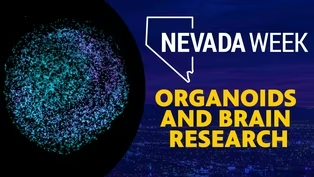
Video has Closed Captions
Clip: S9 Ep8 | 7m 41s | Cutting-edge UNLV research with lab-grown cell clusters called organoids advances brain health. (7m 41s)
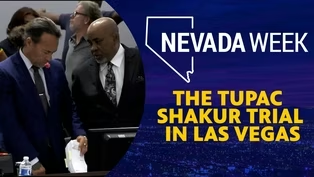
The Tupac Shakur Trial in Las Vegas
Video has Closed Captions
Clip: S9 Ep8 | 7m 15s | The man accused of orchestrating the murder of Tupac Shakur 30 years ago in Las Vegas is on trial. (7m 15s)
Providing Support for PBS.org
Learn Moreabout PBS online sponsorship New Episode
- News and Public Affairs

Top journalists deliver compelling original analysis of the hour's headlines.
 New Episode
- News and Public Affairs

Today's top journalists discuss Washington's current political events and public affairs.

 New Episode
 New Episode
 New Episode
 New Episode
 New Episode

 New Episode
 New Episode
Support for PBS provided by:
Nevada Week is a local public television program presented by Vegas PBS