
A’s, Nevadans celebrate stadium groundbreaking
Season 7 Episode 51 | 26m 46sVideo has Closed Captions
A historic day for Las Vegas, as the Athletics break ground on their new stadium.
Four years after the Athletics started the relocation process from Oakland, dignitaries break ground on Las Vegas’ new stadium. We bring you to the green and gold ceremony and hear from those who worked to make this ballpark possible. Then, Part 2 of our interview with Nevada’s first female Rabbi Cantor, Jessica Hutchings, and retiring Rabbi Sanford Akselrad of Congregation Ner Tamid.
Problems playing video? | Closed Captioning Feedback
Problems playing video? | Closed Captioning Feedback
Nevada Week is a local public television program presented by Vegas PBS
A’s, Nevadans celebrate stadium groundbreaking
Season 7 Episode 51 | 26m 46sVideo has Closed Captions
Four years after the Athletics started the relocation process from Oakland, dignitaries break ground on Las Vegas’ new stadium. We bring you to the green and gold ceremony and hear from those who worked to make this ballpark possible. Then, Part 2 of our interview with Nevada’s first female Rabbi Cantor, Jessica Hutchings, and retiring Rabbi Sanford Akselrad of Congregation Ner Tamid.
Problems playing video? | Closed Captioning Feedback
How to Watch Nevada Week
Nevada Week is available to stream on pbs.org and the free PBS App, available on iPhone, Apple TV, Android TV, Android smartphones, Amazon Fire TV, Amazon Fire Tablet, Roku, Samsung Smart TV, and Vizio.
Providing Support for PBS.org
Learn Moreabout PBS online sponsorship[cheering] The Athletics break ground on their Las Vegas Major League Baseball stadium, plus... -Those women have come to me and said, I never thought I could speak out about my miscarriage or even think about it again, but you gave me permission to do that.
-Part 2 of our interview with Nevada's first female rabbi cantor and the beloved rabbi she's replacing.
That's this week on Nevada Week.
♪♪ Support for Nevada Week is provided by Senator William H. Hernstadt.
-Welcome to Nevada Week.
I'm Amber Renee Dixon.
In June 2023 is when the State of Nevada approved up to $380 million in public funding to help the Athletics build a Major League Baseball stadium in Las Vegas.
Two years later, the A's have now broken ground on the ballpark located on Las Vegas Boulevard where the Tropicana once stood.
It's set to open in 2028.
(John Fisher) And three years from now, you'll see the fruits of all of that labor when in 2028 we have Opening Day out here on the Las Vegas Strip.
It's, it's an epic moment for our 124-year-old franchise.
-That was A's Owner John Fisher at the groundbreaking ceremony.
MLB Commissioner Rob Manfred was also there and joined John Fisher in praising the state's elected officials.
(Rob Manfred) You know, when you have 30 teams, you get a chance to work with governments around the United States.
And those of you who live here in Nevada should take great comfort in the efficiency and effectiveness of your elected officials.
And trust me, we would not be here today were it not for some of the hard work that went into making this a reality.
-Manfred highlighted Nevada Governor Joe Lombardo's efforts.
The Republican governor called a special legislative session in 2023 specifically for the A's stadium bill.
Critics clamored that the taxpayer money involved should instead be used to address the state's struggling education system.
At Monday's groundbreaking, Governor Lombardo said this is all about economic growth.
(Gov.
Joe Lombardo) To me, it's economic drivers, it's jobs, it's an ability to be the true "Entertainment Capital of the World" and drive everything home what we envisioned and what John and I envisioned in having success in this.
So here we are today.
The conversations still continue, but I anticipate that the pile drivers behind me are going to be hitting the ground sometime this evening.
And in 2028, we're going to be throwing a pitch across that plate.
-And to make sure that happens, the A's hired Marc Badain as their president in March.
He's the former president of the Las Vegas Raiders and oversaw their relocation to Las Vegas, as well as the construction of Allegiant Stadium.
A's owner, John Fisher, who also owns the Major League Soccer team the San Jose Earthquakes, is reportedly contributing more than $1 billion to the A's stadium, despite reports that he's also looking for investors to help finance it.
Badain told us the project is fully funded.
The basics, how much is this stadium expected to cost?
(Marc Badain) It'll probably come in around $1.75 billion as has been reported.
-And has that been adjusted for the anticipated impacts of tariffs?
-Yes, we've prepared for tariffs; we've built in a contingency.
You do all that when you do a project of this size.
-So the funding part of it, there is public funding, there is private funding, but it's not fully funded, correct?
-No, it is fully funded.
The Fisher family has made a commitment, and they're prepared to fund any amount, any overage, and that's one of the reasons why we're standing here today.
-Okay.
So there was the 1 billion committed by the Fisher family, right?
-There is.
-And so anything extra-- -Will also be committed by the Fisher family.
-Do you know if that is why Mr. Fisher is putting up the MLS team for sale?
-It has nothing to do with that.
That's been part of their plan for a long time.
-How much of a role did you play-- do you think you played in getting us to this point today?
-It's nice of you to say that.
I'm very fortunate.
The team did an incredible job.
Reached out to me about six months ago.
There are certain things they asked for me to help with, and the team of people that they put in place and, obviously, from what you see here in this tent, it takes, it takes a cast of thousands.
So I'm just, I'm happy to be a part of it.
-What were some of the requests they made for your help?
-Just, obviously, my relationships in this town go back about a decade now.
And then help with the sales and monetization of the building.
The design is done; I don't have to do anything there.
The construction team's in place.
It's a lot of people that I worked with on the previous project on Allegiant Stadium, so that familiarity is very helpful.
And the relationships, as you know, in this town are very important.
-How has this experience compared to your work with the Raiders getting a stadium here?
-Anytime you do something for a second time, it's a lot easier.
It's like doing a movie sequel.
You know the players, you know the director, you know the producer, and you put the right people in the right place.
And we've got a great team that's effectuating the plan.
-And then the last time I spoke with you, you were working on getting a privately funded NBA arena in Las Vegas.
What happened with that?
-That's still-- it's still ongoing.
I'm not a part of that project anymore, but I speak to Tim a lot, and I'm a big advocate of his company and the plan he has in place.
I'm looking forward to that coming to Vegas and being part of the infrastructure here as well.
-What's your level of confidence that that will happen?
-I wouldn't bet against Tim Leiweke.
-And then last thing, you grew up as a Raiders ball boy, correct?
-I started in the football operations department, yeah.
-Okay.
So what did you think of the A's who shared the stadium with the Raiders?
-I had a lot of very deep relationships with people there.
Some are here today.
Dave Rinetti and I have known each other 30 years.
Steve Fanelli and I have known each other 25.
So, yeah, there's a lot of history, and we had our issues.
We got through them, but they're really good people, and I'm just blessed to be working with them.
-Because to some it may seem strange that you were a Raider and now an A.
-Well, we-- I wouldn't consider it strange.
I'd consider it fortunate.
-The A's say the stadium's first concrete column should be in place by the end of this year.
Meanwhile, in last place is where the A's find themselves in the American League West.
A poorly performing team in recent years, will the A's improve by the time they get to Las Vegas?
I spoke with A's Assistant General Manager, Billy Owens, about that and more.
What was your level of confidence that we would reach this day?
(Billy Owens) You know what, out of 100%, I was like 99.5.
I mean, this is so exciting to all of a sudden on June 23, 2025, and here we are, grand opening.
-When you first heard Las Vegas, what did you think?
-Yeah, Las Vegas is special.
I go back to the Jerry Tarkanian Thomas & Mack Center, seeing the Las Vegas Knights win an NHL championship, the Aces win the WNBA championship.
It's kind of the mecca for sports.
The Raiders coming here, having the Super Bowl here, so baseball is obviously the next step.
I'm sure the NBA will be here at some point.
So this is exciting.
-This is a tough one: What are you saying to people who are thinking, Gosh, you're bringing a team with not a great record to Las Vegas?
-Yeah, the record is not great right now, but you can see the young talent flowing through.
I mean, Jacob Wilson right now is tied with Aaron Judge as far as the most Major League hits, and Jacob Wilson is 23 years old.
I mean, I comped him to Derek Jeter coming up.
His father is Jack Wilson, was all-star shortstop as well.
He's a star.
And Nick Kurtz, he came up, literally drafted last year, started the year in Triple-A.
He's got home runs in five out of the last six games, 10 home runs.
So I firmly believe Jacob Wilson and Nick Kurtz, they'll be 1, 2 in the Rookie of the Year voting this year, 2025.
And honestly, with the momentum, we'll see which one wins.
-To 2028 then.
-Cheers to 2028.
Can't wait.
-In 2028, Las Vegas Mayor Shelley Berkley will still be in office.
She, too, was at the stadium groundbreaking where I asked her about several topics, including immigration enforcement in Las Vegas and the United States' bombing of Iranian nuclear facilities.
Let's start off with the event that we are at.
I imagine you were following all the progression ahead of becoming mayor.
Did you think that this was going to happen, that we'd reach this day?
(Shelley Berkley) I did believe that this day would happen.
Where else would any team on any sport want to be than Las Vegas right now?
We are the hottest ticket in the sports world, and I'm so excited to welcome the A's to Las Vegas.
-What role do you play in making sure that that happens?
Because this is technically Clark County.
-And I have a very limited official role to play, but I still think it's important for the mayor of Las Vegas to be very supportive and welcoming, and we are.
-I want to ask you on a different topic about immigration and how you currently understand the situation to be.
There have been, gosh, a series of events.
At one time, Las Vegas was named a sanctuary city.
You had to respond to that.
Then we heard that hotels and farms are no longer going to be targeted, yet democratic cities will be targeted.
What do you make of all this?
-Well, I think this is a very fluid situation.
As you know, I'm the granddaughter of immigrants that came to this country to escape the Holocaust.
We're a very diverse community.
Everybody is valued here.
Obviously, we don't want criminals in the streets committing crimes, but on the other hand, we welcome people.
We want them to be here, and they've contributed mightily to the success of our city.
So we'll see what happens on the federal level, but I think right now, the city is doing exactly what we need to do.
We protect our fellow citizens, and we do whatever we need to do to work with ICE to ensure that the bad actors are not here.
-Do you have an example of that, of what Las Vegas is doing?
-Yes.
We signed an agreement with ICE, the sheriff did.
As you know, the protests were relatively peaceful.
For 10,000 people to have 22 arrests, I think was-- I took a deep breath of relief.
We don't want anything messing up our city.
We all belong here; we're all a part of it.
Setting fires or attacking the police doesn't do anybody any good.
And we have our own issues.
We know where we stand on the issues, and you execute appropriately without doing anything foolish.
Everybody has a right to protest, and I welcome that, but we also need to keep our city safe.
-And for our viewers who are not familiar with that agreement that the sheriff has made with ICE, what is it?
-If you are an illegal or you're not here legally and you are arrested, the Metro is going to detain the person that's arrested for a few days to give ICE an opportunity to pick them up from the jail.
That is the extent of our agreement with ICE, and I think it's an appropriate one.
-You support it?
-Well, I don't believe that Metro should be doing ICE's job.
Metro has enough on their plate without doing federal law enforcement.
So as long as we have an agreement with ICE that we can execute appropriately, I think that's okay.
And that's exactly what we're doing now.
-Mayor, as a prominent member of the Jewish community, your thoughts on the US getting involved in Iran alongside Israel?
-Well, when I was in Congress, obviously, I wanted to eliminate the threat of a nuclear Iran.
I am very hopeful that this latest action did, in fact, do that, but I think it's still early in the game.
We're going to have to wait and see what happens.
-And the last question: Rabbi Sanford Akselrad, he is going to be retiring.
I think you were at his retirement party.
We have an interview with him coming up.
Any thoughts about him leaving this position?
-Well, I love this man.
I was not only at his retirement party, but I was there to welcome him when he was first hired.
So we have a very long relationship.
My husband was on the board of Ner Tamid for many, many years.
We love this man.
He's been a wonderful asset, not only to the Jewish community, but to the entire Las Vegas community.
And I, for one, will be very-- am very sad to see him leave.
He's earned this retirement, and we have a great new rabbi coming on that we know very, very well.
So it's a win-win-win for everybody.
-That new rabbi is Jessica Hutchings.
She's Nevada's first female rabbi cantor and will soon take the place of Rabbi Sanford Akselrad at Congregation Ner Tamid.
After almost 40 years leading the largest Reform Jewish Temple in Nevada, he's retiring.
We recently spoke with both rabbis.
Part 1 of that interview aired last week, and in Part 2, we pick up where we left off, talking about the increased antisemitism happening here and across the country.
(Rabbi Cantor Jessica Hutchings) We had a situation recently where a congregant was getting in their car in the parking lot and someone yelled, you know-- it was some kind of slanderous thing about Jewish people as they drove by our campus.
This just happened a couple of days ago.
We've had a-- threats come in.
We had a written, mailed threat about that we should not exist, basically.
That came in through the mail with someone's return address on it, so they wanted us to know who they were.
That was like a week and a half ago.
Things like that, that people are outwardly-- we'll get on our live stream, we live stream our services, and once in a while, I'll have to go in and delete comments on the YouTube or Facebook because there'll be bots or trolls that come in and say things about how they feel about the Jewish people.
And I want to keep it a peaceful space for our people to have communal prayer.
And so yeah, I mean, these are things I never saw before, not in Las Vegas, not in Los Angeles, like, they happen, of course, but at this level where it's like, okay, what are we waking up to today?
Never before.
(Rabbi Sanford Akselrad) And you know what happens in another state reverberates in the Jewish community throughout the world.
So if you have a governor whose house is fire bombed, right, on Passover, that reverberates here.
If you have people in Boulder who are the victims of a Molotov cocktail, that reverberates here.
We're a small community.
And when something happens in another state, in another country, we look in the mirror and say, Oh, my God, that could happen here.
What are you doing, Rabbi, to protect our community?
-And then comes-- -That's very real.
-Then comes the tax it costs to be Jewish, which is to have to spend hundreds of thousands of dollars a year per community to have ample security.
And it's tough.
It's tough to know that you need that in order to just be, just live in peace.
-So you want to balance that with a great career coming ahead where you're supposed to be warm and friendly, engaging, outgoing-- -You're doing my job for me.
You're transitioning-- -Right?
So there you are.
On the one hand, you have an open hand, and other you have a closed fist.
It's a very confusing time that way, and but that's what we are.
We hope that people don't think they're going to come to Congregation Ner Tamid and think that, you know, like we're just bunkered down in such a way that people won't feel welcome.
We try very hard, programmatically and also person to person, for people to feel at home and welcome and also safe.
-Perhaps some may argue, a female rabbi is needed now more than ever?
-In what way?
-Well, I want to ask, actually.
-You're talking about being more maternal?
-But that is some of the talk around what a female rabbi can provide that perhaps a male rabbi cannot.
Do you agree with that?
-Sure.
I think it's about the person.
In this particular situation, we spoke yesterday, because Rabbi Akselrad just got back from a men's retreat.
And I said, Okay, well, if you're not here next year, I'll have to lead the retreat, and he said, It can't happen.
It has to be a man leading the retreat.
So there is a need-- -That wasn't exactly what happened.
You said, How do you feel about whether I could lead it or not?
I said, I don't think it would work.
I think the men really want to be led in a men's retreat by a fellow man.
-Totally, so I reflected on that.
-Whether that's right or wrong...?
-No, I reflected on that.
I think that there is a truth to that.
Like people that you identify with, you feel closer to and say things to or act in a certain way that you may not with a different-- with someone of the opposite gender or different gender.
So I think for the women in our community that have experienced, you know, infertility or have body image issues, things that I've written about, spoken about in my own life, and those women have come and said, I never thought I could speak out about my miscarriage or even think about it again, but you gave me permission to do that.
Or I have been struggling with these issues with the way I feel about my body, but you speaking about it made me think about this in a whole new way.
So there are things-- those are things that maybe Rabbi Akselrad couldn't talk about, as he doesn't live in that same body.
So I think it just depends about the person that we're speaking about, and, hopefully, one of the benefits of having a community our size is that we will eventually have two clergy, and we will bring two different perspectives.
We may be two different genders, we may not, but we bring something that hopefully our community will find that they are-- like there's that need to be close to that person.
They can see themselves in that person in some way.
-Your legacy, what are you most proud of having done here in Southern Nevada?
-There's a lot of things.
First of all, when I came, it was about 60 families.
Now we're about 600 families.
So I'm proud of the growth, but it's not just growth for growth's sake.
It's because people have found within our community, I hope, a welcoming environment where people can feel a sense of being supported, whether they don't have children, do have children, have toddlers, all the way to being a senior and on to grave.
I've wanted to be a family rabbi.
So I think I've achieved that type of legacy.
Social justice, whether it's helping victims in Katrina, I went out to Poland to help the refugees from Ukraine.
Most recently, we worked together to provide this incredible support to the victims of fire in Los Angeles.
So this whole motto that I've carried of "Stand tall," I think, is something that I hope stays on.
Interfaith, I've been involved in Interfaith throughout my career.
I'm part of the Interfaith Council.
Forging programs for Thanksgiving.
When One October happened, I was part of the planning.
We held it in the Catholic Diocese church and cathedral, and just bringing people together of other faiths.
The work that I've done, in particular, with the Muslim community, has always been a source of pride.
I remember after 9/11, I said, I know what's going to happen.
People are going to blame all Muslims for what happened.
And so I purposely went and reached out to their community, and we planned a huge program in support of the Muslim community, and it was an Interfaith program.
And I remember there was an incident of, in the Muslim community, they built a funeral home, and it burned down.
They never found out if it was an act of arson or not; but from their perspective, it could have been.
And so I heard about it.
No one invited me.
I just showed up, and they looked out there and there was Rabbi Akselrad, and they were so happy.
They said, Please, Rabbi, would you speak?
And I wasn't, quote, prepared to speak.
I wasn't there to speak.
I was there as a citizen of Las Vegas to say, I support you.
But they felt seen, and when they invited me, I gave an extemporaneous talk about "not in our town," because it can, it can fall on the Muslims, it can fall on the Jews, it can fall on any minority, but hate anywhere is something that we have to tackle head-on.
And so that's also part of the legacy.
And the last thing I remember is during the recession, I created this jobs program that was all based upon relationships, and we got over 1,000 people jobs.
And it was called Project Ezra.
And Ezra was a prophet in the Bible who provided help to the Jewish people at a time of despair.
And it also means "help."
So it was kind of a play on words.
I don't know, I could go on and on down memory lane.
And if we had a two-hour show, I think we could go down that lane -Easily.
-And I have nothing to live up to at all.
[laughter] -What do you want to continue?
-All that.
-What do you want to add?
What are your hopes?
-Look, I think, as times change, things will have to change within the community, and but that, the legacy that I think will carry through is wanting to bring the community together, both the Jewish community, the community at large, that we want to do right by the community that we're living in, in Henderson, Las Vegas.
Some of the things, getting all of the supplies together for the fires in Los Angeles was an initiative that I felt was very important, because they're our neighbors.
I created a Vegas Strong in Song.
We had a concert that was like seven days after One October to bring funding and awareness to our community.
And those kinds of things are really the moments that you feel like community is the most important thing.
And so I definitely want that to continue on, that people feel that it's a special place to be and a community that they want to be part of.
And the future is yet to be known, but I definitely was mentored very nicely.
-She has the unique ability, also, of combining her love of music and her leadership skills.
I think you should share what you did in Israel and how you brought that cantoris concert there.
That was really important.
-If you want me to.
-Yes, please.
-So there's a-- we have a sister city called Ramat HaNegev.
It's a very large geographical part of this kind of south of Israel, or the middle south, and that community neighbors the Gaza "envelope" is what they call it, so the area that is really right next to Gaza and where a lot of the front lines are.
And they have been-- all of their efforts have been exhausted because they're helping all these people in the towns right next to them, and I felt like they needed a little bit of solidarity and support.
And a few months had passed since everything had happened, almost a year, and I got together some of my cantor friends from around the country and I also called some in Jerusalem, and we put together a beautiful-- it was like Spring Mountain Ranch, if you've ever been to that.
It was like that under the stars in front of how these ibexim, these beautiful-- Ibexim.
I used a Hebrew plural-- ibexes, like these beautiful animals, like roaming in the valleys, and it was just this beautiful desert landscape.
And these people who live on a kibbutz, and they-- I just wanted to bring solidarity to them, to show them like we're here for you.
We're going to bring-- we can't bring you-- we can't fix this war, but we can bring you beautiful melodies and prayers and songs.
So let's just sing together.
-And dance again, that was kind of the motto, "We can dance again.
We can sing again," because, initially, Israel was in such despair.
For her to travel there and to say, It's time, you know, we're still in mourning, and yet, there's a time to hear each other sing and to celebrate Jewish life.
-Absolutely.
-And from a female cantor, that was especially important, because that's not well known in Israel.
-Not at all.
I mean-- -So again, she's breaking the mold in so many ways, which is why I'm so proud of her.
-They see my kippah in Israel and they're like, Ohhh.
Yeah.
I usually get a, Good for you!
or yelled at in some way.
I'm used to it by now.
-All right.
Rabbi Cantor Hutchings, Rabbi Akselrad, thank you so much for joining Nevada Week.
-Thank you for having us.
-And thank you for watching.
To see Part 1 of that interview, go to vegaspbs.org/nevadaweek, and I'll see you next week on Nevada Week.
♪♪
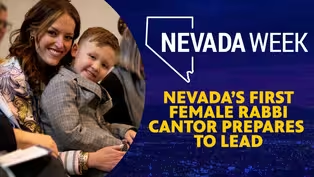
Nevada’s first female Rabbi Cantor prepares to lead
Video has Closed Captions
Clip: S7 Ep51 | 12m 19s | Rabbi Cantor Jessica Hutchings shares how she plans to lead Congregation Ner Tamid. (12m 19s)
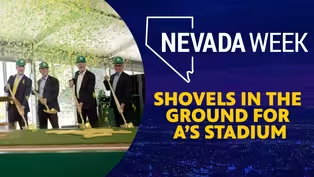
Shovels in the ground for A’s Stadium
Video has Closed Captions
Clip: S7 Ep51 | 13m 20s | Nevada leaders, Little Leaguers, and A’s dignitaries break ground for LV future stadium. (13m 20s)
Providing Support for PBS.org
Learn Moreabout PBS online sponsorship
- News and Public Affairs

Top journalists deliver compelling original analysis of the hour's headlines.

- News and Public Affairs

FRONTLINE is investigative journalism that questions, explains and changes our world.



Support for PBS provided by:
Nevada Week is a local public television program presented by Vegas PBS