
America at 250: The Indigenous Perspective
Clip: Season 8 Episode 50 | 20m 22sVideo has Closed Captions
While the country celebrates America at 250, what do the original residents of America think?
While the country celebrates America’s 250th birthday, what do the original residents of America think?
Problems playing video? | Closed Captioning Feedback
Problems playing video? | Closed Captioning Feedback
Nevada Week is a local public television program presented by Vegas PBS
America at 250: The Indigenous Perspective
Clip: Season 8 Episode 50 | 20m 22sVideo has Closed Captions
While the country celebrates America’s 250th birthday, what do the original residents of America think?
Problems playing video? | Closed Captioning Feedback
Where to Watch Nevada Week
Nevada Week is available to stream on pbs.org and the PBS app.
Providing Support for PBS.org
Learn Moreabout PBS online sponsorshipThis July 4th marks 250 years since the Second Continental Congress adopted the Declaration of Independence.
The document announced that the Thirteen Colonies were separating from Great Britain and considered themselves free and independent states.
One passage famously declares that "all men are created equal, that they are endowed by their Creator with certain unalienable Rights, that among these are Life, Liberty, and the pursuit of Happiness."
Continue reading, though, and that same document goes on to describe Indigenous people not as men but merciless Indian savages.
And so as the country marks this historic anniversary, we're asking what this date means to Indigenous communities and what they want people to know about their history, accomplishments, and future.
Joining us now are Benny Tso, Chairman of the Las Vegas Paiute Tribe; Ashley Hemmers, Tribal Administrator of the Fort Mojave Indian Tribe; and Tammi Tiger, Director of the Tribal Education Initiative at UNLV.
Thank you all for joining us.
-Thank you.
-And since we are on Southern Paiute land, I'd like to start off with you, Chairman Tso.
What does "America at 250" mean to you?
(Benny Tso) 250 years to me, I believe it means to the Las Vegas Paiute Tribe, survival, you know, being able to be in existence this long and still having our footprint known, you know, being able to, you know, thrive through what has happened and what was meant to erase our existence here and being able to prolong our existence and providing those means of success to our younger kids, our younger generations.
So speaking previously, we talked about seven generations out.
I think that's what that means.
I think an ability to last, you know, those seven generations.
-Ashley Hemmers with the Fort Mojave Indian Tribe, what does "America at 250" mean to you?
(Ashley Hemmers) My name is Ashley Hemers.
I'm from the Fort Mojave Indian Tribe, and, you know, I think it's a good reflecting point for America.
I think it's a good time for them to really understand that, even in Nevada, there is a complex and diverse history, right?
A lot of people think of Las Vegas as very young for Southern Nevada as a new landscape, but it's not.
Our people have lived here for millennia.
And when you move into the desert, it's a new lifestyle, new acclimation, but it's a good time to learn about your surroundings and learn about the communities that have been here and that have thrived for generations and that continue to live here and grow.
-And Tammi Tiger, in addition to your role at UNLV, you also describe yourself as an urban native.
What does that mean, and what about "America at 250"?
(Tammi Tiger) I'm Tammi Tiger, citizen of Choctaw Nation and descended from Muskogee and Seminole People, have called Nuwu lands my home here for over 35 years, because my family was relocated under BIA policies, Bureau of Indian Affairs.
And when I think about America 250, what first comes to mind is the land of America is millions of years old, the people of America are thousands of years old, and the United States of America is 250 years old.
And so I think of all the people that moved here and what an educational opportunity and awareness opportunity it is for them to explore their own heritage and where they came from before America or the United States.
-What about the actual day itself, Fourth of July?
What will each of you be doing?
Chairman Tso?
-I think we'll probably be doing what most Americans do, you know, celebrating our existence.
You know, me being Southern Paiute, you know, celebrating that, celebrating our, our successes with the sacrifices that our tribal people have made, you know, from the, from the way history has went.
So I think we'll be celebrating that, you know, have some family time together.
I'm not going to any type of fireworks display, even though it's all around us.
So that question is kind of-- it's kind of hard to answer for us, because it's surrounding us, right?
So how do you get away from that?
You don't get away from that.
So in our own way, we'll be at the house.
-No Uncle Sam posters hanging up.
No decorations around the home maybe.
-Ashley, how about you?
-Yeah.
Well, I think it's important to remember that tribes are sovereign nations, that we do have a special unique relationship with the Federal Government, which means we weren't conquered.
It means that we have agreements with the Federal Government to live in coexistence.
And so I think that that's very important for people to understand that even though the United States is 250 years old, that didn't eliminate our nationhoods for tribes of Indigenous peoples across the Americas, specifically in the United States.
And so for us, what we do at Fort Mojave is we do something called honoring traditions, where it's similar to a celebration that regular Americans have, family, like the chairman had mentioned, but we also celebrate our traditional songs, our stories, our culture, just because, for us-- and this is something that's a little different, is that a lot of Americans don't really dig into what that revolution looked like and that tribes were a part of those, those times.
And so when we go back and we dig deeper into that history, then you can see that our relationship is not an us versus them.
It's more of a coordinated kind of tension in terms of how we've been able to live together and how we live together now.
-The White House, under President Biden, said that Native Americans serve in the armed forces at higher rates than any other group.
-Yes, they do.
-What do you think is behind that?
-Well, for us, we're very fortunate at Fort Mojave that our chairman and vice chairman are veterans from the Marine Corps and Army.
I'm a proud Army aunt.
And so for us, because we have that unique relationship with the Federal Government, we have agreements with the Federal Government.
So there's an interest in making sure that we continue our-- what you can consider peace agreements now, right?
And so those are-- those are how we've been able to historically align as allies across this nation.
And I think that that's very important that it's a government-to-government relationship, just like any other international relationship, it's just that we're here.
-Do you think that's not understood?
-I think, you know, to her point, I think it is.
I think it gets, you know, blurred.
My personal belief on, you know, about our people serving the armed forces, we've been doing it since day one.
We've been protecting and fighting for our land since, you know, 250 years previously, before that.
So having that high per capita per armed forces for protecting our country, that's just in our nature to do that.
-Tammi, I didn't ask you about your Fourth of July plans as an urban native.
-I like bacon wrapped hot dogs and fireworks and dual citizenship.
You know, we're part of this great country, and I celebrate both.
I have an American flag with a Native American on it that I'll probably put up and do a little opportunity to educate online that how this country came about, how it listed us as merciless Indian savages in it, but how we're still here with this relationship with the United States now.
-Tribal sovereignty, you've been talking about that with the various agreements with the Federal Government.
But what is the definition from both of you--I'll start with you, Chairman Tso--of "tribal sovereignty"?
-Tribal sovereignty, I think for us, is something that we hold utmost respect for.
We have the utmost respect for it.
That identifies who we are, you know?
Before all of this came about, these new lands came about to 250 years, we expressed our tribal sovereignty through each one of our nations, you know, having these, you know, the concept of the government-to-government relationships is not, it's not new.
It's something that we've been doing since day one.
Of course, you know, we've had our territorial battles.
We've had things like that, but there's times of peace, times to work alongside one another.
I'm talking about the tribes, you know, back then.
So tribal sovereignty to me is everything.
It helps us identify who we are, you know?
And that's something that, you know, we really haven't let-- we haven't let anybody take that from us.
It gives us our identities of who we are, you know, being able to dictate how our tribes are going, being able to, you know, tell our story, and so being able to-- If you want to add, Tammi.
-I was gonna say it's inherent.
Sovereignty is inherent.
We had it before the United States was here.
My tribe had treaties with England before the United States was formed, and so our sovereignty just continues.
It's recognized through the treaties and different agreements, like Ashley mentioned.
-What does it look like in modern day life, Ashley?
What examples are there of tribal sovereignty?
-I mean, I think that you can-- I think when we think about America 250, it's a really good opportunity for Americans, in general, to understand, because they're celebrating freedom, that that is not a new concept to the Americas.
That's actually a concept that when people came here, they're like, Oh, freedom.
We're like, yes, but you got to protect it, you got to respect it, and there are certain things that you have to do to keep it sacred.
And so that's where some of the, if you look historically, some of the conflict has come in, because it's about whose freedom, what freedom, why, right?
And for us, to Tammi's point, it has always been inherent for us.
We've had-- We've established our boundaries, to the chairman's point.
And so 250 is that history of Americans finding their place in our lands.
-Okay.
How-- -Can I mention one more thing?
-Of course.
-I think it's important to also acknowledge that we weren't even fully citizens of the United States until, what, just 102 years ago, when our tribes established the treaties and had our citizenship.
So we weren't even recognized fully as citizens of the United States until-- -And the ability to vote, even though-- -Yes.
- --you were fighting in the wars here.
Right.
-To add a little bit, too, as well, it's something that we would love to maintain, because, for some odd reason, we're the only ethnicity that has to prove how much we are native.
We have to carry our tribal cards around to tell people, to show, in fact, how-- I don't even know if that's a real word, but how much native, "nativer" we are.
-And this is an issue that you recently addressed yourself within your own tribe.
Will you explain how and why?
-Yeah.
So what we did, you know, exercising our sovereign immunity and exercising our right to dictate who belongs in our tribe and not having the issue of blood quantum come about, you know, we took that into our own hands.
So the Las Vegas Paiute Tribe, through a constitutional amendment, we adopted some new enrollment criteria, because that enrollment process, you know, with the blood quantum aspect of it, you know, again, the federal government, is a way to erase our existence.
And it's starting to come ahead now, but we took a step in front of that.
And so what we did is we created new enrollment criteria for our tribal citizens, and now we just, in May, we allowed 48 new tribal citizens to come aboard, which we have a lot more coming in.
So it again, going back to, you know, prolonging our existence, you know, and securing our, our footprint, you know, here in Southern Nevada, I think that's something that, you know, I think we're proud of that.
We're proud to have that, you know, and being able to decide who belongs to our tribe.
I think that's best something suited for our tribe and not anybody else.
-Ashley, you and I spoke off camera about this topic.
What do you want people to know?
-I think that it's very important to, even though there are theoretical understandings of tribal sovereignty, like big picture stuff, right, that sometimes policies can impact contemporary life in ways that some people don't understand.
And so when people throw around things like blood quantum, it's really important to remind folks that you're actually counting the amount of blood you have.
And so that means that because of these policies during the termination era was very specific time in the United States history, that there was a rollout that at that point in time, this is how many Fort Mojave you have.
And you're a Fort Mojave, so you're 100% Fort Mojave, you're 100% Fort Mojave, and you're not tainted with any other blood.
This is how this policy came to be.
So if you took that Fort Mojave person and they went and married an American that wasn't Fort Mojave, then that child would be half Mojave.
It wouldn't just be Mojave and American, it would be half Mojave.
And if that child went and married someone else, then that child would be a quarter Mojave.
And then after, if that child decided to marry someone else, then they would no longer be eligible for enrollment in our tribes, even though their grandmother is Fort Mojave, their mother is Mojave, they are Mojave, and that's when we talk about erasure.
It's not so much that we're disappearing, that we're vanishing, because we're here.
It's more so that these policies can have impact to say that we're no longer here.
And they had very intentional purposes for doing that historically, which we are combating as tribal nations to remind folks that we do have inherent sovereignty, that these policies, whoever made them, may not have understood or had a misaligned agenda for us.
And so we have to remind people that that is the practical implication and the devastating reality that tribal nations are facing right now.
-Okay.
We are running out of time, but I want to fit in one topic that has a few questions.
Tribal sovereignty, to any of you, does it ever feel at risk?
Has it felt at risk?
And what relation does the strength of a tribe's economy have to that, if any?
I'll start with you, Chairman Tso.
-There are some times, you know, when we feel like some of the our sovereignty is at risk.
But those are things that we have to take into consideration when we do, when we try to provide for our tribes, such as economic development for our tribes.
There's arenas for certain things that have to take place.
Not all of them, not all of the entities that the tribe does business with, you know, want to have anything go in tribal court, so there's those aspects like that.
So, you know, being able to be in the future, you know, being able to be present today, we have to figure out ways to work alongside the outside entities, you know, and outside companies to provide future economic development for our tribe.
So I think if the tribes stand up, you know, and kind of stick together and do our best, what we can, sharing our resources, sharing our, our economic development ideas, and our successes with other tribes, I think we can hold strong, and we can keep all that.
We can keep that sovereign immunity to ourselves and pass that along to other tribes.
We've done it with the Southern Paiute bands, and I think that's something that we hold near and dear and that we're going to fight very hard for.
-Okay.
You have the Golf Resort, we're talking about economic sustainability up on the Snow Mountain Reservation.
You also have the cannabis dispensary on the Las Vegas Paiute Reservation here.
You are an economic engine, even employing people outside of your tribe, correct?
-Yes.
We have the-- There's more to the tribe than the Golf Resort, you know, more than the Nuwu Cannabis dispensaries.
So we have our smoke shops, which is pretty much what we've been thriving on.
We have our clinic, our health and wellness center, which we do, again, talking about those treaties, you know, and government-to-government relations.
We have the third-party billing with our clinics.
We have our police department that, you know, we have them.
Our child development center.
So, yeah, we're pretty successful.
We do employ outside of our tribal people.
We're probably one of the largest in Las Vegas that employ non-natives in Las Vegas area.
We're looking to do more.
We're looking to build upon those relationships to extend the boundaries of our tribe, you know, and create more economic stability for us, specifically for our tribe, but Las Vegas in general.
-Tammi, from your perspective, does economic self-sufficiency relate to tribal sovereignty at all?
-Absolutely.
Fort Mojave was the first tribe to have gaming in Nevada.
And cases against tribal sovereignty have gone all the way to the Supreme Court a number of times, one of those being the passage of the Indian Gaming Regulatory Act, which allowed gaming on-- tribal gaming on tribal lands with very strict regulatory conditions on it.
And so the tribes have been able to use that as an economic-- like one of the best economic drivers all across the country to provide resources.
Revenues go directly back into the communities, build homes, health care programs, educational programs, all of it to help the tribes grow their self-determination to provide not only for their citizens but their surrounding communities.
-And what are you doing at UNLV with the Tribal Education Initiative?
-We're growing those future leaders from within the tribal communities into their own tribal gaming, hospitality, and tourism enterprises.
-Okay.
Ashley, I will let you add on to any of that, but also we must acknowledge the accomplishment of Avi Kwa Ame and your role in that.
Will you begin to dive into that?
-Yeah.
So Avi Kwa Ame National Monument passed.
It is a national monument.
It's something that Southern Nevada can be proud of, and Avi Kwa Ame is the name that that mountain holds, even prior to America's existence.
So it's the first national monument to have its Indigenous place name that is its original Indigenous place name, which we're very proud about for Fort Mojave.
But it also connects 12 tribes across the high desert, Southern Nevada, Arizona, and California.
And one of the things that we're hoping to do, especially with the beautiful dark night skies of the desert, is to-- We're in the process of trying to make it a dark night skies park so that we can continue to see the Milky Way and all of the stars and the galaxies because for us and for Mojave, it's not just about the landscape.
It's not just about the land in the landscape, it's the landscape as a whole.
So when you go out to the national monument, if you have time to go for a hike or a night ride, you'll be able to take in that landscape and appreciate Southern Nevada for what it really is.
-Wonderful.
Thank you all so much for joining Nevada Week.
-Thank you.
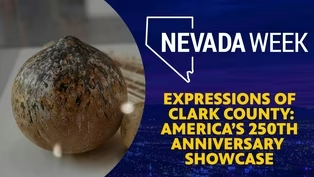
Expressions of Clark County: America’s 250th Anniversary Showcase
Video has Closed Captions
Clip: S8 Ep50 | 5m 50s | A new Rotunda Gallery exhibit honors America at 250 with traditional Southern Paiute items. (5m 50s)
Providing Support for PBS.org
Learn Moreabout PBS online sponsorship New Episode
- News and Public Affairs

Top journalists deliver compelling original analysis of the hour's headlines.
 New Episode
- News and Public Affairs

Today's top journalists discuss Washington's current political events and public affairs.

 New Episode
 New Episode
 New Episode


 New Episode
 New Episode

Support for PBS provided by:
Nevada Week is a local public television program presented by Vegas PBS