
Alzheimer’s Disease to Anthropology: Research News from UNLV
Season 8 Episode 24 | 26m 46sVideo has Closed Captions
We explore the results of a years-long study on Ozempic’s impact on Alzheimer’s Disease.
A study on Ozempic’s impacts on Alzheimer’s disease didn’t have the results scientists hoped for. We talk to UNLV’s Dr. Jeffrey Cummings on the research and what’s next. Also from UNLV: a look at how a “new” species of an ancient human ancestor can help shape our view on evolution. We end with a fun story on “Silver Belle”... the first tree from Nevada to serve as the U.S. Capitol Christmas Tree!
Problems playing video? | Closed Captioning Feedback
Problems playing video? | Closed Captioning Feedback
Nevada Week is a local public television program presented by Vegas PBS
Alzheimer’s Disease to Anthropology: Research News from UNLV
Season 8 Episode 24 | 26m 46sVideo has Closed Captions
A study on Ozempic’s impacts on Alzheimer’s disease didn’t have the results scientists hoped for. We talk to UNLV’s Dr. Jeffrey Cummings on the research and what’s next. Also from UNLV: a look at how a “new” species of an ancient human ancestor can help shape our view on evolution. We end with a fun story on “Silver Belle”... the first tree from Nevada to serve as the U.S. Capitol Christmas Tree!
Problems playing video? | Closed Captioning Feedback
How to Watch Nevada Week
Nevada Week is available to stream on pbs.org and the free PBS App, available on iPhone, Apple TV, Android TV, Android smartphones, Amazon Fire TV, Amazon Fire Tablet, Roku, Samsung Smart TV, and Vizio.
Providing Support for PBS.org
Learn Moreabout PBS online sponsorshipA Nevada tree travels to the nation's capital, and the local filmmaker who followed its journey joins us in studio to explain why.
Plus... -It's a lot more work, but it's going to get us to better drugs for patients.
-Highly anticipated Alzheimer's trials deliver disappointing results.
What researchers say comes next.
And... -Primates have a lot of different species.
Apes have a lot of different species.
And you shouldn't expect anything else from human evolution.
-UNLV helps discover a new species of ancient human ancestor.
The impact on how scientists view evolution, that's this week on Nevada Week.
♪♪ -Support for Nevada Week is provided by Senator William H. Hernstadt and other supporters.
-Welcome to Nevada Week.
I'm Amber Renee Dixon.
And for the first time ever, the U.S.
Capitol Christmas Tree is from Nevada.
That story is ahead, but we begin with a new segment called "Your Brain Health Matters."
Each month, we're exploring research to help us better understand brain diseases and the work underway here in the state to address them.
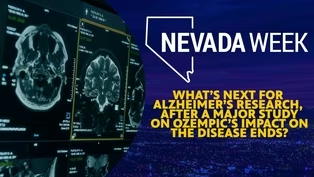
This week, the results are in on a five-year study to find out if drugs like Ozempic can slow the progression of Alzheimer's disease.
Dr.
Jeffrey Cummings is a professor with UNLV's Department of Brain Health and was the co-chair of the trial's Steering Committee.
He told us, although the results were not what he hoped for, there's still a lot to learn from the study.
♪♪ (Jeffrey Cummings) This was two very large trials that tested the diabetes drug Ozempic for the ability to treat Alzheimer's disease.
And this was all brought forward by the observation that patients with diabetes who were treated with Ozempic were less likely to get Alzheimer's disease.
So it was a very logical next step to treat Alzheimer patients with Ozempic.
And two very well-done trials were executed, and we showed no benefit for patients with Alzheimer's disease.
That was a great disappointment.
There were almost 4,000 patients in the two trials combined, and they were on the trial for two years.
So this was a very big investment by the patients and their families in terms of testing this drug.
But we learned an enormous amount.
That's the important thing.
We learned an enormous amount even though the trial was negative.
-What did you learn?
-Well, we had the hypothesis that inflammation present in the body is driving part of Alzheimer's disease progression.
And we knew that this drug, Ozempic, reduced inflammation in patients with diabetes, and we thought that's why they're getting less Alzheimer's disease when they're treated with Ozempic.
And so we tested that hypothesis.
And we showed absolutely that we can decrease inflammation in the blood when patients are treated with Ozempic, but it didn't translate into benefit for the patients.
Now, the important learning there is that the peripheral blood is a bad target for developing treatment for Alzheimer's disease.
It can't guide us in the way that we had hoped to find new treatments for Alzheimer's disease.
Well, that's very important because it extends across the whole field of drug development for patients with Alzheimer's disease.
That's a tremendously important lesson.
-So then what do you do with that in terms of testing?
Do you no longer test a specific way?
-There are about 20 drugs in development for inflammation in Alzheimer's disease.
So we'll now re-examine all of those programs, all of the biomarkers, the blood tests that they are using to guide those programs to see whether the learnings from the Ozempic trial can help make those trials better.
-That sounds like so much more work that everyone now has to do.
-It's a lot more work, but it's going to get us to better drugs for patients.
And ultimately, that's the goal of the work we do is, can we treat patients better?
Can we slow their disease?
Can we prevent their disease?
Can we delay their disease?
These are the goals that we're striving to achieve, and every lesson contributes to that, to that project.
-There has been some reporting that perhaps patients who received the semaglutide didn't get enough, that maybe it should have been injected versus taken orally, and that maybe there still could be some promise here.
-That's a very good question.
And we think that that's not the case, because there was substantial weight loss.
Not surprisingly, this is a drug which is also used for weight loss.
And we saw weight loss in the Alzheimer patients, and we saw that they tolerated it well, but we wouldn't want a higher dose that would produce greater weight loss, because these are already older, frail patients.
And the weight loss was proportional to their baseline weight.
So if they were more overweight at baseline, then they lost more weight; and if they were thin at baseline, they lost very little weight.
Nevertheless, we wouldn't want them to lose more weight, because we think that could lead them to some sort of healthcare compromise.
-How did you take this news personally?
-I mourned these data when I saw them.
I was so disappointed.
We have been working on this trial for five years.
We involved 4,000 patients in 40 countries, 255 trial sites.
This was an enormous undertaking, and I was so disappointed.
I really thought that the information we had from the diabetics, the information we had from a laboratory experiment, which supported the efficacy of semaglutide for the treatment of Alzheimer's disease, was going to come together to predict a positive trial.
And it didn't, and I was very disappointed.
And you have a grieving process to go through when you have invested five years of your lives in doing something and it turns out to be negative.
-You seem to be in a different state right now?
Is that accurate, or is it just for the cameras?
-I am in a different state now because I'm starting to see the lessons that we are learning from this trial, and we've just barely scratched the surface of the data.
We've only had the data for about three weeks from the end of the trial, and there are so many relationships to examine.
For example, we saw changes in the spinal fluid that looked like a small magnitude therapeutic effect.
So we will go back and look at those patients who had these very positive changes in the spinal fluid to look at whether they also had a clinical benefit, because that's the kind of hint that would tell us what we have to achieve in order to advance this kind of drug to a therapy for patients.
-Do these results negate the idea that semaglutide is a miracle drug?
-Semaglutide has had so many beneficial effects.
It is really effective in diabetes.
It is really effective in obesity.
We can see it reduces cardiovascular events like heart attacks and stroke.
We can see that it has a beneficial effect in liver disease.
We can see that it improves kidney function.
It probably has a role in addiction.
So there are many benefits of semaglutide.
None of them are challenged by these results.
What we see is that they don't translate into the very difficult, challenging problem that Alzheimer's disease represents in the brain.
-What comes next?
-What comes next is the trial has to be stopped worldwide.
And that's actually a very complicated process in itself, because you have to make sure that you have all of the data from all of the participating sites so that no patient had even one clinic visit that didn't count in the data that we have.
We have to understand it completely and fully, so all of-- And, of course, the patients have to be told.
You know, we made great efforts to get the information to the patients as fast as possible so that they don't read it in the newspaper and realize they were in a failed trial, a negative trial.
So the trial has to-- is going to be closed now, and then we start examining all the data.
And I still think this class of drugs will be re-examined.
We knew from the beginning that semaglutide itself had a peripheral effect, and we thought that would translate into a brain effect but that the drug itself did not enter the brain.
And it is possible that a drug with a similar mechanism of action but one that enters the brain might still have a benefit specifically in Alzheimer's disease.
And that must be tested.
-Is it too soon to ask what's the next promising treatment in the pipeline?
-Right now we have two drugs that are approved for intravenous therapy for removal of the toxic protein of Alzheimer's disease, and we have one in trials now that is doing everything the current drugs are faster and safer.
So we absolutely can see the next generation of those drugs.
We have a drug that is targeting another form of toxic protein in the brain.
There are many promising candidates in the pipeline that we're really excited about.
-As for what you can do to prevent Alzheimer's disease, we'll cover that in our next segment of "Your Brain Health Matters."
In the meantime, more research news out of UNLV, the university's Anthropology department played a part in the discovery of a new species of an ancient ancestor, the details of which were published in the journal Nature.
These remains are not only helping scientists understand more about how humans evolved, but they also open up the possibility that multiple types of early human ancestors existed at the same time.
Nevada Week Executive Producer Kristen Kidman visited UNLV to learn more.
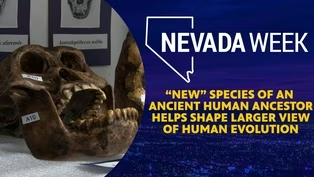
(Kristen Kidman) In 2018, UNLV Associate Professor of Anthropology Brian Villmoare and a team of international scientists found 13 teeth at a field site in Ethiopia.
(Brian Villmoare) They date to 2.6 million years ago.
They are a new species of Australopithecus.
So before this time in East Africa, Australopithecus was only known up to about 3 million years.
That's Australopithecus afarensis, which is Lucy's species.
-In case you need a quick refresher, the eight levels of classification for species goes like this: domain, kingdom, phylum, class, order, family, genus, species.
You're looking at a list of what this looks like for homosapiens, or us.
These fossils are a newly discovered species of Australopithecus, best known for being the genus the famous Lucy skeleton belongs to.
Villmoare says these fossils can help explain some of the timeline of how ancient human ancestors evolved after Lucy, millions of years ago.
-The Australopithecus was kind of a surprise, because we had assumed that after about 3.0 or 2.9 Australopithecus basically couldn't make it.
It seems that they did make it until 2.6, but we have nothing after that.
So just like the last vestige, you know?
-The teeth of this new species were actually discovered with the teeth of another early human ancestor.
-That means that you had two different species that are in two different genera, living at the same place, roughly at the same time.
You can't know if they saw each other.
I mean, it could be seasonal; like in other words, animals do migrate seasonally.
But at least in the coarsest possible terms, they were in the same place at the same time.
-Although scientists only have the teeth of this newly discovered ancestor, Villmoare says there's a lot we can learn from them.
-Like you can really tell a ton about an animal just by looking at his teeth.
It's the way most animals sort of interact with the natural world is by biting it.
So if you have sharp teeth, you're a carnivore.
If you have flat teeth, you're probably grinding something.
If you have big canines, you're using them to fight or to hunt.
So, yeah, the teeth are great.
And so we like the fact that teeth are found.
It would be nice if we found the whole thing in a skull, you know, but that's just, you just sometimes get lucky, and sometimes you don't.
The fossil record gives what it's going to give.
-Villmoare says we often view evolution as a straight line, but discoveries like these show human evolution looks more like a tree with many branches representing the different types of early human species.
-Primates have a lot of different species.
Apes have a lot of different species.
And you shouldn't expect anything else from human evolution.
Now, right now?
Yes, there's only one.
But very recently, as recently as, say, 30,000 years ago, there might have been four or five at the same time on Earth and over, as far as we know, there are, we're up to 26 or 27 different human species over the last 4 million years.
So the fact that we have this newly discovered species, it survived for a while, then went extinct.
We don't think it's any kind of a missing link.
It's probably not ancestral to anything we know of.
That's fine.
That's the way nature works; it experiments.
It says we're going to try this for a while.
Didn't work.
You're now extinct.
And that's what happened to this particular species, we think.
-The teeth are currently with more of the team's discoveries at the National Museum in Ethiopia where other researchers have the opportunity to examine them.
-The way it works is, if you discover a fossil, you sort of have the rights to describe it and do the initial work on it.
Then it becomes the property of the scientific community.
Anyone can go look at our fossils.
All you have to do is just ask the museum.
The museum, as a courtesy, will normally email us and just say somebody wants to look at the fossils.
But our policy is, yeah, absolutely, open door, right?
That's the way science works.
You know?
They need to check to see if what we did was wrong.
You know, scientific knowledge is always provisional.
-The new species does not have a name.
Villmoare says that won't happen until more of its parts are discovered.
We move now to our nation's capital, where, right now, a tree from Nevada stands tall on the West Lawn.
It's the official U.S.
Capitol Christmas Tree, and this is the first time that tree has come from the Silver State.
The 53-foot red fur named Silver Bell traveled from the Carson Mountain Range near Carson City, all the way to Washington, D.C., and made multiple merry stops along the way.
The journey is the subject of a new documentary called From Nevada.
And Chris DeFranco, its Producer and Director, joins us now.
Chris, welcome to Nevada Week.
-Well, thanks for having me.
Appreciate it.
-So From Nevada: The Journey of our Nation's Christmas Tree airs right here on Vegas PBS Friday, December 19, at 8 p.m.
It's about an hour long.
But the time span of this, how long did you work on this?
(Chris DeFranco) A little bit more than a year.
It was a little more than a year.
It was, it started as a little bit of a conversation.
You know, I also produce Outdoor Nevada.
-Yes.
Right here on Vegas PBS.
-Right here.
And with that, working with the U.S.
Forest Service, I had heard-- They got really excited one day, and they said, We've been chosen to deliver the People's Tree to the U.S.
Capitol.
And I didn't understand what that meant.
So when we started talking about it, I had never heard about it.
You know, it just wasn't something that was, I ever knew about.
And when I learned more about it, and I went home and did some research, and I just had seen news stories about it.
And then I asked, I said, Hey, would it be possible to do a documentary on this?
And when we started, then all of a sudden, the ball just started rolling.
And you don't realize how much goes into this and how long it was going to take until you really started, because it starts in January.
Immediately, they start looking for trees, and things start happening a full year beforehand.
-Explain this tradition.
How long has it been going on?
And why is this the first year that Nevada has a tree involved?
-So the U.S.
Forest Service started providing trees to the U.S.
Capitol in 1970.
And then a new forest is chosen every year to provide the tree.
So what happens is the U.S.
Forest Service from that particular forest gets picked.
They have to then identify and find a tree.
Once a tree is identified, there's candidate trees that are chosen.
Those trees are kind of said, Okay, where are they located?
What do they look like?
Do they look like a Christmas tree?
And then those candidates are put forth to the office of the Architect of the Capitol in DC.
Then a representative from the Architect of the Capitol comes out, looks at the tree, they ultimately pick the tree that's going to sit there on the West Lawn of the Capitol.
And then once that happens, it becomes a harvest, a-- getting it prepared to travel across the country, Whistle Stop tour through the state and then across the country, then to Washington, D.C., where it's then set up and then it's decorated, and then it's lit.
And all that takes a year.
-Wow.
-So we hung out with them.
We filmed with them.
We filmed the entire process.
-Tell me about that selection process.
It sounds stressful.
-It is.
Well, especially here.
So Nevada has one forest, the Humboldt-Toiyabe, and it's 6.3 million acres.
It's the largest forest in the lower 48.
So what happens is, is the supervisor for the state, John, who's out of Sparks, he then puts it out to all his field people and says, Start looking for a tree.
So then they start looking for trees.
And all the different foresters and anyone who's in the U.S.
Forest Service can nominate a tree.
So once they figure out what their nominations, they cut it down and start to narrow it down.
Once they narrow it down, they say, Okay, these are the trees we'd like to submit to the Architect of the Capitol.
-And how perfect do they have to be?
-So it's, it's funny, because I had seen some that I was like, That's the one.
That's, that's my pick, you know?
And then it wasn't, because there's a lot of little things that go into picking the tree.
What's the health of the tree?
So they have to monitor the trees for a while.
They have to see that they're disease-free, they're bug-free, that they can make the trip, they're sturdy enough to make the trip.
And it was interesting when the architect came out and they were looking, and he's ultimately making the decision.
So there were five trees in the Spring Mountains right outside of Las Vegas, and then there were five trees up in the Carson Range outside of Reno.
So he had to go tour all the trees.
And he would look at them and like examining them top to bottom, looking, looking, and looking again and looking again.
And one of the things, when I talked to him, that I thought was really interesting is that he was excited because Nevada's trees were so hardy because of the harsh conditions, because of the dry climate, because of avalanche and storms.
Any tree that is this size is strong.
And his thing was, like, that was exciting to him.
And it was very funny to see someone get so excited about a tree, and but then you really came to realize, and you understand it, because we got excited about it, too, when you see people get excited about it, you know?
-You told me off camera ahead of this that the tree became a symbol.
-Yes.
-How so?
-So when they harvested the tree and the tree went on the truck and it started to make its way, you know, there's viewing windows for this tree.
And every place you stop, people get to go up and look at the tree.
In my mind, I was like, Oh, this is, this is about Christmas.
This is, this is season.
But it was so much more than that.
Every single place you stopped, people had questions.
Where did it come from?
What does it mean?
You know, What does it mean to be the People's Tree?
And it was a-- It is a Christmas tree, but it's the People's Tree.
And when, when people saw that and heard that and got to understand that this was their tree and their gift to the rest of the country for it to sit proudly on the West Lawn on the Capitol, it became a different thing.
-It's the People's Tree.
-It's the People's Tree.
-But is it the taxpayer money funding it?
-No, it's not.
That was the other thing.
It was like, you know, everyone assumed that this is a government thing that's happening.
And it's like, Oh, it's taxpayers' money.
It's not.
The Society of American Foresters, which is a nonprofit organization, they start the process of looking for sponsors and donations to make this journey possible, to get the truck, to get the trailer, to get the cranes, to get everything--hotels, food, everything--taken care of, so that it is, that it's not a strain on and coming from the taxpayers.
It's, it's meant to be, This is our gift.
So these are all these people are saying, This is our gift.
This is our tree.
So that was something that I didn't know either, is that this was a much bigger thing.
They raised over a million dollars to take care of this whole thing, and they did a great job.
And they made each one of these stops magical for so many people, you know, and that, and that was the other thing, too, is like going on tour with the tree... -Yeah.
What was that like?
Were you on the truck with the tree the whole-- No.
-No, no.
So we were, we were in a vehicle, Justin and I, who was associate producer, and also we filmed everything together.
We traveled with everyone from the U.S.
Forest Service and the tree.
The tree had a very specific route, because it was a extended trailer.
It had a caravan of law enforcement that were, you know, guiding it through state to state to state.
So we occasionally, but their trips were a lot longer because they had to go specific routes.
We would always get there before and film and then move to the next city.
So we were always apart, and then we were a part of the caring for the tree and seeing how they do that.
That was a whole other thing.
How do you care for a tree that's going to travel almost a month across country, you know?
I mean, imagine taking care of a live Christmas tree in your home.
Now imagine taking care of a live Christmas tree that's 53 feet tall that has to go through, across the country, through multiple environments, you know, as far as the Southwest and then moving its way north and ended up in, you know, the Northeast.
You know, so temperature change.
There were so many things that the care team for the U.S.
Forest Service had to do to manage it, manage the tree and the health, so that when it got to the Capitol, it looked the way it's supposed to look.
-You got to feature a lot of Nevadans in this documentary.
Is there one in particular whose story will stay with you?
-You know, all the U.S.
Forest Service members, they each have their own story because they're each incredibly proud of what was happening, because it's a once-in-a-lifetime thing.
This won't happen for Nevada for probably another 75 to 100 years, because they go to a new forest every year.
And Nevada only has one forest.
And there's 154 national forests in the country.
So they have to hit all of them before they get back to Nevada.
-Wow.
From Nevada: The Journey of our Nation's Christmas Tree can also be seen on Passport.
Chris DeFranco, thank you so much.
-No, thank you for having me.
I really appreciate it.
-And thank you for watching.
For any of the resources discussed, go to vegaspbs.org, and I'll see you next week on Nevada Week.

A Christmas tree’s journey “From Nevada” to Washington D.C.
Video has Closed Captions
Preview: S8 Ep24 | 10m 6s | A tree from Nevada is the official U.S. Capitol Christmas Tree! (10m 6s)
“New” species of an ancient human ancestor helps shape larger view of human evolution
Video has Closed Captions
Clip: S8 Ep24 | 4m 29s | UNLV Anthropology Professor Brian Villmoare and a team of scientists discovered fossilized teeth. (4m 29s)
What’s next for Alzheimer’s research, after a major study on Ozempic’s impact on the disease ends?
Video has Closed Captions
Clip: S8 Ep24 | 10m 25s | A five year study on Ozempic’s impact in delaying the progression of Alzheimer’s disease has ended. (10m 25s)
Providing Support for PBS.org
Learn Moreabout PBS online sponsorship
- News and Public Affairs

Top journalists deliver compelling original analysis of the hour's headlines.

- News and Public Affairs

FRONTLINE is investigative journalism that questions, explains and changes our world.











Support for PBS provided by:
Nevada Week is a local public television program presented by Vegas PBS