
A Christmas tree’s journey “From Nevada” to Washington D.C.
Preview: Season 8 Episode 24 | 10m 6sVideo has Closed Captions
A tree from Nevada is the official U.S. Capitol Christmas Tree!
For the first time… a tree from Nevada is the official U.S. Capitol Christmas Tree! We talk to producer and director Chris DeFranco on covering this tree’s journey across the United States in the documentary “From Nevada”.
Problems playing video? | Closed Captioning Feedback
Problems playing video? | Closed Captioning Feedback
Nevada Week is a local public television program presented by Vegas PBS
A Christmas tree’s journey “From Nevada” to Washington D.C.
Preview: Season 8 Episode 24 | 10m 6sVideo has Closed Captions
For the first time… a tree from Nevada is the official U.S. Capitol Christmas Tree! We talk to producer and director Chris DeFranco on covering this tree’s journey across the United States in the documentary “From Nevada”.
Problems playing video? | Closed Captioning Feedback
How to Watch Nevada Week
Nevada Week is available to stream on pbs.org and the free PBS App, available on iPhone, Apple TV, Android TV, Android smartphones, Amazon Fire TV, Amazon Fire Tablet, Roku, Samsung Smart TV, and Vizio.
Providing Support for PBS.org
Learn Moreabout PBS online sponsorshipA tree from Nevada stands tall on the West Lawn.
It's the official U.S.
Capitol Christmas Tree, and this is the first time that tree has come from the Silver State.
The 53-foot red fur named Silver Bell traveled from the Carson Mountain Range near Carson City, all the way to Washington, D.C., and made multiple merry stops along the way.
The journey is the subject of a new documentary called From Nevada.
And Chris DeFranco, its Producer and Director, joins us now.
Chris, welcome to Nevada Week.
-Well, thanks for having me.
Appreciate it.
-So From Nevada: The Journey of our Nation's Christmas Tree airs right here on Vegas PBS Friday, December 19, at 8 p.m.
It's about an hour long.
But the time span of this, how long did you work on this?
(Chris DeFranco) A little bit more than a year.
It was a little more than a year.
It was, it started as a little bit of a conversation.
You know, I also produce Outdoor Nevada.
-Yes.
Right here on Vegas PBS.
-Right here.
And with that, working with the U.S.
Forest Service, I had heard-- They got really excited one day, and they said, We've been chosen to deliver the People's Tree to the U.S.
Capitol.
And I didn't understand what that meant.
So when we started talking about it, I had never heard about it.
You know, it just wasn't something that was, I ever knew about.
And when I learned more about it, and I went home and did some research, and I just had seen news stories about it.
And then I asked, I said, Hey, would it be possible to do a documentary on this?
And when we started, then all of a sudden, the ball just started rolling.
And you don't realize how much goes into this and how long it was going to take until you really started, because it starts in January.
Immediately, they start looking for trees, and things start happening a full year beforehand.
-Explain this tradition.
How long has it been going on?
And why is this the first year that Nevada has a tree involved?
-So the U.S.
Forest Service started providing trees to the U.S.
Capitol in 1970.
And then a new forest is chosen every year to provide the tree.
So what happens is the U.S.
Forest Service from that particular forest gets picked.
They have to then identify and find a tree.
Once a tree is identified, there's candidate trees that are chosen.
Those trees are kind of said, Okay, where are they located?
What do they look like?
Do they look like a Christmas tree?
And then those candidates are put forth to the office of the Architect of the Capitol in DC.
Then a representative from the Architect of the Capitol comes out, looks at the tree, they ultimately pick the tree that's going to sit there on the West Lawn of the Capitol.
And then once that happens, it becomes a harvest, a-- getting it prepared to travel across the country, Whistle Stop tour through the state and then across the country, then to Washington, D.C., where it's then set up and then it's decorated, and then it's lit.
And all that takes a year.
-Wow.
-So we hung out with them.
We filmed with them.
We filmed the entire process.
-Tell me about that selection process.
It sounds stressful.
-It is.
Well, especially here.
So Nevada has one forest, the Humboldt-Toiyabe, and it's 6.3 million acres.
It's the largest forest in the lower 48.
So what happens is, is the supervisor for the state, John, who's out of Sparks, he then puts it out to all his field people and says, Start looking for a tree.
So then they start looking for trees.
And all the different foresters and anyone who's in the U.S.
Forest Service can nominate a tree.
So once they figure out what their nominations, they cut it down and start to narrow it down.
Once they narrow it down, they say, Okay, these are the trees we'd like to submit to the Architect of the Capitol.
-And how perfect do they have to be?
-So it's, it's funny, because I had seen some that I was like, That's the one.
That's, that's my pick, you know?
And then it wasn't, because there's a lot of little things that go into picking the tree.
What's the health of the tree?
So they have to monitor the trees for a while.
They have to see that they're disease-free, they're bug-free, that they can make the trip, they're sturdy enough to make the trip.
And it was interesting when the architect came out and they were looking, and he's ultimately making the decision.
So there were five trees in the Spring Mountains right outside of Las Vegas, and then there were five trees up in the Carson Range outside of Reno.
So he had to go tour all the trees.
And he would look at them and like examining them top to bottom, looking, looking, and looking again and looking again.
And one of the things, when I talked to him, that I thought was really interesting is that he was excited because Nevada's trees were so hardy because of the harsh conditions, because of the dry climate, because of avalanche and storms.
Any tree that is this size is strong.
And his thing was, like, that was exciting to him.
And it was very funny to see someone get so excited about a tree, and but then you really came to realize, and you understand it, because we got excited about it, too, when you see people get excited about it, you know?
-You told me off camera ahead of this that the tree became a symbol.
-Yes.
-How so?
-So when they harvested the tree and the tree went on the truck and it started to make its way, you know, there's viewing windows for this tree.
And every place you stop, people get to go up and look at the tree.
In my mind, I was like, Oh, this is, this is about Christmas.
This is, this is season.
But it was so much more than that.
Every single place you stopped, people had questions.
Where did it come from?
What does it mean?
You know, What does it mean to be the People's Tree?
And it was a-- It is a Christmas tree, but it's the People's Tree.
And when, when people saw that and heard that and got to understand that this was their tree and their gift to the rest of the country for it to sit proudly on the West Lawn on the Capitol, it became a different thing.
-It's the People's Tree.
-It's the People's Tree.
-But is it the taxpayer money funding it?
-No, it's not.
That was the other thing.
It was like, you know, everyone assumed that this is a government thing that's happening.
And it's like, Oh, it's taxpayers' money.
It's not.
The Society of American Foresters, which is a nonprofit organization, they start the process of looking for sponsors and donations to make this journey possible, to get the truck, to get the trailer, to get the cranes, to get everything--hotels, food, everything--taken care of, so that it is, that it's not a strain on and coming from the taxpayers.
It's, it's meant to be, This is our gift.
So these are all these people are saying, This is our gift.
This is our tree.
So that was something that I didn't know either, is that this was a much bigger thing.
They raised over a million dollars to take care of this whole thing, and they did a great job.
And they made each one of these stops magical for so many people, you know, and that, and that was the other thing, too, is like going on tour with the tree... -Yeah.
What was that like?
Were you on the truck with the tree the whole-- No.
-No, no.
So we were, we were in a vehicle, Justin and I, who was associate producer, and also we filmed everything together.
We traveled with everyone from the U.S.
Forest Service and the tree.
The tree had a very specific route, because it was a extended trailer.
It had a caravan of law enforcement that were, you know, guiding it through state to state to state.
So we occasionally, but their trips were a lot longer because they had to go specific routes.
We would always get there before and film and then move to the next city.
So we were always apart, and then we were a part of the caring for the tree and seeing how they do that.
That was a whole other thing.
How do you care for a tree that's going to travel almost a month across country, you know?
I mean, imagine taking care of a live Christmas tree in your home.
Now imagine taking care of a live Christmas tree that's 53 feet tall that has to go through, across the country, through multiple environments, you know, as far as the Southwest and then moving its way north and ended up in, you know, the Northeast.
You know, so temperature change.
There were so many things that the care team for the U.S.
Forest Service had to do to manage it, manage the tree and the health, so that when it got to the Capitol, it looked the way it's supposed to look.
-You got to feature a lot of Nevadans in this documentary.
Is there one in particular whose story will stay with you?
-You know, all the U.S.
Forest Service members, they each have their own story because they're each incredibly proud of what was happening, because it's a once-in-a-lifetime thing.
This won't happen for Nevada for probably another 75 to 100 years, because they go to a new forest every year.
And Nevada only has one forest.
And there's 154 national forests in the country.
So they have to hit all of them before they get back to Nevada.
-Wow.
From Nevada: The Journey of our Nation's Christmas Tree can also be seen on Passport.
Chris DeFranco, thank you so much.
-No, thank you for having me.
I really appreciate it.
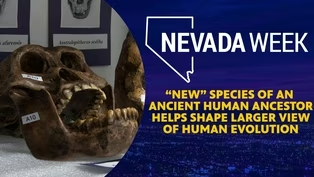
“New” species of an ancient human ancestor helps shape larger view of human evolution
Video has Closed Captions
Clip: S8 Ep24 | 4m 29s | UNLV Anthropology Professor Brian Villmoare and a team of scientists discovered fossilized teeth. (4m 29s)

What’s next for Alzheimer’s research, after a major study on Ozempic’s impact on the disease ends?
Video has Closed Captions
Clip: S8 Ep24 | 10m 25s | A five year study on Ozempic’s impact in delaying the progression of Alzheimer’s disease has ended. (10m 25s)
Providing Support for PBS.org
Learn Moreabout PBS online sponsorship
- News and Public Affairs

Top journalists deliver compelling original analysis of the hour's headlines.

- News and Public Affairs

FRONTLINE is investigative journalism that questions, explains and changes our world.











Support for PBS provided by:
Nevada Week is a local public television program presented by Vegas PBS